Astrophotography locations · Alabama
Where to Shoot and What to Know Before You Drive
Alabama's urban light domes sit over Birmingham, Huntsville, and Montgomery — but the rural stretches in between are genuinely dark. The Black Belt's open farmland, the Talladega and Bankhead national forests, and the undeveloped portions of the Tennessee Valley all hold Bortle 4 or better skies. Moon phase matters more than location. Even Alabama's darkest sites lose their Milky Way window when the moon is up; check lunar phase and rise/set times before making the drive. Summer humidity is the main atmospheric enemy — transparency suffers on warm, muggy nights. Spring and fall offer the best combination of dark skies and stable air.
🌲
Cheaha State Park, Talladega National Forest Bortle 4
At 2,407 feet, Cheaha Mountain is the highest point in Alabama and the best elevated dark-sky site in the state. The summit overlook and Bald Rock boardwalk give wide southern and western horizons with minimal tree obstruction. Birmingham's light dome is visible to the west but stays low enough to keep most of the sky clean. The Talladega National Forest surrounding the park extends the dark corridor considerably. Best months are October through April when humidity is lower and the Milky Way core is either rising or has cleared the horizon before dawn.
🌾
Black Belt Prairie Region, Hale and Perry Counties 3–4
The rural Black Belt running through central Alabama is among the least light-polluted corridors in the eastern US. Hale and Perry counties have some of the lowest population densities in the state, and the flat, open farmland provides unobstructed 360-degree horizons. There are no formal dark sky parks here, so you're looking at roadsides, fields with permission, and county roads away from town centers. The payoff is genuine Bortle 3 pockets with excellent Milky Way visibility from late March through September.
🌳
Bankhead National Forest, Winston County 4
Bankhead National Forest in northwestern Alabama covers over 180,000 acres and includes the Sipsey Wilderness, one of the largest wilderness areas in the eastern US. The forest's interior is well shielded from Birmingham and Huntsville. Clearing around the Sipsey Fork river corridor and several forest roads provides open sky. This is a reliable drive-to dark site for photographers in the Birmingham to Huntsville corridor who want to avoid long travel times.
💧
Lake Guntersville State Park, Marshall County 4–5
Lake Guntersville offers water reflections as a compositional tool that Alabama's inland forest sites can't match. The park's south-facing shoreline areas look away from Huntsville, keeping the sky reasonably dark to the south and east. Moonless nights in fall and spring give the best transparency. The lake also moderates temperature swings, which helps with dew and condensation management on long exposures. Not the darkest site in Alabama, but one of the most photographically interesting.
🏕️
Conecuh National Forest, Covington and Escambia Counties 3–4
In Alabama's deep south, Conecuh National Forest sits far enough from the Gulf Coast resort towns and Montgomery to produce legitimately dark skies. Open longleaf pine savannas within the forest give more sky access than dense hardwood canopy. The Blue Lake Recreation Area and Open Pond campground both have clear overhead sky. Summer nights bring Gulf moisture and humidity, but fall through early spring can be very good. The southerly latitude pushes the Milky Way core higher in the sky during peak season, which helps with compositions.
Conditions matter as much as location
Check Before You Make the Drive
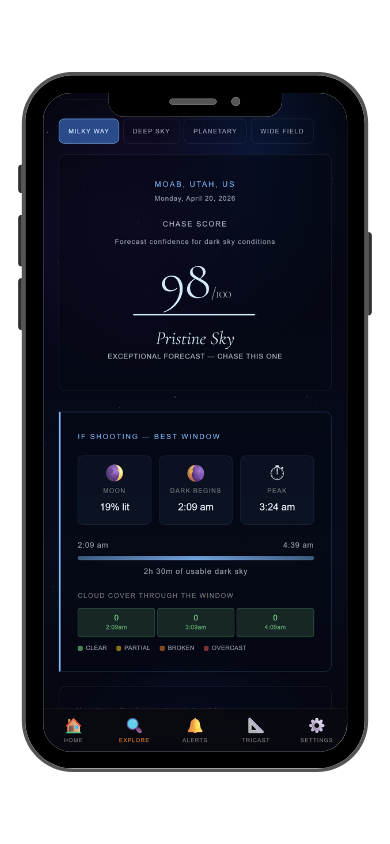
Driving two hours into the Black Belt only to hit a humid overcast or a near-full moon is a familiar mistake. StarCast scores cloud cover, moon phase, atmospheric transparency, and seeing into a single night-sky verdict — updated daily for any location.
StarCast + More
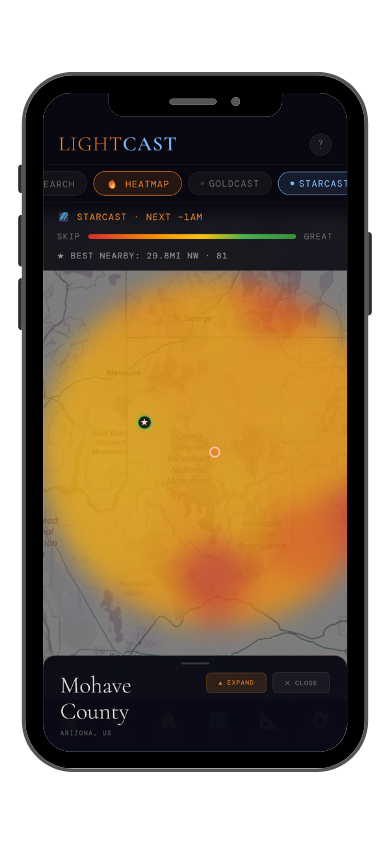
See the sky and the light on one map
Night sky · Nearby Conditions
StarCast scores cloud cover, moon phase, atmospheric transparency, and astronomical seeing. See on a map where skies are clearest before committing to the drive out to Cheaha or Conecuh.
Get Tonight's Forecast on iPhone
$2.99/mo · 7-day free trial
Learn More →
Frequently asked
Where can I see the Milky Way in Alabama?
Cheaha State Park, the Conecuh National Forest, and the rural Black Belt counties are your best options. You need a new moon window and clear skies — check StarCast for tonight's conditions free on
web, full features in the
iOS app.
What is the darkest sky in Alabama?
The rural Black Belt counties in central Alabama (Hale, Perry, Marengo) hold the darkest skies, with pockets of Bortle 3. Cheaha Mountain and Conecuh National Forest are the best designated-access dark sites, both reaching Bortle 3–4 on moonless nights.
When is the best time for astrophotography in Alabama?
The Milky Way core is visible from roughly late March through October from Alabama's latitude, peaking June through August. Spring and fall offer the best atmospheric transparency. Summer is peak Milky Way season but humidity and afternoon thunderstorms make planning harder — check conditions the day of.
Does cloud cover matter for astrophotography?
Completely — even thin high cirrus kills deep-sky exposures. Atmospheric transparency matters too, not just cloud-free skies. StarCast scores both cloud cover and transparency separately, so you know whether you're looking at a genuinely good night or just a technically clear one.
What is LightCast StarCast?
StarCast scores night sky conditions using cloud cover, moon phase, atmospheric transparency, and astronomical seeing. GoldCast (same app) handles golden hour timing. Free on web at
lightcastsuite.com/starcast, full features in the
LightCast iOS app — $2.99/month after a 7-day free trial.