Frequently asked
Is tonight good for stargazing at Big Bend?
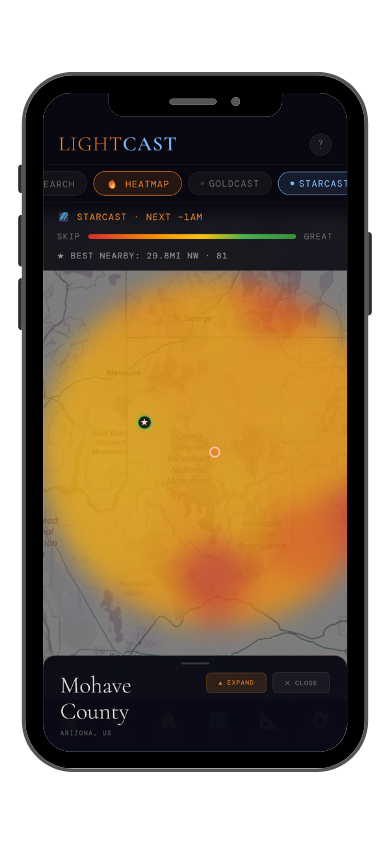
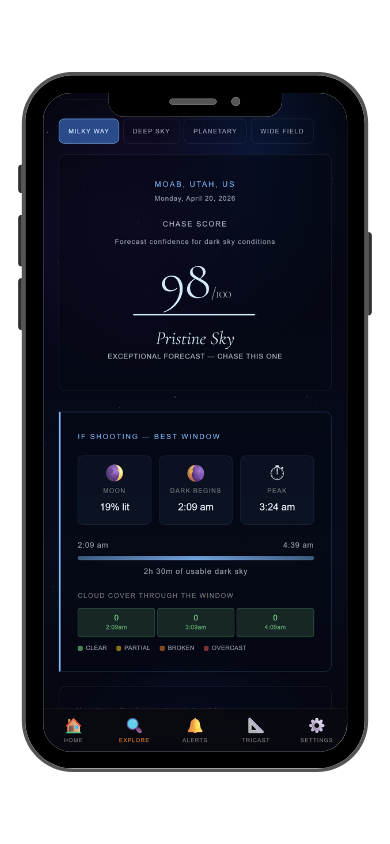
The live score above pulls today's forecast and runs it through StarCast's scoring model, which factors in cloud cover, moon illumination, Bortle class, humidity, and atmospheric transparency. Above 70 is an excellent night. Below 40, conditions are poor. The score updates daily.
What makes Big Bend good for astrophotography?
Big Bend National Park is consistently rated among the darkest parks in the lower 48, with some of the lowest light pollution readings east of the Mojave. The park's extreme remoteness in southwest Texas means no significant urban glow on any horizon. The Chisos Mountains rise from the desert floor and catch moonlight dramatically, while the Rio Grande canyon provides deep foreground shadow. The park's southern latitude gives northern hemisphere photographers a lower galactic center that clears the horizon earlier in the evening than at higher latitudes. November through April is the best season for comfortable overnight temperatures.
When is the Milky Way visible at Big Bend?
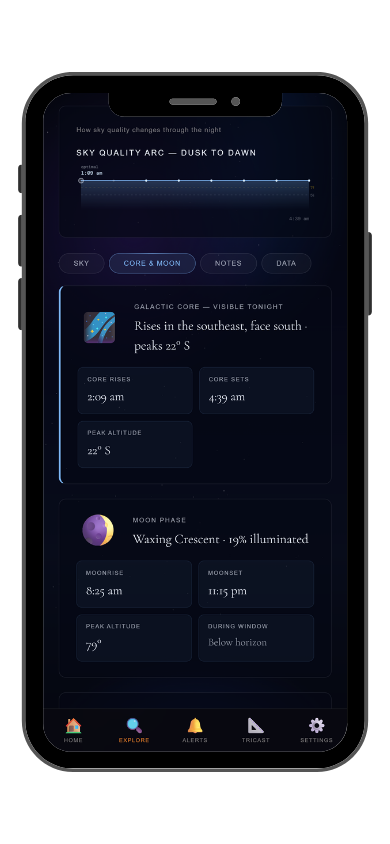
The galactic core is visible at Big Bend from February through November due to its southern latitude. The core rises earlier here than at most US dark sky sites, giving you a longer shooting window before dawn. Sotol Vista and the Santa Elena Canyon overlook are the most popular astrophotography positions in the park.