Astrophotography locations · Alaska
Where to Shoot and What to Know Before You Drive
Alaska operates on completely different rules from the lower 48. The primary constraint is not light pollution — almost none of the state has any — but seasonal darkness. From roughly late April through mid-August, astronomical twilight never fully ends at interior latitudes, making deep-sky imaging impossible. The prime window is September through March, when nights are long and aurora activity peaks. Aurora is weather-dependent and unpredictable; check Kp index and cloud cover together. Anchorage has a significant light dome for aurora compositions, but it's only 30–60 minutes from genuinely dark terrain. Winter road conditions and extreme cold require serious preparation before heading to any backcountry site.
🏔️
Denali National Park, Interior Alaska Bortle 1
Denali is one of the most remote and photogenically powerful dark sky environments in North America. The park road goes 92 miles into roadless wilderness, most of it accessible only by park bus. Wonder Lake at mile 85 gives the classic Denali reflection foreground, and on a clear September night with aurora overhead, there are few more dramatic compositions anywhere. Bortle 1 through virtually the entire park. Road access beyond Savage River checkpoint requires park bus tickets from late May through mid-September; in winter, the road is closed to vehicles beyond the park entrance.
🌌
Fairbanks and Cleary Summit 2–3 outside city
Fairbanks sits directly under the auroral oval — the band of maximum aurora activity — and is one of the most reliable aurora photography destinations on Earth. The city itself contributes a light dome, but Cleary Summit on the Steese Highway (about 20 miles northeast) puts you above the valley inversion and away from the worst of it. The Chena River State Recreation Area east of town is another accessible option. Aurora season runs August through April, peaking in equinox months. The University of Alaska Fairbanks Aurora Forecast is the local benchmark for activity predictions.
🌋
Wrangell-St. Elias National Park Bortle 1
The largest national park in the US and one of the most remote. The Kennecott area, accessible via the 60-mile dirt McCarthy Road, gives glacier and historic mine foregrounds under Bortle 1 skies. Aurora photography here in September and October, with the Kennecott mill buildings lit against the northern lights, is a genuinely rare image. Cell service is essentially nonexistent; go fully prepared. The road typically opens in late May and closes in early winter depending on conditions.
🏞️
Chugach State Park, Anchorage vicinity 3–4
For photographers based in Anchorage, Chugach State Park is the practical dark-sky escape. The park boundary sits within 30 minutes of downtown, and higher elevations in the front range face north and east away from the city's main light dome. Flattop Mountain and the Eagle River area are most accessible year-round. Not the darkest sky in Alaska by any measure, but it gets aurora shoots done without the logistics of a full interior expedition. Best in October through February.
🌊
Kenai Peninsula, Kachemak Bay Area 2–3
The Kenai Peninsula south of Anchorage offers coastal dark skies with ocean and mountain foregrounds. The Homer Spit on Kachemak Bay gives west-facing views with the Kenai Mountains behind, and on aurora nights the bay can produce vivid reflections. Areas outside the Homer and Soldotna town centers are genuinely dark. Fall and early winter are the practical window before ice and storms make the roads difficult. The peninsula is accessible by road from Anchorage year-round, which makes it the most convenient option for coastal foregrounds.
Conditions matter as much as location
Check Before You Make the Drive
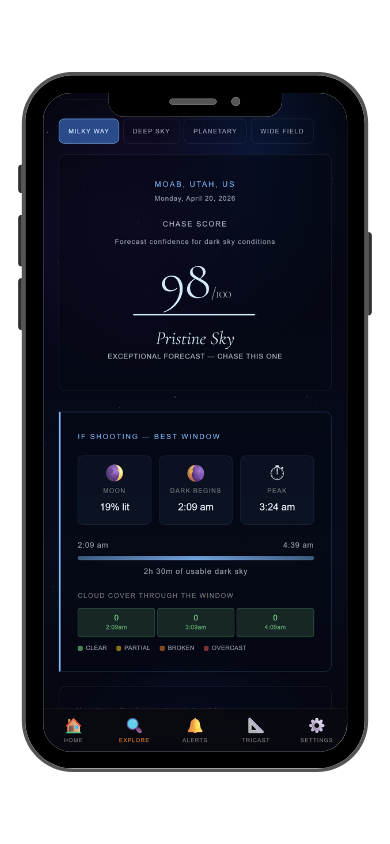
Driving an hour out of Fairbanks into a clouded-over Kp-4 night is a familiar mistake. StarCast scores cloud cover, moon phase, atmospheric transparency, and seeing into a single night-sky verdict — updated daily for any location.
StarCast + More
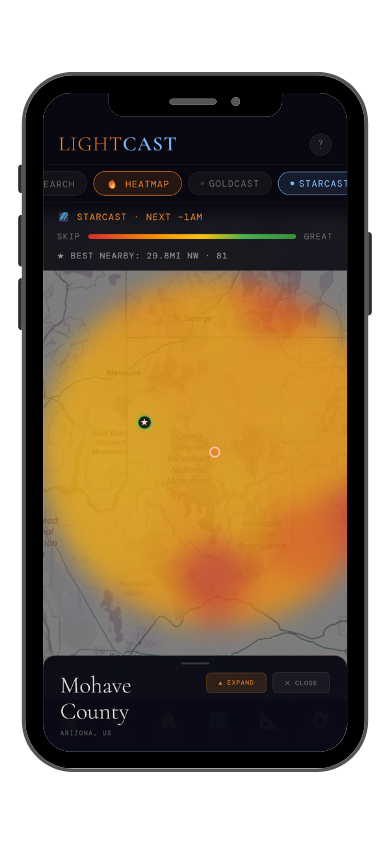
See the sky and the light on one map
Night sky · Nearby Conditions
StarCast scores cloud cover, moon phase, atmospheric transparency, and astronomical seeing. See on a map where skies are clearest before committing to the drive out to Denali or Cleary Summit.
Get Tonight's Forecast on iPhone
$2.99/mo · 7-day free trial
Learn More →
Frequently asked
Where can I photograph the northern lights in Alaska?
Fairbanks and the surrounding interior are the most reliable. Cleary Summit on the Steese Highway, Denali National Park, and Chugach State Park near Anchorage are all strong options. You need clear skies and a Kp index of at least 2–3 — check StarCast for cloud cover free on
web, full features in the
iOS app.
When is the best time for astrophotography in Alaska?
September through March for aurora and deep-sky imaging — nights are long and darkness is complete. The Milky Way core is visible from roughly March through October, but only after mid-August when astronomical darkness returns. Avoid late April through mid-August for serious night sky work at interior latitudes.
Can you see the Milky Way in Alaska?
Yes, and better than almost anywhere in the US — virtually the entire state is Bortle 1–2. The constraint is the summer white nights. From roughly mid-August through late March, the Milky Way is visible from any dark site in the interior. The galactic core rises lower on the horizon than from lower latitudes, but the overall sky quality is exceptional.
Does cloud cover matter for astrophotography?
Completely — even thin high cirrus kills deep-sky exposures. Atmospheric transparency matters too, not just cloud-free skies. StarCast scores both cloud cover and transparency separately, so you know whether you're looking at a genuinely good night or just a technically clear one.
What is LightCast StarCast?
StarCast scores night sky conditions using cloud cover, moon phase, atmospheric transparency, and astronomical seeing. GoldCast (same app) handles golden hour timing. Free on web at
lightcastsuite.com/starcast, full features in the
LightCast iOS app — $2.99/month after a 7-day free trial.