Astrophotography locations · Arizona
Where to Shoot and What to Know Before You Drive
Arizona has more certified dark sky parks and sanctuaries than any other state. Phoenix and Tucson produce large light domes visible from 50+ miles, but the Colorado Plateau, the Sky Islands in the southeast, and the rural west are genuinely pristine. Arizona also enforces the strictest outdoor lighting code in the US, which actively protects its skies. Moon phase matters more than location. Even Bortle 1 sites lose their Milky Way window when the moon is up. The summer monsoon season (July through September) brings unpredictable afternoon and evening storms — conditions can change fast; check StarCast same-day before driving out to remote terrain.
🏜️
Grand Canyon National Park: North Rim & Desert View Bortle 2
The Grand Canyon is a Gold Tier International Dark Sky Park, and the North Rim sits in one of the darkest zones — far from Phoenix and Las Vegas light domes. Desert View Watchtower on the South Rim gives foreground architecture against a southern sky. The canyon itself creates dramatic depth for Milky Way compositions. North Rim access is limited to May 15 through October 15. The South Rim is open year-round and has darker skies than most people expect given its visitor volume.
🔭
Oracle State Park, Pinal County 2–3
Oracle is Arizona's first dark sky state park and one of the best accessible dark sites within reasonable drive of the Phoenix metro (about 90 minutes). The park sits at 4,500 feet in the Transition Zone between Sonoran Desert and mountain woodland. The open grassland and rolling hills give strong horizon access in multiple directions. The park hosts regular star parties through the Tucson Amateur Astronomy Association. Ranger-led programs and dark sky nights are scheduled on new moon weekends.
🌵
Chiricahua National Monument, Cochise County 2
Deep in the Sky Islands of southeastern Arizona, Chiricahua sits well away from any major city and holds legitimately dark Bortle 2 skies. The monument's volcanic rock formations — the Wonderland of Rocks — give surreal foreground options. At 5,400 feet elevation, seeing is consistently better than low-desert sites. The area around Massai Point is the main viewpoint. The nearest town, Willcox, is small enough that its light contribution is minimal. Best from April through June and September through November.
🌌
Vermilion Cliffs National Monument, Northern Arizona 1–2
The Vermilion Cliffs and the Paria Plateau sit on the Utah-Arizona border in one of the darkest corridors in the continental US. The Wave, Coyote Buttes, and the cliff-face reflections all offer compositional foreground options that are nearly impossible to find elsewhere. Permits are required for most backcountry access and are competitive. The BLM-administered areas along House Rock Valley Road provide less-restricted access on the Arizona side with similarly dark skies.
🏔️
Kitt Peak National Observatory Area, Tohono O'odham Nation 2
The Kitt Peak area southwest of Tucson has been protected from light pollution for decades to preserve observatory operations. The observatory itself offers nighttime programs, but the surrounding BLM land on SR-386 is accessible year-round. At 6,800 feet, the elevation improves transparency. The road up to the observatory ridge gives unobstructed views across the Sonoran Desert to the south and west with no significant light domes in those directions. Tucson's light dome is visible to the northeast but stays below the main shooting horizon.
🌄
Petrified Forest National Park 2
A Silver Tier International Dark Sky Park on the Colorado Plateau. The painted desert badlands provide otherworldly foreground that photographs uniquely under starlight. Blue Mesa and Jasper Forest are the strongest composition spots. The park is bisected by I-40 but sees very little visitor traffic after sunset. The elevation (~5,400 ft) helps with seeing. Access is straightforward year-round from Holbrook or Chambers on US-180.
Conditions matter as much as location
Check Before You Make the Drive
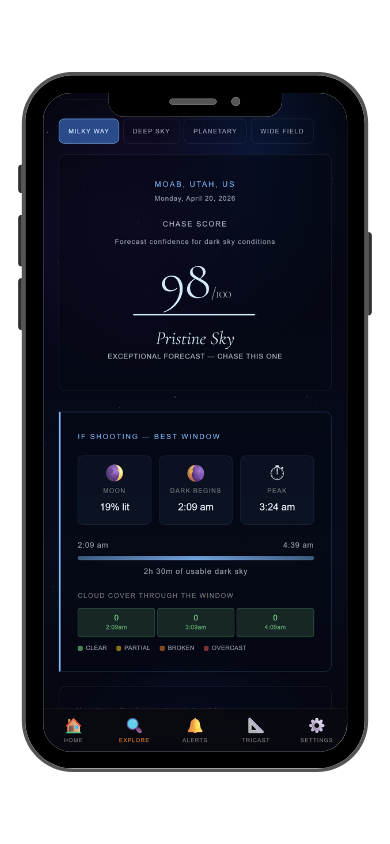
Driving two hours to the Chiricahuas only to hit monsoon clouds or a bright moon is a familiar mistake. StarCast scores cloud cover, moon phase, atmospheric transparency, and seeing into a single night-sky verdict — updated daily for any location.
StarCast + More
See the sky and the light on one map
Night sky · Nearby Conditions
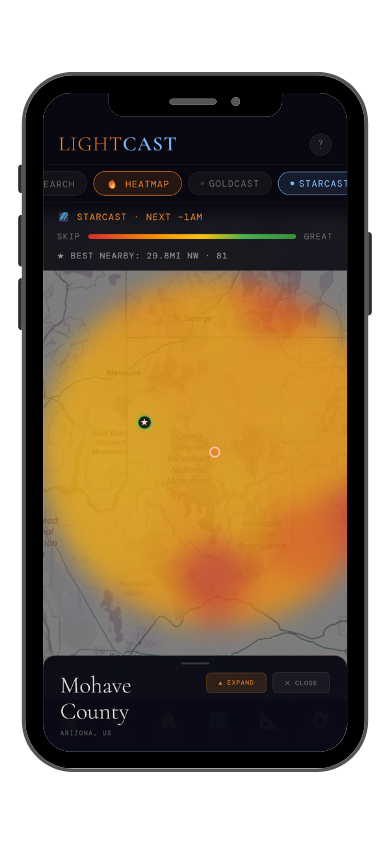
StarCast scores cloud cover, moon phase, atmospheric transparency, and astronomical seeing. See on a map where skies are clearest before committing to the drive out to the Grand Canyon or Oracle.
Get Tonight's Forecast on iPhone
$2.99/mo · 7-day free trial
Learn More →
Frequently asked
Where can I see the Milky Way in Arizona?
The Grand Canyon North Rim, Vermilion Cliffs, Chiricahua National Monument, and Oracle State Park are your best options. You need a new moon window and clear skies — check StarCast for tonight's conditions free on
web, full features in the
iOS app.
What is the darkest sky in Arizona?
The Vermilion Cliffs and Grand Canyon North Rim areas hold Bortle 1–2 skies, among the darkest accessible terrain in the continental US. The Sky Islands of southeastern Arizona (Chiricahua, Dragoon Mountains) are similarly dark and less visited. Arizona has more International Dark Sky designations than any other state.
When is the best time for astrophotography in Arizona?
The Milky Way core is visible from late February through October from Arizona latitudes, peaking June through August. New moon windows are the primary scheduling constraint. The monsoon (July–September) brings afternoon and evening storms that can clear by midnight, but conditions are unpredictable. April through June and October through November are the most reliable months.
Does cloud cover matter for astrophotography?
Completely — even thin high cirrus kills deep-sky exposures. Atmospheric transparency matters too, not just cloud-free skies. StarCast scores both cloud cover and transparency separately, so you know whether you're looking at a genuinely good night or just a technically clear one.
What is LightCast StarCast?
StarCast scores night sky conditions using cloud cover, moon phase, atmospheric transparency, and astronomical seeing. GoldCast (same app) handles golden hour timing. Free on web at
lightcastsuite.com/starcast, full features in the
LightCast iOS app — $2.99/month after a 7-day free trial.