Astrophotography locations · Arkansas
Where to Shoot and What to Know Before You Drive
Arkansas sits in an underappreciated dark sky corridor. Little Rock and Fort Smith produce light domes, but the Ozark Plateau, the Buffalo River wilderness, and the Ouachita Mountains push well away from both. The state has no major metro sprawl across much of its northern and western territory, and the result is Bortle 3–4 skies that are accessible within a few hours of any population center in the region. Moon phase matters more than location. Even Arkansas's darkest sites lose their Milky Way window when the moon is up. Summer humidity and atmospheric haze are real factors — spring and fall deliver significantly better transparency than July and August.
🌊
Buffalo National River, Newton County Bortle 3–4
America's first national river runs through some of the most rugged and sparsely populated terrain in the Ozarks. The upper river corridor around Ponca and Steel Creek is the darkest section — Newton County has virtually no towns of any size. The river gives water reflection foregrounds, and the bluffs provide elevation for wider sky access. Lost Valley and Steel Creek campgrounds are practical base camps. The area is best from late March through May and September through October. Summer crowds and humidity make those months less ideal for both the sky and the experience.
🏔️
Mount Magazine State Park, Logan County 3–4
At 2,753 feet, Mount Magazine is the highest point in Arkansas. The summit plateau gives a wide horizon with drop-offs on multiple sides, and the surrounding Ouachita National Forest cushions it from light pollution. The summit lodge and Signal Hill trail areas provide open sky access. It's the best elevated dark site in the state with reliable road access year-round. The western and southern horizons are the cleanest; Fort Smith is to the northwest but its light dome stays relatively low at this distance.
🌲
Ouachita National Forest, Montgomery and Polk Counties 3
The Ouachita National Forest spans nearly 1.8 million acres across western Arkansas and eastern Oklahoma. Interior forest roads and designated wilderness areas away from Hot Springs produce legitimately dark skies with minimal infrastructure lighting. The Caddo Gap area and the Little Missouri Falls corridor are particularly accessible. The forest's east-west ridge orientation creates natural clearing along ridgelines. Hot Springs' light dome is visible to the east from eastern sections; go west of Mena for cleaner sky.
🔭
Ozark National Forest, Newton and Madison Counties 3–4
The Ozark National Forest's western sections, particularly around Boxley Valley and the Whitaker Point (Hawksbill Crag) area, combine strong dark skies with photogenic landscape features. Hawksbill Crag is one of Arkansas's most recognized natural landmarks and an increasingly popular long-exposure photography subject. The trail is 2.8 miles round trip. Parking fills early on weekends; weeknight visits during new moon windows are much more workable for astrophotographers.
💧
Lake Ouachita State Park, Garland County 4
Lake Ouachita is Arkansas's largest lake and sits in a basin surrounded by national forest. The north shore areas away from the town of Mount Ida are the darkest, with open water giving unobstructed views. The lake's surface provides strong reflection compositions. The state park's Point Remove area faces south and west with minimal light interference. Not the absolute darkest site in Arkansas, but one of the most compositionally versatile, and accessible year-round.
Conditions matter as much as location
Check Before You Make the Drive
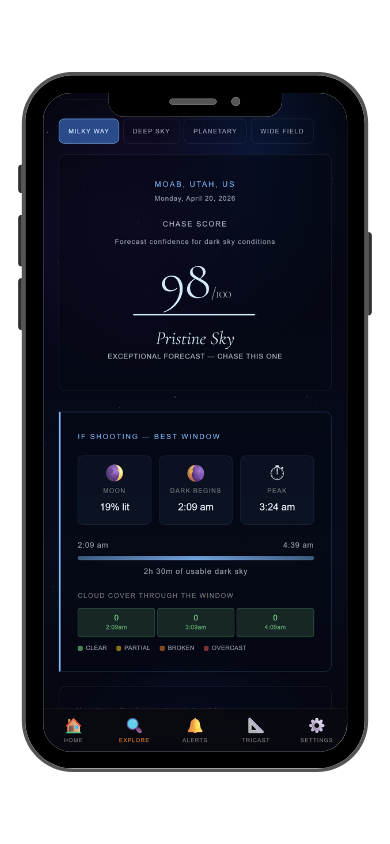
Driving two hours into the Ozarks only to hit humidity haze or a near-full moon is a familiar mistake. StarCast scores cloud cover, moon phase, atmospheric transparency, and seeing into a single night-sky verdict — updated daily for any location.
StarCast + More
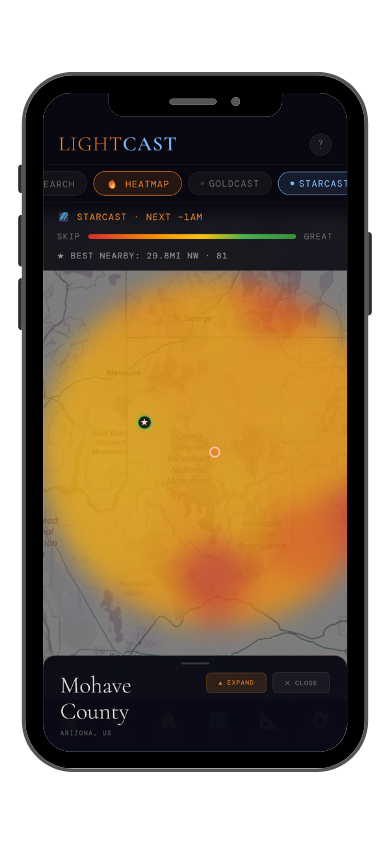
See the sky and the light on one map
Night sky · Nearby Conditions
StarCast scores cloud cover, moon phase, atmospheric transparency, and astronomical seeing. See on a map where skies are clearest before committing to the drive out to Buffalo River or Mount Magazine.
Get Tonight's Forecast on iPhone
$2.99/mo · 7-day free trial
Learn More →
Frequently asked
Where can I see the Milky Way in Arkansas?
Buffalo National River, Mount Magazine, and the Ouachita National Forest are your best options. You need a new moon window and clear skies — check StarCast for tonight's conditions free on
web, full features in the
iOS app.
What is the darkest sky in Arkansas?
Newton County in the upper Buffalo River corridor holds the darkest skies, with pockets reaching Bortle 3. The western Ouachita National Forest and the Ozark National Forest's interior ridgelines are comparably dark. None are certified International Dark Sky Parks currently, but the sky quality is legitimate.
When is the best time for astrophotography in Arkansas?
The Milky Way core is visible from late March through October from Arkansas latitudes, peaking June through August. Spring and fall offer the best atmospheric transparency. Summer nights can be good if a cold front has passed through, but humidity is the main limiting factor. Check conditions the day of rather than planning strictly by month.
Does cloud cover matter for astrophotography?
Completely — even thin high cirrus kills deep-sky exposures. Atmospheric transparency matters too, not just cloud-free skies. StarCast scores both cloud cover and transparency separately, so you know whether you're looking at a genuinely good night or just a technically clear one.
What is LightCast StarCast?
StarCast scores night sky conditions using cloud cover, moon phase, atmospheric transparency, and astronomical seeing. GoldCast (same app) handles golden hour timing. Free on web at
lightcastsuite.com/starcast, full features in the
LightCast iOS app — $2.99/month after a 7-day free trial.