Astrophotography locations · California
Where to Shoot and What to Know Before You Drive
California's light pollution is severe along the coast and Central Valley — the Bay Area, LA Basin, and Sacramento produce light domes visible from over 100 miles out. The saving terrain is east of the Sierra crest and deep desert. Moon phase matters more than location. Even Bortle 2 sites lose their Milky Way window when the moon is up; check lunar phase and rise/set times before making the drive. Always verify road and seasonal closures, as Tioga Pass and many high-Sierra roads close in winter.
🏜️
Death Valley: Mesquite Flat & Racetrack Playa Bortle 1–2
Death Valley holds some of the darkest certified skies in the US — a Gold Tier International Dark Sky Park. Mesquite Flat Sand Dunes give foreground texture for Milky Way compositions. Racetrack Playa, accessible by high-clearance vehicle via a rough 27-mile dirt road, gives unobstructed 360° horizon with zero light interference. Spring and fall are the practical windows; summer nights are extreme heat.
🏔️
Eastern Sierra: Alabama Hills, Lone Pine Bortle 2–3
The Alabama Hills west of Lone Pine put granite arch foregrounds against both the Sierra crest and dark Owens Valley sky. The Milky Way core rising over Whitney Portal in summer is among the most compositionally strong astrophotography setups in the state. Whitney Portal Road gives high-elevation access at ~8,300 ft when open (typically May–November).
🌵
Joshua Tree National Park: Keys View & Skull Rock Bortle 3–4
An International Dark Sky Park with certified dark zones — the north and east sections are darkest. Keys View at 5,185 ft gives wide horizon; Joshua tree silhouettes against the Milky Way is a signature composition. The most accessible dark-sky site from Southern California at 2–3 hours from LA.
🌌
Anza-Borrego Desert State Park Bortle 2–3
California's largest state park and a Gold Tier Dark Sky Park. Font's Point — a 4WD road off S-22 — gives a badlands overlook with one of the best Milky Way compositions in Southern California. Borrego Springs uses dark-sky compliant lighting. Mid-January through April and September through November avoid the worst heat.
🏔️
Yosemite: Glacier Point & Tuolumne Meadows Bortle 3
Glacier Point at 7,214 ft gives the Half Dome view that makes Milky Way photos here iconic — reservation-required in peak season. Tuolumne Meadows at 8,600 ft is higher and less trafficked, open July–October, with broad meadow and granite dome foregrounds. The valley floor itself suffers internal light pollution; go to elevation.
🔭
Lassen Volcanic National Park: Manzanita Lake Bortle 2–3
Among the darkest national parks in California, well north of Sacramento's light dome. Manzanita Lake gives volcanic peak reflections. Most sites sit above 5,500 ft, reducing atmospheric distortion. Open late May through October. Consistently underrated relative to the sky quality it delivers.
Conditions matter as much as location
Check Before You Make the Drive
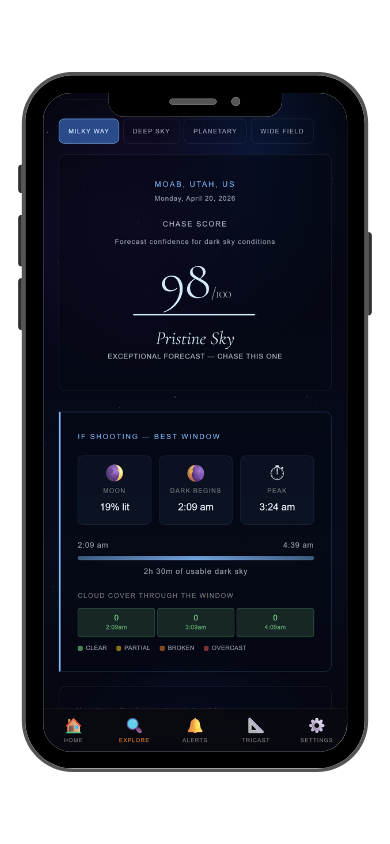
Driving 3 hours to Death Valley only to hit a marine layer or a 75% illuminated moon is a familiar mistake. StarCast scores cloud cover, moon phase, atmospheric transparency, and seeing into a single night-sky verdict — updated daily for any location.
StarCast + More
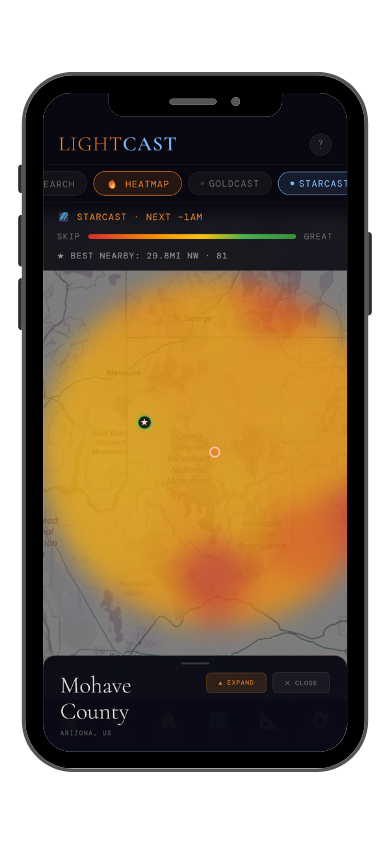
See the sky and the light on one map
Night sky · Nearby Conditions
StarCast scores cloud cover, moon phase, atmospheric transparency, and astronomical seeing. See on a map where skies are clearest before committing to the drive out to Eastern Sierra or Death Valley.
Get Tonight's Forecast on iPhone
$2.99/mo · 7-day free trial
Learn More →
Frequently asked
Where can I see the Milky Way in California?
Death Valley, Anza-Borrego, and the Eastern Sierra are your best options. You need a new moon window and clear skies — check StarCast for tonight's conditions free on
web, full features in the
iOS app.
What is the darkest sky in California?
Death Valley National Park and Anza-Borrego Desert State Park hold Bortle 1–2 certified dark sky designations in their darkest zones — among the darkest accessible skies in the continental US. Lassen Volcanic is the darkest option in Northern California. All three are Gold Tier International Dark Sky Parks.
When is the best time for astrophotography in California?
The Milky Way core is visible from roughly late February through October from California latitudes, peaking June–August. New moon windows are the primary scheduling constraint. Desert sites are best in spring and fall; high Sierra access opens when Tioga Pass is open, typically mid-July through October.
Does cloud cover matter for astrophotography?
Completely — even thin high cirrus kills deep-sky exposures. Atmospheric transparency matters too, not just cloud-free skies. StarCast scores both cloud cover and transparency separately, so you know whether you're looking at a genuinely good night or just a technically clear one.
What is LightCast StarCast?
StarCast scores night sky conditions using cloud cover, moon phase, atmospheric transparency, and astronomical seeing. GoldCast (same app) handles golden hour timing. Free on web at
lightcastsuite.com/starcast, full features in the
LightCast iOS app — $2.99/month after a 7-day free trial.