Astrophotography locations · Colorado
Where to Shoot and What to Know Before You Drive
The Denver-Boulder-Fort Collins corridor produces a significant light dome across the Front Range, and Colorado Springs adds to the southern end of it. But Colorado's geography works in your favor: drive two hours in almost any direction from the metro and you're above 8,000 feet with Bortle 2–3 skies. The San Luis Valley, the San Juan Mountains, and the western slope are legitimately exceptional. Moon phase matters more than location. Even Bortle 2 sites lose their Milky Way window when the moon is up. Afternoon thunderstorms are daily events from July through August at elevation — the sky can be perfectly clear by 10 PM, but check conditions same-day before making a mountain drive.
🏜️
Great Sand Dunes National Park, San Luis Valley Bortle 2
A Gold Tier International Dark Sky Park sitting at 7,500 feet in one of the most remote valleys in Colorado. The San Luis Valley's flat terrain and low population density create a dark sky corridor that extends for hundreds of miles. The dunes themselves, up to 750 feet tall, give a foreground unlike anything else in North America. The Sangre de Cristo peaks loom to the east. Medano Creek in spring provides water reflection possibilities. The park's remoteness from the Front Range and from Pueblo keeps all horizons reasonably clean. Best from April through October; winter access is possible but mountain passes can be difficult.
🏔️
Black Canyon of the Gunnison National Park Bortle 2
A Gold Tier International Dark Sky Park. The South Rim sits at 8,300 feet with essentially no nearby population centers — Montrose is 15 miles away and small enough to have minimal sky impact. The canyon itself creates a dramatic vertical foreground. Tomichi Point and the Painted Wall overlook are the most accessible shooting spots. The canyon is open year-round on the South Rim; the North Rim road closes in winter. One of Colorado's most consistently dark accessible national park sites.
🌌
San Juan Mountains, Silverton and Ouray Area 2–3
The San Juans hold some of the highest and most visually dramatic terrain in the Rockies, with multiple peaks above 14,000 feet. Silverton and Ouray are small enough not to generate significant light domes, and the surrounding national forest is vast. Alpine lakes (Ice Lake, lower Ice Lake Basin, Molas Lake near Silverton) give reflective foregrounds. The alpine season runs roughly mid-July through September. Afternoon storms are common; window shooting from about 10 PM onward on nights with a clean forecast. The Million Dollar Highway corridor gives access to multiple sites.
🔭
Westcliffe and Silver Cliff, Custer County 2
The Westcliffe-Silver Cliff area in the Wet Mountain Valley holds a formal International Dark Sky Community designation — the first in Colorado. The valley sits at 7,900 feet between the Sangre de Cristo and Wet Mountains, with the Sangre de Cristos' sharp profile as a western foreground element. The communities use dark-sky compliant lighting. This is a practical choice for Front Range photographers who want certified dark skies without driving to the San Juans. About 2.5 hours from Denver or Colorado Springs.
🌄
Mesa Verde National Park, Montezuma County Bortle 2
Mesa Verde sits at 7,000–8,500 feet in the Four Corners region, well removed from any major city. The cliff dwellings provide a foreground that is genuinely singular — shooting the Milky Way over Cliff Palace is one of the more compositionally unusual opportunities in the US. Park photography policies require staying on designated trails and overlooks. Chapin Mesa has the most accessible viewpoints after hours. The park's location near the Colorado-Utah-New Mexico-Arizona junction means the surrounding sky on multiple horizons is exceptionally dark.
🌊
Ridgway State Park and Dallas Divide, Ouray County 2–3
Dallas Divide, on CO-62 between Ridgway and Telluride, is one of Colorado's best-known landscape photography locations for its view of the Sneffels Range. At night, those same peaks serve as an anchor for Milky Way compositions. Ridgway Reservoir below provides water reflections. The area sits well away from any significant population center. The Pa-Co-Chu-Puk campground at Ridgway State Park gives reliable lake access year-round, while the Divide itself is best accessed late spring through fall.
Conditions matter as much as location
Check Before You Make the Drive
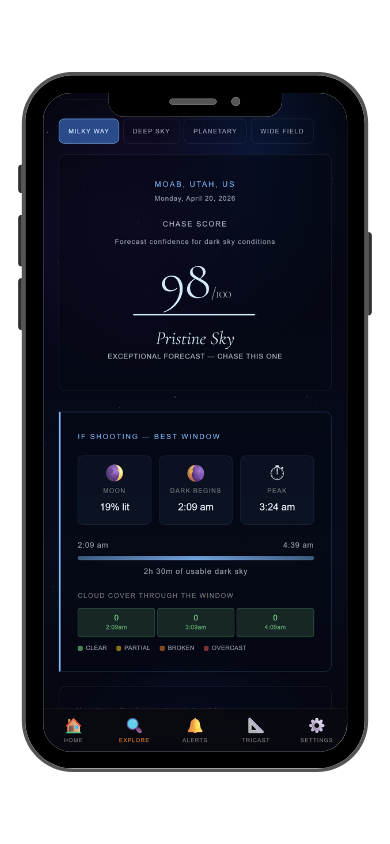
Driving three hours to the San Juans only to hit afternoon storm remnants or a bright moon is a familiar mistake. StarCast scores cloud cover, moon phase, atmospheric transparency, and seeing into a single night-sky verdict — updated daily for any location.
StarCast + More
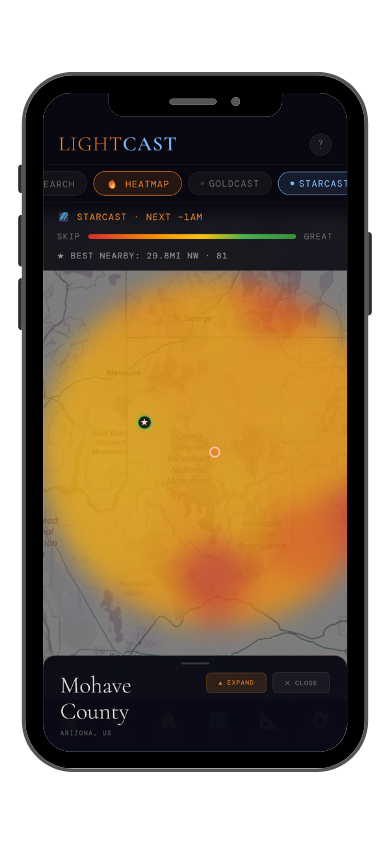
See the sky and the light on one map
Night sky · Nearby Conditions
StarCast scores cloud cover, moon phase, atmospheric transparency, and astronomical seeing. See on a map where skies are clearest before committing to the drive out to Great Sand Dunes or Black Canyon.
Get Tonight's Forecast on iPhone
$2.99/mo · 7-day free trial
Learn More →
Frequently asked
Where can I see the Milky Way in Colorado?
Great Sand Dunes, Black Canyon of the Gunnison, the San Juan Mountains, and the Westcliffe area are your best options. You need a new moon window and clear skies — check StarCast for tonight's conditions free on
web, full features in the
iOS app.
What is the darkest sky in Colorado?
The San Luis Valley (Great Sand Dunes) and the Black Canyon of the Gunnison are Colorado's darkest certified national park sites, both Gold Tier International Dark Sky Parks at Bortle 2. The San Juan Mountains' interior and the Four Corners region near Mesa Verde are similarly dark and essentially uncertified.
When is the best time for astrophotography in Colorado?
The Milky Way core is visible from late March through October, peaking June through August. Afternoon thunderstorms are daily from July through August at elevation but typically clear by late evening. Spring and fall (April–June, September–October) offer the most reliable conditions. High-altitude road access (above 11,000 ft) is generally limited to July through September.
Does cloud cover matter for astrophotography?
Completely — even thin high cirrus kills deep-sky exposures. Atmospheric transparency matters too, not just cloud-free skies. StarCast scores both cloud cover and transparency separately, so you know whether you're looking at a genuinely good night or just a technically clear one.
What is LightCast StarCast?
StarCast scores night sky conditions using cloud cover, moon phase, atmospheric transparency, and astronomical seeing. GoldCast (same app) handles golden hour timing. Free on web at
lightcastsuite.com/starcast, full features in the
LightCast iOS app — $2.99/month after a 7-day free trial.