Astrophotography locations · Connecticut
Where to Shoot and What to Know Before You Drive
Connecticut is one of the most light-polluted states in the US — Hartford, New Haven, Bridgeport, and the NYC metro glow cover the southern third of the state entirely. The darkest areas sit in the northeastern corner (Quiet Corner) and the Litchfield Hills in the northwest. Moon phase matters more than location — even the best CT sites are Bortle 4–5 at best, so shooting during new moon windows is critical. Cloud cover and humidity are the dominant constraints; the Northeast is notoriously inconsistent. Check transparency, not just cloud coverage, before committing to the drive.
🌲
Pachaug State Forest, Voluntown Bortle 4–5
Connecticut's largest state forest at nearly 27,000 acres sits in the rural Quiet Corner far from major urban centers. Beachdale Pond and Glasgo Pond offer dark water reflections for Milky Way compositions in summer. The forest's interior roads provide some of the least light-polluted accessible sky in the state. Best accessed via CT-49 or Headquarters Road. Expect some eastern glow from Providence, RI.
🏔️
Litchfield Hills: Mount Tom State Park & Mohawk State Forest 4–5
The northwestern highlands offer Connecticut's highest elevations and some respite from the coastal light domes. Mount Tom's summit at 1,291 ft gives wide horizon views. Mohawk State Forest near Cornwall sits at elevation with tree breaks useful for Milky Way arching compositions in summer. The Litchfield Hills are the best option for residents of Fairfield County looking to avoid NYC glow.
🔭
Connecticut Dark Sky Preserve: Joshua's Trust Lands, Eastford 4
Several Joshua's Trust conservation properties in Eastford and Ashford in the Quiet Corner provide relatively dark northern sky. The Nipmuck State Forest adjoining areas add depth. These lands sit in the corridor farthest from Hartford and Providence, making them among the most consistently usable sites in the state. Bring a red-light headlamp; roads are unlit and rural.
🌊
Hammonasset Beach State Park, Madison 5–6
Not a dark-sky site by any metric, but the Long Island Sound horizon provides a wide unobstructed southern sky and interesting foreground for Milky Way core compositions in late spring and summer when the core rises to the south. The flat beach gives a true horizon. Best shot during new moon in May–July before the core drops. This is more of an accessible compromise than a dark-sky destination.
🌌
Cockaponset State Forest, Haddam 4–5
Connecticut's second-largest state forest covers the rural hills between Middletown and the Connecticut River valley. Interior forest roads and Pataconk Reservoir provide foreground options with moderate darkness. The surrounding farmland keeps ambient scatter lower than suburban areas. A reasonable option for central CT residents who want to avoid the full drive to the Quiet Corner.
Conditions matter as much as location
Check Before You Make the Drive
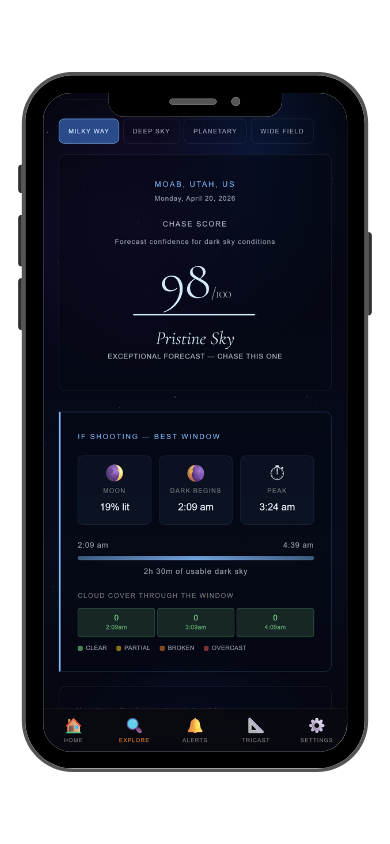
Driving an hour to Pachaug only to hit a humid haze layer or a half-moon is a familiar Northeast mistake. StarCast scores cloud cover, moon phase, atmospheric transparency, and seeing into a single night-sky verdict — updated daily for any location.
StarCast + More
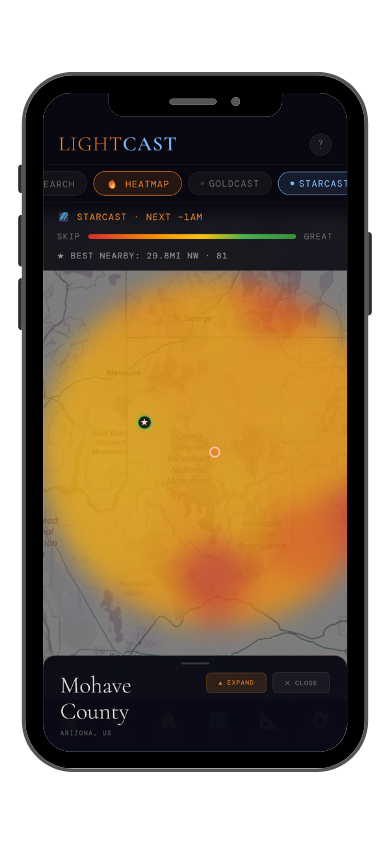
See the sky and the light on one map
Night sky · Nearby Conditions
StarCast scores cloud cover, moon phase, atmospheric transparency, and astronomical seeing. See on a map where skies are clearest before committing to the drive out to Pachaug or the Litchfield Hills.
Get Tonight's Forecast on iPhone
$2.99/mo · 7-day free trial
Learn More →
Frequently asked
Where can I see the Milky Way in Connecticut?
Pachaug State Forest and the Quiet Corner in northeastern CT are your best in-state options. For genuinely dark skies, consider crossing into the Berkshires in western Massachusetts or the Catskills in New York. Check StarCast for tonight's conditions free on
web, full features in the
iOS app.
What is the darkest sky in Connecticut?
The northeastern Quiet Corner — particularly the area around Pachaug State Forest in Voluntown and Eastford — holds the darkest accessible skies in the state, typically Bortle 4. No location in Connecticut qualifies as Bortle 3 or better due to the density of surrounding metro areas.
When is the best time for astrophotography in Connecticut?
The Milky Way core is visible from Connecticut latitudes from roughly late March through October, peaking June–August. New moon windows are essential given Connecticut's elevated Bortle ratings. Summer nights also tend toward better transparency than spring. Always check atmospheric transparency separately from cloud cover — humid Northeast nights can be technically clear but optically poor.
Does cloud cover matter for astrophotography?
Completely — even thin high cirrus kills deep-sky exposures. Atmospheric transparency matters too, not just cloud-free skies. StarCast scores both cloud cover and transparency separately, so you know whether you're looking at a genuinely good night or just a technically clear one.
What is LightCast StarCast?
StarCast scores night sky conditions using cloud cover, moon phase, atmospheric transparency, and astronomical seeing. GoldCast (same app) handles golden hour timing. Free on web at
lightcastsuite.com/starcast, full features in the
LightCast iOS app — $2.99/month after a 7-day free trial.