Astrophotography locations · Delaware
Where to Shoot and What to Know Before You Drive
Delaware is the second-smallest state and sits inside one of the most light-polluted corridors in the US — the DC–Baltimore–Philadelphia–Wilmington megalopolis. The northern third of the state is essentially unusable for serious astrophotography. The saving terrain is southern Delaware (Sussex County), where flat coastal geography, low population density, and the absence of major cities create surprisingly usable dark sky windows. Moon phase is the dominant constraint — shoot within three days of new moon. Coastal humidity and sea fog are real factors; atmospheric transparency matters as much as cloud cover here.
🌿
Prime Hook National Wildlife Refuge, Milton Bortle 4–5
Prime Hook NWR on Delaware Bay offers one of the darkest accessible skies in the state. The refuge's marshes, ponds, and bay access provide flat unobstructed horizons. Shooting from the beach access areas toward the east over Delaware Bay puts the Milky Way core rising over open water in summer. Limited artificial lighting within the refuge boundary helps significantly. Open year-round but access roads vary seasonally.
🦅
Bombay Hook National Wildlife Refuge, Smyrna 4–5
A 16,000-acre refuge on Delaware Bay's western shore with tidal marshes and managed pools giving broad horizon access. The refuge road system allows vehicle access to multiple overlook points. Northern Delaware's light dome is present but not dominant from the southern sections of the refuge. Summer and fall nights offer the best combination of Milky Way position and manageable humidity. Check refuge hours; access is restricted at dusk in some areas.
🏖️
Delaware Seashore State Park, Rehoboth Beach 5
The barrier island strip between Rehoboth Bay and the Atlantic provides an unobstructed eastern ocean horizon — useful for Milky Way core compositions when the core rises to the southeast in early summer. The park is bright by dark-sky standards due to nearby resort towns, but the eastern ocean face avoids the worst of the inland glow. The inlet area near Indian River Inlet Bridge offers accessible dark spots.
🌾
Sussex County Farmland, Laurel & Seaford Area 4
The rural agricultural interior of Sussex County — particularly the flat farmland between Laurel, Seaford, and Bridgeville — offers some of the darkest accessible skies in Delaware. No single designated site; the key is getting well clear of town lighting on county roads and using flat fields as foreground. The wide-open agricultural landscape eliminates tree horizon obstruction that limits forest sites. A good option for photographing wide-field Milky Way arches.
🌊
Cape Henlopen State Park, Lewes 5
At the confluence of Delaware Bay and the Atlantic Ocean, Cape Henlopen gives wide unobstructed horizons in multiple directions. The dune areas north of the main developed zone are darkest. The ocean-facing shore eliminates horizon obstruction to the east and south. Best used in early summer for Milky Way core compositions. Lewes town glow is present to the west; shoot toward the water.
Conditions matter as much as location
Check Before You Make the Drive
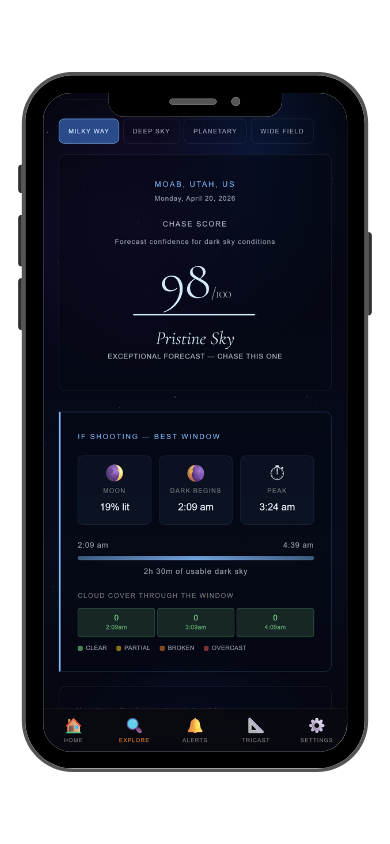
Driving down to Prime Hook or the Seashore only to hit coastal sea fog or a rising half-moon is a familiar mistake along the Delmarva. StarCast scores cloud cover, moon phase, atmospheric transparency, and seeing into a single night-sky verdict — updated daily for any location.
StarCast + More
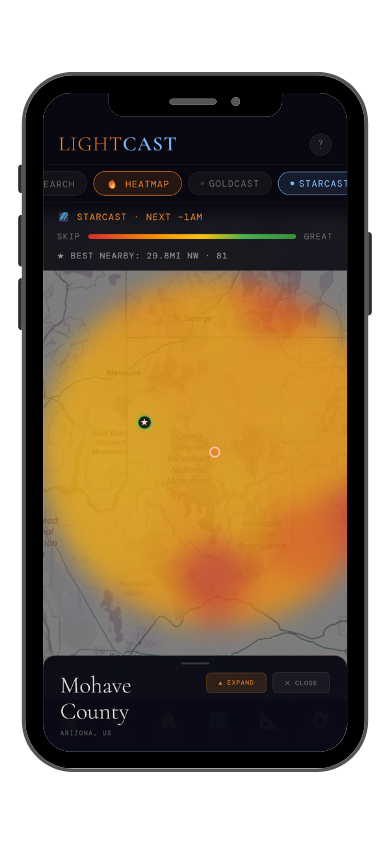
See the sky and the light on one map
Night sky · Nearby Conditions
StarCast scores cloud cover, moon phase, atmospheric transparency, and astronomical seeing. See on a map where skies are clearest before committing to the drive out to Sussex County or the coast.
Get Tonight's Forecast on iPhone
$2.99/mo · 7-day free trial
Learn More →
Frequently asked
Where can I see the Milky Way in Delaware?
Southern Delaware — Prime Hook NWR, rural Sussex County farmland, and Delaware Seashore State Park — are your best in-state options. For significantly darker skies, consider crossing into the Eastern Shore of Maryland. Check StarCast for tonight's conditions free on
web, full features in the
iOS app.
What is the darkest sky in Delaware?
The rural Sussex County interior around Laurel and the farmland between Seaford and Bridgeville holds the darkest accessible skies in the state — roughly Bortle 4. Prime Hook NWR is the best combination of darkness and interesting foreground. No site in Delaware reaches Bortle 3 due to surrounding mid-Atlantic urban density.
When is the best time for astrophotography in Delaware?
The Milky Way core is visible from Delaware latitudes from roughly late March through October, peaking June–August. New moon windows are essential. Late summer and early fall often bring the best atmospheric transparency after the humid mid-summer period. Coastal sites are most affected by summer humidity; inland farmland sites tend to have better seeing on clear fall nights.
Does cloud cover matter for astrophotography?
Completely — even thin high cirrus kills deep-sky exposures. Atmospheric transparency matters too, not just cloud-free skies. StarCast scores both cloud cover and transparency separately, so you know whether you're looking at a genuinely good night or just a technically clear one.
What is LightCast StarCast?
StarCast scores night sky conditions using cloud cover, moon phase, atmospheric transparency, and astronomical seeing. GoldCast (same app) handles golden hour timing. Free on web at
lightcastsuite.com/starcast, full features in the
LightCast iOS app — $2.99/month after a 7-day free trial.