Astrophotography locations · Florida
Where to Shoot and What to Know Before You Drive
Florida's astrophotography challenge is not elevation — the state is entirely flat — but light pollution from a dense coastal population ring and chronic summer thunderstorms. Miami, Orlando, Tampa, Jacksonville, and Fort Lauderdale produce massive light domes that contaminate most of the state's sky. The saving terrain is the interior south: Big Cypress, the Everglades, and Kissimmee Prairie hold the state's darkest skies. Florida's southern latitude (~25–30°N) is a genuine advantage — the Milky Way core rises higher above the horizon here than anywhere else in the continental US, making summer shots more impactful. Summer is wet season — afternoon storms clear by midnight more often than not, but transparency is often poor. Late winter and spring offer the best combination of clear skies and Milky Way visibility.
🌿
Kissimmee Prairie Preserve State Park Bortle 3–4
Florida's only certified Dark Sky Park and one of the darkest sites in the eastern US. The 54,000-acre dry prairie in Okeechobee County sits well away from major cities and has an on-site observatory and primitive camping. The flat open grassland gives 360° unobstructed horizon — exceptional for Milky Way arch compositions. The park enforces dark-sky lighting standards in all visitor facilities. Reserve primitive camping sites in advance, especially during new moon windows.
🐊
Big Cypress National Preserve, Ochopee Bortle 3–4
Over 700,000 acres of cypress swamp and wet prairie in southwest Florida. The Tamiami Trail (US-41) corridor provides road access to genuinely dark sections far from Naples and Miami. Turner River Road and Loop Road (CR-94) give vehicle-accessible dark spots with cypress and open marsh foreground. The low horizon and reflective water surfaces make for strong Milky Way compositions. Watch for wildlife at night — this is active panther and alligator territory.
🌊
Everglades National Park: Anhinga Trail & Flamingo Bortle 3–4
The Flamingo area at the southern tip of the park is among the darkest easily accessible spots in the southeastern US — essentially surrounded by water and protected land in every direction. The Milky Way core rises high and early from this latitude in summer. The Royal Palm area near Anhinga Trail offers cypress and water foregrounds. Park admission required; Flamingo campground offers overnight access.
🔭
Ocala National Forest, Central Florida 4–5
The 607,000-acre national forest in central Florida provides significant dark-sky buffer from Orlando, Gainesville, and Daytona Beach. Lake Kerr, Alexander Springs, and the forest interior roads offer foreground variety. While not as dark as south Florida sites, it is the most accessible option for Orlando and Jacksonville residents. Longleaf pine flatwoods and spring-fed lakes give unusual foreground character for Florida astrophotography.
🏝️
Florida Keys: Bahia Honda State Park 4–5
Surrounded by ocean on both sides, Bahia Honda offers genuinely dark southern and eastern horizons despite being a well-known tourist destination. The old railroad bridge ruins make for iconic Milky Way foregrounds in summer when the core rises to the south and east over the Atlantic. The Atlantic-facing beach minimizes light interference from the Gulf side. Key West's glow is visible but manageable from Bahia Honda's eastern end.
Conditions matter as much as location
Check Before You Make the Drive
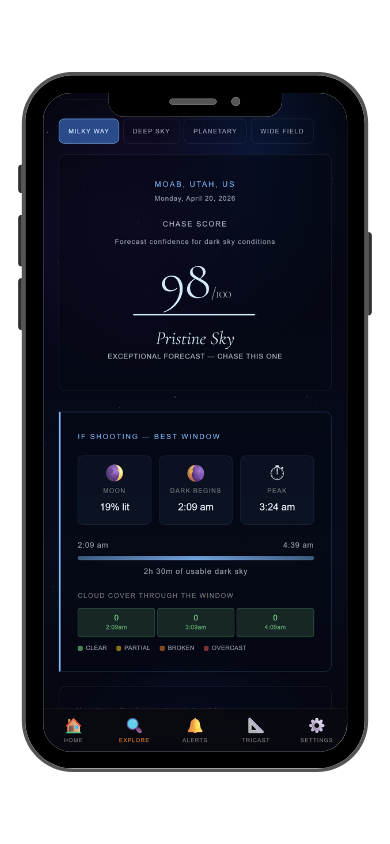
Driving two hours to Kissimmee Prairie only to hit a post-storm haze layer or a rising moon is a familiar Florida mistake. StarCast scores cloud cover, moon phase, atmospheric transparency, and seeing into a single night-sky verdict — updated daily for any location.
StarCast + More
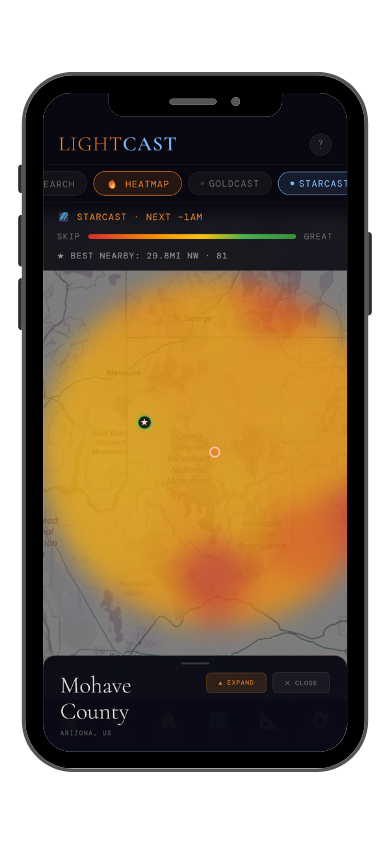
See the sky and the light on one map
Night sky · Nearby Conditions
StarCast scores cloud cover, moon phase, atmospheric transparency, and astronomical seeing. See on a map where skies are clearest before committing to the drive out to Big Cypress or Kissimmee Prairie.
Get Tonight's Forecast on iPhone
$2.99/mo · 7-day free trial
Learn More →
Frequently asked
Where can I see the Milky Way in Florida?
Kissimmee Prairie Preserve State Park, Big Cypress National Preserve, and the Flamingo area of Everglades National Park are Florida's best Milky Way sites. The state's southern latitude means the core rises unusually high — a real photographic advantage. Check StarCast for tonight's conditions free on
web, full features in the
iOS app.
What is the darkest sky in Florida?
Kissimmee Prairie Preserve State Park is Florida's only certified Dark Sky Park — Bortle 3 in its darkest zones. Big Cypress and the Flamingo area of the Everglades approach similar darkness. These are among the darkest easily accessible sites in the eastern US.
When is the best time for astrophotography in Florida?
The Milky Way core is visible from Florida from late February through October. The peak galactic center window runs April–September. Late winter through spring (February–May) offers the best balance of Milky Way visibility and clear, low-humidity skies. Summer nights produce dramatic core images due to Florida's southern latitude, but afternoon thunderstorms and tropical humidity often limit usable nights to post-midnight windows.
Does cloud cover matter for astrophotography?
Completely — even thin high cirrus kills deep-sky exposures. Atmospheric transparency matters too, not just cloud-free skies. StarCast scores both cloud cover and transparency separately, so you know whether you're looking at a genuinely good night or just a technically clear one.
What is LightCast StarCast?
StarCast scores night sky conditions using cloud cover, moon phase, atmospheric transparency, and astronomical seeing. GoldCast (same app) handles golden hour timing. Free on web at
lightcastsuite.com/starcast, full features in the
LightCast iOS app — $2.99/month after a 7-day free trial.