Astrophotography locations · Georgia
Where to Shoot and What to Know Before You Drive
Atlanta's light dome is severe and visible for over 80 miles in all directions, contaminating a broad swath of central Georgia sky. The two viable astrophotography regions are the Blue Ridge mountains in the north — where elevation, terrain shielding, and distance from Atlanta combine — and the deep south near the Okefenokee Swamp and surrounding rural flatlands. Moon phase is the primary scheduling constraint in all Georgia locations. Summer humidity and cloud cover are significant — Georgia sees frequent afternoon storms June through September; transparency is often poor even after storms clear. Spring and fall offer the best clear-sky frequency.
🏔️
Brasstown Bald, Hiawassee Bortle 3–4
Georgia's highest point at 4,784 ft gives the most elevation-advantaged astrophotography in the state. The summit's 360° observation deck provides unobstructed horizon in all directions — rare for the forested Southeast. The surrounding Chattahoochee National Forest extends the dark buffer significantly. Access is via paved road to a parking area with a short trail to the summit. Open seasonally; confirm access and gate hours before planning an overnight trip. Atlanta's glow is visible to the south but manageable from this elevation.
🌲
Cloudland Canyon State Park, Rising Fawn 3–4
Perched on Lookout Mountain's western edge near the Alabama border, Cloudland Canyon sits well north and west of Atlanta's light dome. The canyon rim overlooks give dramatic topographic foregrounds. The park's designated primitive camping areas allow all-night access. At ~1,800 ft elevation and surrounded by Chattahoochee National Forest, this is among the most accessible dark-sky sites for Atlanta residents willing to make the 2-hour drive northwest. Rim Trail offers multiple overlook compositions.
🐊
Okefenokee National Wildlife Refuge, Folkston Bortle 3
One of the largest blackwater swamps in North America, Okefenokee sits in the far southeastern corner of Georgia — well away from any major city. The refuge's interior is one of the darkest places in the southeastern US. The East Entrance at Folkston provides road access; canoe camping in the interior gives the most immersive (and darkest) experience. Cypress reflections on still water create exceptional Milky Way foreground compositions. Permit required for overnight canoe trips; book well in advance.
🌌
Cohutta Wilderness, Chatsworth 3–4
Georgia's largest designated wilderness area in the northern Blue Ridge provides extremely dark skies accessible only by trail. The Cohutta's interior ridges put Atlanta's dome well below the southern horizon at night. No vehicle access past the trailheads — this requires backpacking. The trade-off is genuine Bortle 3 darkness with impressive ridge-and-valley topographic foregrounds. Hemp Top, East Cowpen Trail, and the Conasauga River corridor are popular access routes.
🔭
Hard Labor Creek State Park, Rutledge 4–5
Home to the Georgia Tech Hard Labor Creek Observatory and regularly hosts public star parties. While not a particularly dark site by national standards — Atlanta's dome is still visible — the organized astronomy infrastructure and lake foreground make it the most practical intro astrophotography site for Atlanta metro residents. The observatory hosts monthly public nights. A reasonable starting point before committing to longer drives to the mountains or south Georgia.
Conditions matter as much as location
Check Before You Make the Drive
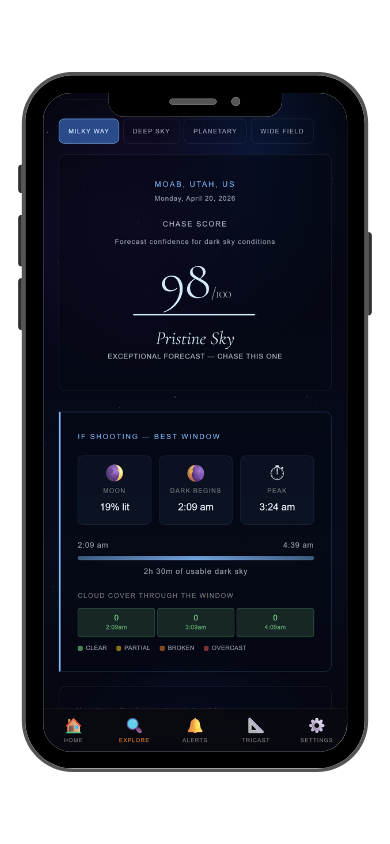
Driving two hours to the Blue Ridge only to hit a humidity haze or a rising gibbous moon is a familiar Georgia mistake. StarCast scores cloud cover, moon phase, atmospheric transparency, and seeing into a single night-sky verdict — updated daily for any location.
StarCast + More
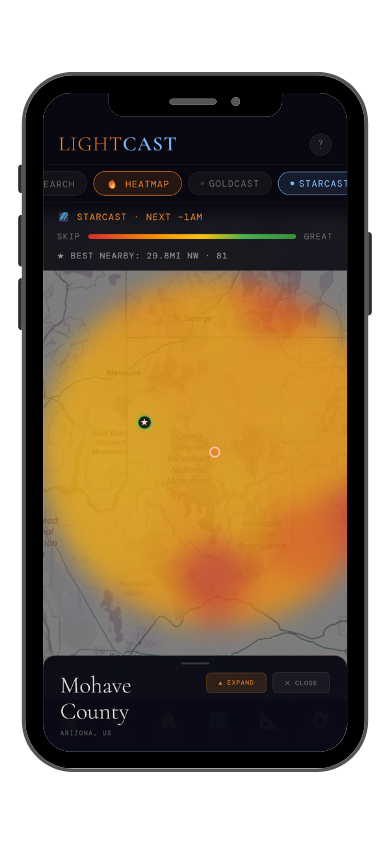
See the sky and the light on one map
Night sky · Nearby Conditions
StarCast scores cloud cover, moon phase, atmospheric transparency, and astronomical seeing. See on a map where skies are clearest before committing to the drive out to Brasstown Bald or Okefenokee.
Get Tonight's Forecast on iPhone
$2.99/mo · 7-day free trial
Learn More →
Frequently asked
Where can I see the Milky Way in Georgia?
Brasstown Bald and the Cohutta Wilderness in the northern mountains, and Okefenokee NWR in south Georgia, are the best options. All require driving well clear of Atlanta. Check StarCast for tonight's conditions free on
web, full features in the
iOS app.
What is the darkest sky in Georgia?
The Okefenokee NWR interior and the Cohutta Wilderness backcountry hold Georgia's darkest accessible skies — roughly Bortle 3. Brasstown Bald is the darkest easily driveable site at Bortle 3–4. No site in Georgia reaches Bortle 2 due to the surrounding Southeast urban density.
When is the best time for astrophotography in Georgia?
The Milky Way core is visible from Georgia from late February through October, peaking June–August. Spring (March–May) and fall (September–October) offer the best balance of Milky Way position and clear, low-humidity skies. Summer nights are often cloud-free after midnight but atmospheric transparency suffers from heat and humidity. New moon windows are essential at all Georgia sites.
Does cloud cover matter for astrophotography?
Completely — even thin high cirrus kills deep-sky exposures. Atmospheric transparency matters too, not just cloud-free skies. StarCast scores both cloud cover and transparency separately, so you know whether you're looking at a genuinely good night or just a technically clear one.
What is LightCast StarCast?
StarCast scores night sky conditions using cloud cover, moon phase, atmospheric transparency, and astronomical seeing. GoldCast (same app) handles golden hour timing. Free on web at
lightcastsuite.com/starcast, full features in the
LightCast iOS app — $2.99/month after a 7-day free trial.