Astrophotography locations · Hawaii
Where to Shoot and What to Know Before You Drive
Hawaii is one of the world's premier astrophotography destinations for good reason: islands surrounded by thousands of miles of open Pacific Ocean produce almost no regional light pollution, the summits of Mauna Kea and Haleakalā rise above the cloud inversion layer, and the tropical latitude (~19–22°N) reveals southern sky objects — the Magellanic Clouds, Centaurus, and deep galactic center angles — that US mainland photographers never see. Cloud inversion is the key concept — trade wind clouds typically sit at 6,000–8,000 ft, and summits above that level are often clear even when the coast is socked in. Altitude acclimatization is critical at Mauna Kea's 13,796 ft summit; visitors are advised to spend time at the Visitor Information Station (9,200 ft) before ascending. Check road conditions and summit access closures before departing.
🔭
Mauna Kea Summit, Big Island Bortle 1
At 13,796 ft — above 40% of Earth's atmosphere — Mauna Kea is one of the best astronomical observing sites on the planet. The Visitor Information Station at 9,200 ft hosts free public stargazing nightly. The summit access road is open to 4WD vehicles but tourists are not permitted at the observatory complex; shooting from the summit access area and saddle between telescopes is possible. The sky here is Bortle 1 with exceptional seeing — the galactic center, Magellanic Clouds, and airglow are visible to the naked eye. Dress for near-freezing temperatures at the summit even in summer.
🌋
Haleakalā National Park, Maui Bortle 1–2
The 10,023 ft summit crater of Haleakalā is an International Dark Sky Park — one of the most celebrated astrophotography destinations in the Pacific. The summit sits above the cloud inversion almost every night, giving Bortle 1 conditions over a volcanic landscape. The crater rim provides extraordinary foreground with the Milky Way arching overhead. A vehicle reservation permit is required for summit access from 3 AM to 7 AM (sunrise rush); plan for post-sunset entry which currently doesn't require a reservation but confirm current rules before visiting.
🌌
Mauna Loa Access Road & Saddle Area, Big Island Bortle 1–2
The Saddle Road corridor between Mauna Kea and Mauna Loa at 6,000–7,000 ft sits near or above the cloud inversion layer on many nights and offers dramatic volcanic landscape foreground with little artificial light. The Mauna Loa access road (closed above the weather observatory) gives lava field foregrounds. Hawaiʻi Volcanoes National Park's higher-elevation areas on the Mauna Loa side also offer excellent dark sky access with active volcanic terrain as compositional foreground elements.
🏝️
South Point (Ka Lae), Big Island Bortle 2
The southernmost point in the United States sits on a remote lava peninsula with unobstructed ocean horizon in every direction. At sea level but with no surrounding light sources for miles, South Point achieves Bortle 2 and gives clear views of southern sky objects that clear just the horizon at this latitude. The dramatic sea cliffs and lighthouse ruins provide foreground character. The access road is paved but narrow; arrive before dark to scout compositions safely.
🌺
Hawaiʻi Volcanoes National Park: Jaggar Museum Area Bortle 2
The caldera rim overlook at Kīlauea gives a unique opportunity to photograph the Milky Way over an active volcano — when lava lake activity is occurring, the reddish volcanic glow creates an otherworldly foreground. The park's elevation (~4,000 ft) and remote location keep skies genuinely dark. The Chain of Craters Road heading to the coast passes multiple pull-offs with different volcanic foreground compositions. Check NPS conditions reports for current volcanic activity and access restrictions.
Conditions matter as much as location
Check Before You Make the Drive
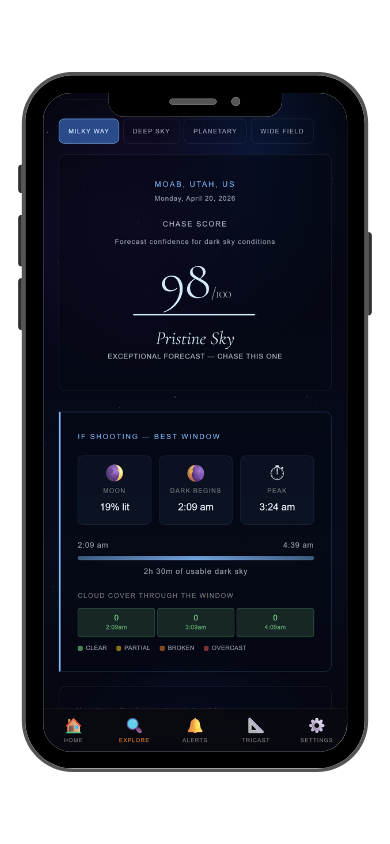
Driving up to the Mauna Kea VIS only to find the summit socked in above 12,000 ft or the access road closed is a well-known disappointment. StarCast scores cloud cover, moon phase, atmospheric transparency, and seeing into a single night-sky verdict — updated daily for any location including Maui and the Big Island.
StarCast + More
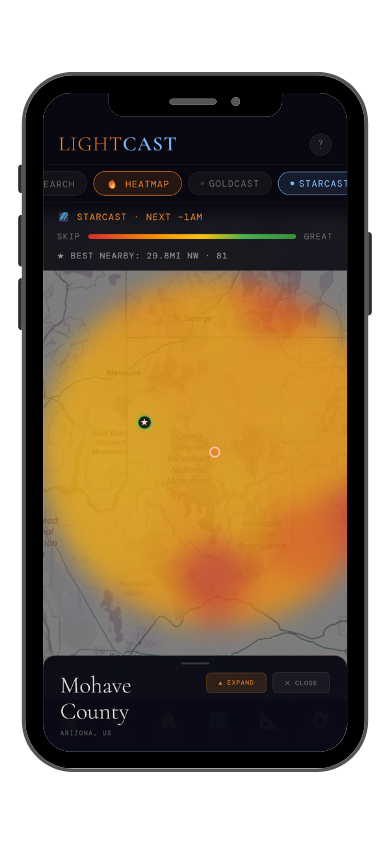
See the sky and the light on one map
Night sky · Nearby Conditions
StarCast scores cloud cover, moon phase, atmospheric transparency, and astronomical seeing. See on a map where skies are clearest before committing to the summit drive on Mauna Kea or Haleakalā.
Get Tonight's Forecast on iPhone
$2.99/mo · 7-day free trial
Learn More →
Frequently asked
Where can I see the Milky Way in Hawaii?
Anywhere dark and away from Honolulu's light dome — but Mauna Kea's summit, Haleakalā on Maui, and the Saddle Road area on the Big Island are the elite options. Even beach-level spots on the west coast of the Big Island can produce excellent results on new moon nights. Check StarCast for tonight's conditions free on
web, full features in the
iOS app.
What is the darkest sky in Hawaii?
Mauna Kea's summit is Bortle 1 — among the darkest skies on Earth. Haleakalā summit on Maui and South Point on the Big Island reach Bortle 1–2. The Magellanic Clouds (small galaxies visible only from the Southern Hemisphere and Hawaii's latitude) are visible from all of these sites on clear moonless nights.
When is the best time for astrophotography in Hawaii?
Hawaii's astrophotography season is essentially year-round due to its mild climate and absence of a winter shutdown. The Milky Way core is visible from approximately February through November from Hawaii's latitude. Summer months offer the highest galactic center position and peak season for the dense core shot. New moon windows apply at all sites — even Bortle 1 sky loses its Milky Way window under a bright moon. Winter months offer excellent transparency and good seeing at elevation.
Does cloud cover matter for astrophotography?
Yes — but Hawaii's cloud inversion layer means high-summit sites like Mauna Kea and Haleakalā are often above the clouds even when the coast is cloudy. Coastal sites are far more cloud-dependent. StarCast scores both cloud cover and transparency separately so you can tell the difference between a clear and a transparent night.
What is LightCast StarCast?
StarCast scores night sky conditions using cloud cover, moon phase, atmospheric transparency, and astronomical seeing. GoldCast (same app) handles golden hour timing. Free on web at
lightcastsuite.com/starcast, full features in the
LightCast iOS app — $2.99/month after a 7-day free trial.