Astrophotography locations · Illinois
Where to Shoot and What to Know Before You Drive
Chicago produces one of the largest light domes in the Midwest — visible for over 100 miles on clear nights — and combined with Peoria, Rockford, Springfield, and the surrounding suburban sprawl, the northern two-thirds of Illinois offer almost no practical astrophotography sky. The situation improves dramatically in the southern quarter of the state: Shawnee National Forest, the Garden of the Gods, and the Ohio River bottomlands are genuinely dark and receive little recreational night use. Moon phase is the primary scheduling constraint at all Illinois locations. Midwest weather is highly variable — clear nights are valuable and worth the drive when they appear. Humidity and cloud cover are the dominant atmospheric challenges; check transparency separately from cloud cover.
🌿
Garden of the Gods, Shawnee National Forest Bortle 3–4
The most dramatic astrophotography foreground in Illinois — sandstone rock formations with names like Camel Rock and Devil's Smokestack rising from a forested ridge in the Shawnee National Forest. At night the area is almost entirely dark; the nearest significant city is well over an hour away. The paved overlook parking area provides easy access, and the main overlook gives a wide eastern horizon perfect for Milky Way core compositions in summer. One of the most compositionally unusual dark-sky sites in the Midwest.
🏔️
Ferne Clyffe & Giant City State Parks, Makanda 3–4
The southern Illinois hill country around Makanda and Cobden — marketed as "Little Egypt" — holds a cluster of dark-sky accessible state parks. Giant City's massive stone bluff formations and Ferne Clyffe's waterfalls and rock shelters give excellent foreground character. The local dark sky community around Carbondale (home of Southern Illinois University) hosts periodic star parties; the surrounding area has multiple amateur astronomy clubs who know the best field locations. Accessible year-round.
🌊
Crab Orchard National Wildlife Refuge, Marion 4
A 44,000-acre refuge surrounding Crab Orchard Lake in southern Illinois provides lake-foreground astrophotography with moderate darkness. The lake's open water gives an unobstructed south horizon useful for capturing the Milky Way core rising in summer. The refuge is surrounded by low-population farmland that limits ambient scatter. A practical and accessible option for Carbondale and Marion area residents who don't want to drive deeper into the Shawnee backcountry.
🦅
Pere Marquette State Park, Grafton 4–5
Illinois's largest state park sits on the Mississippi River bluffs at the confluence of the Illinois and Mississippi rivers — the darkest accessible site within reasonable distance of the St. Louis metro. The Goat Cliff Trail ridge gives views south and west over undeveloped river bottom and Missouri bluffs. Not as dark as the Shawnee sites but significantly more accessible for central Illinois and St. Louis-area photographers. The river horizon and limestone bluffs provide interesting foreground character.
🌌
Pyramid State Recreation Area, Pinckneyville 3–4
A former strip mine reclamation area in Perry County that has been converted into a recreation area with numerous lakes and open rolling terrain. The surrounding farmland and low population density of Perry and Randolph counties provide some of the best dark sky in central-southern Illinois. The open former mine landscape gives wide unobstructed horizons uncommon in the forested Shawnee sites. Primitive camping available. A hidden gem for Illinois astrophotographers looking to avoid the Shawnee crowds on holiday weekends.
Conditions matter as much as location
Check Before You Make the Drive
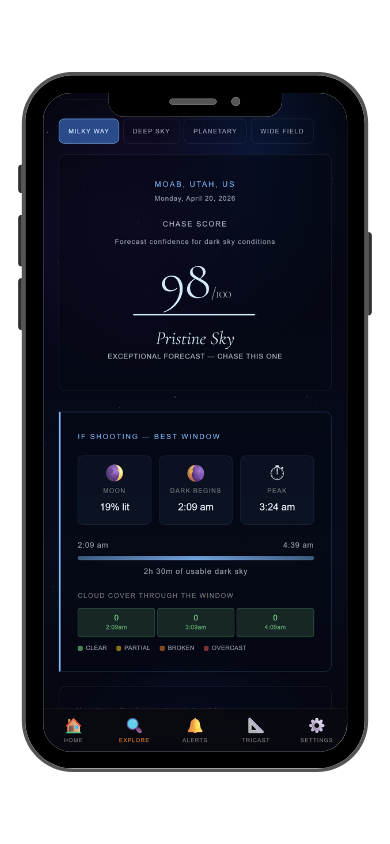
Driving three hours to Garden of the Gods only to hit a Midwest humidity haze or a rising moon is a familiar Illinois mistake. StarCast scores cloud cover, moon phase, atmospheric transparency, and seeing into a single night-sky verdict — updated daily for any location.
StarCast + More
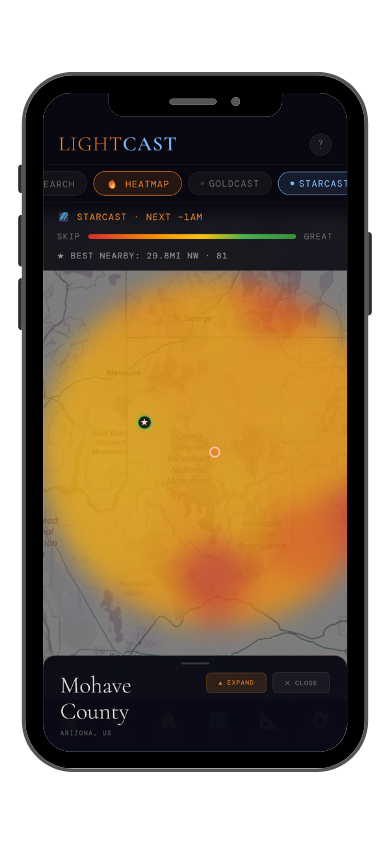
See the sky and the light on one map
Night sky · Nearby Conditions
StarCast scores cloud cover, moon phase, atmospheric transparency, and astronomical seeing. See on a map where skies are clearest before committing to the drive down to Shawnee or the Garden of the Gods.
Get Tonight's Forecast on iPhone
$2.99/mo · 7-day free trial
Learn More →
Frequently asked
Where can I see the Milky Way in Illinois?
Southern Illinois — Garden of the Gods in Shawnee National Forest, Giant City State Park, and the Crab Orchard NWR area — are your best in-state options. The northern half of the state is largely unusable due to Chicago's light dome. Check StarCast for tonight's conditions free on
web, full features in the
iOS app.
What is the darkest sky in Illinois?
Garden of the Gods and the Shawnee National Forest backcountry in southern Illinois hold the darkest skies in the state — roughly Bortle 3 in the deepest sections. No accessible location in Illinois reaches Bortle 2. The surrounding states' dark sky corridors in western Kentucky and the Missouri Ozarks offer somewhat better sky for those willing to cross state lines.
When is the best time for astrophotography in Illinois?
The Milky Way core is visible from Illinois from late March through October, peaking June–August. Spring and fall offer the best combination of Milky Way position and clear, low-humidity Midwest skies. Summer nights can be excellent but heat and humidity often degrade atmospheric transparency. New moon windows are essential at all Illinois locations. Monitor clear-sky charts in the days before your trip — Midwest weather is notoriously hard to predict more than 48 hours out.
Does cloud cover matter for astrophotography?
Completely — even thin high cirrus kills deep-sky exposures. Atmospheric transparency matters too, not just cloud-free skies. StarCast scores both cloud cover and transparency separately, so you know whether you're looking at a genuinely good night or just a technically clear one.
What is LightCast StarCast?
StarCast scores night sky conditions using cloud cover, moon phase, atmospheric transparency, and astronomical seeing. GoldCast (same app) handles golden hour timing. Free on web at
lightcastsuite.com/starcast, full features in the
LightCast iOS app — $2.99/month after a 7-day free trial.