Astrophotography locations · Indiana
Where to Shoot and What to Know Before You Drive
Indiana's flat central plains are densely farmed and widely lit — Indianapolis, Fort Wayne, South Bend, and Evansville each produce their own light domes that blanket much of the state. The exception is the unglaciated hill country of southern Indiana, where Hoosier National Forest and the surrounding terrain create the state's only meaningful dark-sky corridor. Moon phase is the primary scheduling constraint at all Indiana sites. Midwest humidity and cloud frequency are real limitations — Indiana averages more overcast nights than many western states; treat clear new moon windows as high-priority opportunities. Check atmospheric transparency separately from cloud cover, as humid summer nights can be optically poor even when technically clear.
🌲
Hoosier National Forest: German Ridge & Saddle Lake Bortle 3–4
Indiana's only national forest covers the rugged hill country of Crawford, Perry, and Orange counties — among the least light-polluted terrain in the state. German Ridge Recreation Area sits atop one of the highest ridges in southern Indiana and gives partial horizon views through the forest. Saddle Lake provides a water foreground in a genuinely rural setting. The forest's interior roads allow vehicle access to multiple dark spots away from the few small towns in the area. A practical choice for Louisville, KY and Indianapolis residents seeking Milky Way access within state lines.
🏔️
Brown County State Park, Nashville 4
Indiana's largest state park sits in the heart of the Brown County hills — the most topographically varied terrain in the state. While not as dark as the Hoosier NF sites, the hilly forest canopy shields many directions from light scatter, and the park's ridgetop fire tower area gives the best horizon access. Brown County is also home to the Yellowwood State Forest and several astronomy club observing sites nearby. The most accessible dark-sky option for Indianapolis residents at roughly 50 miles south of the city.
🏖️
Indiana Dunes National Park, Chesterton 5–6
Not a dark-sky site by any metric — Chicago's massive light dome dominates the northern horizon — but the Lake Michigan shoreline gives an unobstructed northern water horizon and unique dune-and-beach foreground. The park's West Beach area after dark can produce striking compositions with city glow reflected in the lake as a deliberate element. Best approached as a creative long-exposure and light-pollution landscape site rather than a traditional astrophotography destination. The lake horizon also offers excellent summer storm photography opportunities.
🌊
Wyandotte Cave & O'Bannon Woods State Park, Leavenworth 3–4
The Ohio River valley near Leavenworth in Crawford County gives Indiana's darkest accessible sky within driving distance of Louisville. O'Bannon Woods sits on the river bluffs with terrain shielding from Kentucky towns to the south. The surrounding Crawford County farmland and forested hills have minimal artificial lighting. The river bend near Leavenworth itself provides foreground interest with the Milky Way arching overhead in summer. This area is consistently underused by Indiana astrophotographers relative to its sky quality.
🌌
Glendale Fish & Wildlife Area, Montgomery 4
A large wetland and reservoir complex in Daviess County in southwestern Indiana — one of the darkest accessible sites in the lower half of the state outside Hoosier NF. The open water and marsh provide unobstructed southern horizon access, ideal for Milky Way core compositions in early summer when the core rises to the south. The surrounding rural countryside of Daviess and Martin counties has very low light pollution. A practical option for Evansville residents who want usable dark sky closer to home.
Conditions matter as much as location
Check Before You Make the Drive
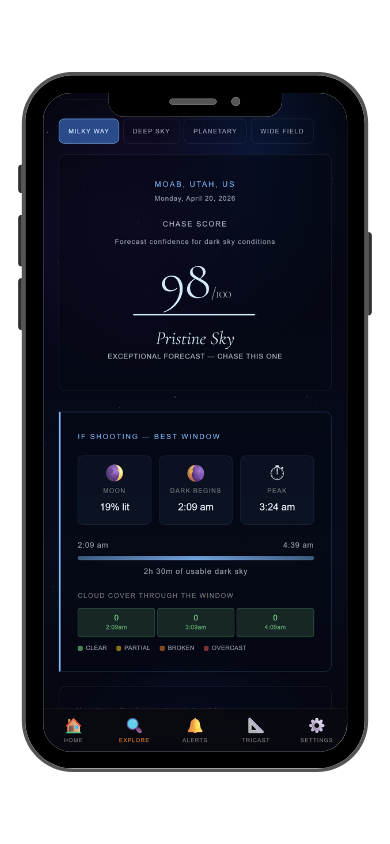
Driving two hours to Hoosier National Forest only to hit a Midwest humidity layer or a rising moon is a familiar Indiana mistake. StarCast scores cloud cover, moon phase, atmospheric transparency, and seeing into a single night-sky verdict — updated daily for any location.
StarCast + More
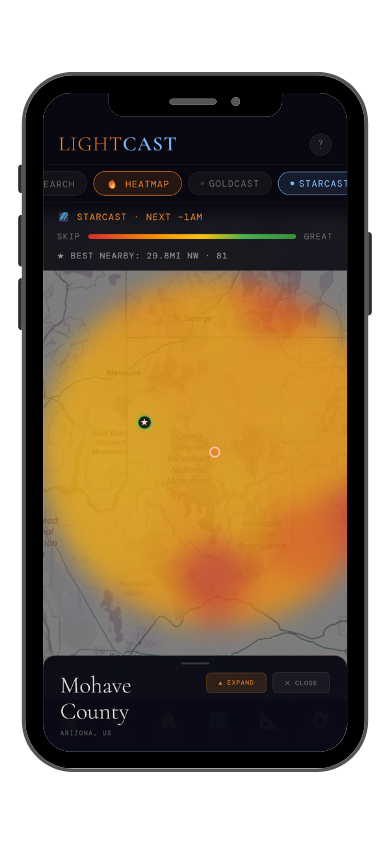
See the sky and the light on one map
Night sky · Nearby Conditions
StarCast scores cloud cover, moon phase, atmospheric transparency, and astronomical seeing. See on a map where skies are clearest before committing to the drive down to Hoosier or the Ohio River bluffs.
Get Tonight's Forecast on iPhone
$2.99/mo · 7-day free trial
Learn More →
Frequently asked
Where can I see the Milky Way in Indiana?
Hoosier National Forest in southern Indiana — particularly the German Ridge and Crawford County areas — is your best in-state option. Brown County State Park is the most accessible compromise for Indianapolis residents. Check StarCast for tonight's conditions free on
web, full features in the
iOS app.
What is the darkest sky in Indiana?
The Crawford and Perry County areas within and around Hoosier National Forest hold the darkest accessible skies in the state — roughly Bortle 3 in the best pockets. The Ohio River bluffs near Leavenworth approach similar quality. No easily accessible site in Indiana reaches Bortle 2 due to surrounding Midwest urban density.
When is the best time for astrophotography in Indiana?
The Milky Way core is visible from Indiana from late March through October, peaking June–August. Spring and early fall offer the best balance of Milky Way visibility and clear, lower-humidity skies. Summer nights can deliver excellent Milky Way positions but Midwest humidity often degrades atmospheric transparency — check transparency separately from cloud cover. New moon windows are essential at all Indiana sites.
Does cloud cover matter for astrophotography?
Completely — even thin high cirrus kills deep-sky exposures. Atmospheric transparency matters too, not just cloud-free skies. StarCast scores both cloud cover and transparency separately, so you know whether you're looking at a genuinely good night or just a technically clear one.
What is LightCast StarCast?
StarCast scores night sky conditions using cloud cover, moon phase, atmospheric transparency, and astronomical seeing. GoldCast (same app) handles golden hour timing. Free on web at
lightcastsuite.com/starcast, full features in the
LightCast iOS app — $2.99/month after a 7-day free trial.