Astrophotography locations · Iowa
Where to Shoot and What to Know Before You Drive
Iowa is more photogenic at night than its flat agricultural reputation suggests. Des Moines, Cedar Rapids, Davenport, and Sioux City each generate their own light domes, but the rural corridors between them — particularly northeast Iowa's Driftless Area and the Loess Hills along the Missouri River — hold genuinely usable dark sky. Iowa's wide open farmland is both the challenge and the opportunity — treeless fields mean almost no horizon obstruction, making wide-field Milky Way arch shots extremely effective. Moon phase and atmospheric transparency are the primary constraints; humid Iowa summers can cloud the optics even on technically clear nights. Spring and fall deliver the best sky quality.
🏔️
Loess Hills State Forest, Preparation Canyon Unit Bortle 3–4
The Loess Hills — a rare geological formation of wind-deposited silt bluffs running along Iowa's western edge — are among the most topographically distinctive landscapes in the Midwest and hold some of the darkest sky in the state. Preparation Canyon State Park near Moorhead sits atop a ridge with sweeping views east over the Missouri River valley. The surrounding Loess Hills State Forest adds dark buffer with minimal artificial lighting. Far from any significant city, this is consistently Iowa's best Milky Way terrain.
🌊
Pikes Peak State Park, McGregor 3–4
Iowa's Pikes Peak — not Colorado's — is a 500-ft bluff overlooking the confluence of the Wisconsin and Mississippi rivers in the northeast Driftless Area. The elevated ridgeline gives a panoramic river valley view with minimal nearby light sources. McGregor and Prairie du Chien (WI) across the river are tiny towns. The surrounding Driftless landscape with its forested coulees and river bends provides exceptional foreground character unique to this part of the Midwest. One of Iowa's most compositionally rewarding dark-sky sites.
🌲
Yellow River State Forest, Harpers Ferry 3–4
Iowa's largest state forest covers rugged Driftless Area terrain in Allamakee County — the most topographically varied county in the state. The forest sits in Iowa's far northeast corner, well away from any urban center, with the Upper Iowa and Yellow rivers cutting through forested limestone ridges. Multiple forest roads provide vehicle access to ridgetop openings. The nearby town of Harpers Ferry on the Mississippi bluffs is a strong alternative shooting location with river foreground.
🔭
Stephens State Forest, Lucas County 4
Iowa's second-largest state forest in south-central Iowa provides a dark-sky option within reasonable range of Des Moines — about 70 miles south. The forested rolling terrain of Lucas and Monroe counties shields from some light scatter. The forest's interior gives partial horizon access with woodland foreground. A practical new-moon destination for Des Moines residents who don't want to make the full drive to northeast Iowa or the Loess Hills.
🌌
Open Farmland: Iowa Great Lakes Region, Okoboji 4
The lake and prairie region of Dickinson County in northwest Iowa offers flat open sky with lake reflections as foreground. Spirit Lake and West Okoboji Lake provide water-mirror Milky Way compositions uncommon in the Midwest interior. While the resort towns produce some local light, the surrounding farmland is genuinely dark and the flat horizon is unobstructed in all directions. Best in early summer before the resort season crowds arrive with vehicle headlights disrupting long exposures.
Conditions matter as much as location
Check Before You Make the Drive
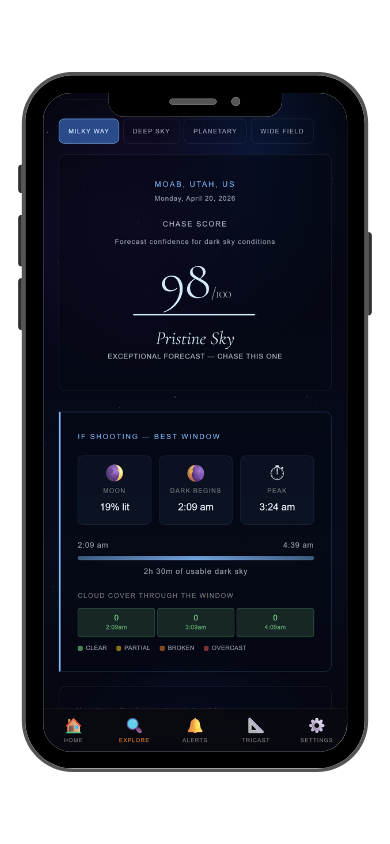
Driving two hours to the Loess Hills only to hit a humid Iowa haze layer or a rising gibbous moon is a familiar mistake. StarCast scores cloud cover, moon phase, atmospheric transparency, and seeing into a single night-sky verdict — updated daily for any location.
StarCast + More
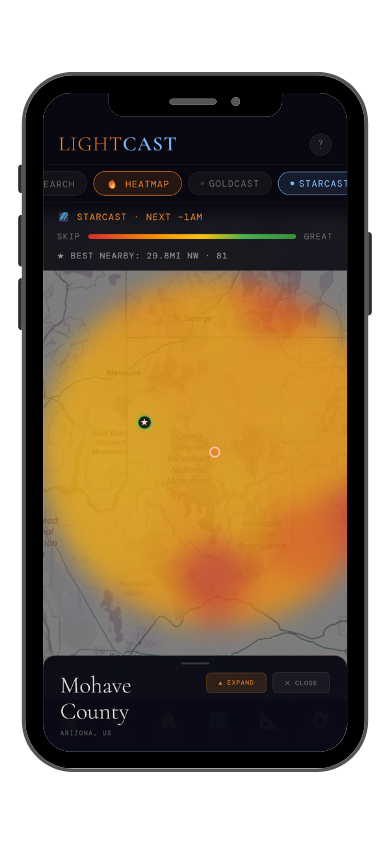
See the sky and the light on one map
Night sky · Nearby Conditions
StarCast scores cloud cover, moon phase, atmospheric transparency, and astronomical seeing. See on a map where skies are clearest before committing to the drive out to the Loess Hills or northeast Iowa.
Get Tonight's Forecast on iPhone
$2.99/mo · 7-day free trial
Learn More →
Frequently asked
Where can I see the Milky Way in Iowa?
The Loess Hills in western Iowa and the Driftless Area in the northeast — Pikes Peak State Park, Yellow River State Forest — are your best in-state options. Between cities, Iowa's open farmland gives very wide horizon and surprisingly dark sky. Check StarCast for tonight's conditions free on
web, full features in the
iOS app.
What is the darkest sky in Iowa?
The Loess Hills near Preparation Canyon and the far northeast corner of the state around Yellow River State Forest and Allamakee County hold Iowa's darkest accessible skies — roughly Bortle 3. The Driftless Area's northeast corner is Iowa's most consistent dark-sky region.
When is the best time for astrophotography in Iowa?
The Milky Way core is visible from Iowa from late March through October, peaking June–August. Spring (April–May) and fall (September–October) offer the best atmospheric transparency. Summer nights are often warm and clear after midnight but humidity can soften seeing. New moon windows are essential. Iowa's open farmland rewards wide-angle shooting — plan compositions that use the unobstructed horizon to capture Milky Way arches.
Does cloud cover matter for astrophotography?
Completely — even thin high cirrus kills deep-sky exposures. Atmospheric transparency matters too, not just cloud-free skies. StarCast scores both cloud cover and transparency separately, so you know whether you're looking at a genuinely good night or just a technically clear one.
What is LightCast StarCast?
StarCast scores night sky conditions using cloud cover, moon phase, atmospheric transparency, and astronomical seeing. GoldCast (same app) handles golden hour timing. Free on web at
lightcastsuite.com/starcast, full features in the
LightCast iOS app — $2.99/month after a 7-day free trial.