Astrophotography locations · Kansas
Where to Shoot and What to Know Before You Drive
Kansas is one of the most underrated astrophotography states in the country. Western Kansas in particular reaches Bortle 2–3 in rural areas, with the Milky Way arching from horizon to horizon over the prairie. The main light domes to avoid are Wichita in the south-center and the Kansas City metro to the east. Wind is often the biggest constraint in Kansas, not light pollution — steady 20 mph gusts will ruin long exposures. Spring and summer bring storm season, so check weather carefully. The payoff when conditions align is extraordinary: true dark sky over a flat, open foreground that frames the galactic core cleanly.
🏜️
Little Jerusalem Badlands State Park, Scott County Bortle 2–3
This newly designated state park protects one of the largest remaining chalk formations in the High Plains, rising dramatically from the surrounding flatlands near Scott City in western Kansas. The Niobrara chalk spires provide stunning sculptural foreground for Milky Way arches in summer. Skies here are among the darkest in the state, with virtually no urban influence for 40+ miles in most directions. Shoot from the upper overlook trail for the widest compositions.
🌾
Cimarron National Grassland, Morton County 2–3
Located in the extreme southwestern corner of Kansas near Elkhart, this 108,000-acre national grassland is among the darkest accessible land in the state. The Santa Fe Trail corridor and Point of Rocks sandstone outcrop provide foreground interest under a sky that can show the Zodiacal Light and airglow without effort. Winds are persistent in this exposed terrain, so low ISO and heavier tripods help. The nearest meaningful light source is several towns away.
🌿
Flint Hills: Tallgrass Prairie National Preserve, Chase County 3–4
The Flint Hills are one of the last intact tallgrass prairie ecosystems in North America, and Chase County sits far enough from major cities to offer genuinely dark skies. The rolling hills and scattered bur oak create a layered foreground unlike the flat western prairie. The national preserve near Strong City allows night access in designated areas. Summer Milky Way shooting here has a distinctly cinematic quality with the undulating grass catching starlight.
💧
Kirwin National Wildlife Refuge, Phillips County 3
This reservoir and wetland complex in north-central Kansas sits in a sparsely populated stretch of the state with minimal artificial light. The water surface reflects stars well and attracts wildlife that adds life to long exposures. The surrounding shortgrass prairie extends the dark horizon in all directions. Phillips County as a whole is one of the least light-polluted counties in Kansas, making any rural pullout in the area a serviceable shooting location.
🏛️
Mushroom Rock State Park, Ellsworth County 3–4
One of Kansas's most distinctive geological features, these sandstone concretion formations sit on open prairie in central Kansas. The sculpted rocks make excellent foreground anchors for wide-angle Milky Way compositions. The park is small and less visited at night, giving a quiet experience. Central location means some influence from Salina to the north, but conditions are reliably better than anything in the eastern third of the state.
Conditions matter as much as location
Check Before You Make the Drive
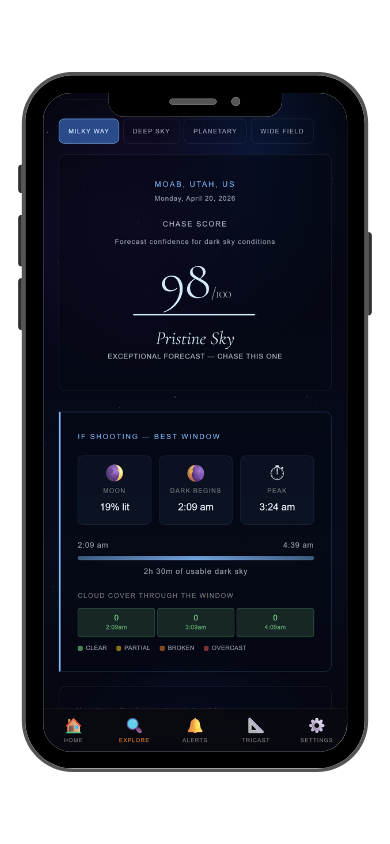
Driving west into the Kansas prairie only to hit a line of thunderstorms rolling in from Colorado or a spring wind advisory is a real risk. StarCast scores cloud cover, moon phase, atmospheric transparency, and seeing into a single night-sky verdict — updated daily for any location.
StarCast + More
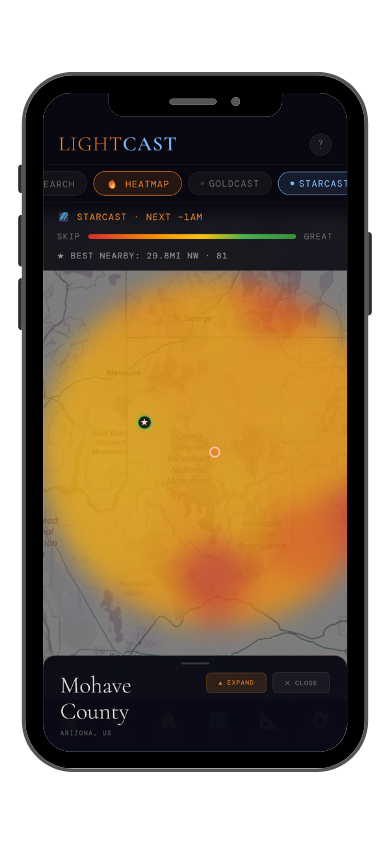
See the sky and the light on one map
Night sky · Nearby Conditions
StarCast scores cloud cover, moon phase, atmospheric transparency, and astronomical seeing. See on a map where skies are clearest before committing to the drive out to Little Jerusalem or the Cimarron Grassland.
Get Tonight's Forecast on iPhone
$2.99/mo · 7-day free trial
Learn More →
Frequently asked
Where can I see the Milky Way in Kansas?
Western Kansas is one of the best Milky Way destinations in the continental US. Little Jerusalem Badlands State Park and Cimarron National Grassland offer Bortle 2–3 skies. Even central Kansas locations like Mushroom Rock State Park provide dramatically better conditions than the eastern cities. Check StarCast for tonight's conditions free on
web, full features in the
iOS app.
What is the darkest sky in Kansas?
The darkest accessible skies in Kansas are in the extreme southwest, around Cimarron National Grassland in Morton County, and the western High Plains near Scott City and Greeley County. These areas regularly achieve Bortle 2 under good conditions, with the Milky Way bright enough to cast faint shadows.
When is the best time for astrophotography in Kansas?
The Milky Way core is well-positioned from April through September at Kansas latitudes, peaking in July and August when the galactic center rises high in the south. New moon windows are valuable even in the dark western prairie. Spring brings storm risk, so monitor weather systems closely. Autumn nights after harvest tend to have excellent transparency with lower humidity.
Does wind affect astrophotography in Kansas?
Yes — Kansas wind is a serious practical constraint. Exposures longer than 15–20 seconds on a standard tripod can show blur or vibration during gusty nights. Using a sturdy tripod, hanging a counterweight, and shooting when wind is forecast below 10 mph all help. StarCast does not score wind directly, but your local weather forecast should be checked alongside the sky score.
What is LightCast StarCast?
StarCast scores night sky conditions using cloud cover, moon phase, atmospheric transparency, and astronomical seeing. GoldCast (same app) handles golden hour timing. Free on web at
lightcastsuite.com/starcast, full features in the
LightCast iOS app — $2.99/month after a 7-day free trial.