Astrophotography locations · Kentucky
Where to Shoot and What to Know Before You Drive
Kentucky's light pollution is concentrated in a band running through Louisville, Lexington, and Frankfort. The eastern mountains and the far western tip of the state near Land Between the Lakes offer the best darkness. Humidity and cloud cover are the primary constraints — Kentucky averages more cloudy nights than much of the South, and summer atmospheric transparency can be poor. The eastern Kentucky mountains provide not just dark sky but dramatic terrain with sandstone arches, gorges, and ridge lines that elevate astrophotography compositions well beyond a simple "stars over field" shot.
🏞️
Big South Fork National River and Recreation Area, McCreary County Bortle 3–4
This 125,000-acre federal recreation area straddles the Kentucky-Tennessee border in the Cumberland Plateau. Deep gorges, sandstone bluffs, and the Big South Fork river canyon create extraordinary foreground for astrophotography. The Blue Heron area and Leatherwood Ford are popular access points. The surrounding mountains block most distant light domes, and the terrain itself is sparsely populated. Summer Milky Way over the canyon rim is one of Kentucky's finest night-sky compositions.
🌊
Land Between the Lakes National Recreation Area, Trigg and Lyon Counties 3–4
This narrow peninsula between Kentucky Lake and Lake Barkley in western Kentucky is one of the state's most accessible dark-sky areas. The lakes provide excellent reflective foregrounds, and the surrounding forests buffer most artificial light. The Woodlands Nature Station area and the Golden Pond Planetarium are good orientation points. Western sky views are particularly clean, and the Milky Way core sets over the lake in summer making for long horizon compositions.
🪨
Red River Gorge Geological Area, Powell and Menifee Counties 4
The Red River Gorge is Kentucky's most famous natural area and one of the best astrophotography destinations in the state. Natural Bridge, Chimney Top Rock, and Sky Bridge arch all provide iconic foreground compositions at altitude. The gorge walls block lower horizon glow from the north and west, concentrating clean sky overhead and to the south. Camping in the gorge gives all-night access. Some influence from Lexington to the northwest, but high terrain walls mitigate it considerably.
🌲
Daniel Boone National Forest: Laurel River Lake, Laurel County 3–4
Laurel River Lake in the southern Daniel Boone National Forest sits in a bowl of forested ridges that suppress surrounding light pollution effectively. The lake's reflective surface gives wide-angle compositions across the galactic core in summer. The recreation area has low overnight visitor numbers mid-week, giving a quiet experience. This stretch of the forest between London and Corbin is far enough from the I-75 corridor to hold genuinely dark sky overhead.
🏔️
Black Mountain, Harlan County 3
At 4,145 feet, Black Mountain is the highest point in Kentucky, sitting in the far southeastern corner of the state near the Virginia border. The summit and upper ridges give a 360-degree horizon from elevation, with the galactic core clearing the horizon cleanly to the south. This area of Harlan County is among the least light-polluted in the state, with the nearest city glows distant and low on the horizon. Access roads can be rough; check conditions before driving at night.
Conditions matter as much as location
Check Before You Make the Drive
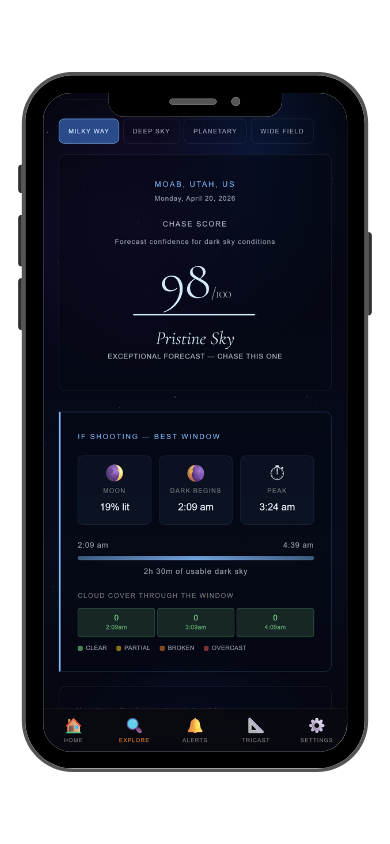
Driving into the Kentucky mountains only to hit a foggy gorge or overcast ridgeline is a familiar frustration. StarCast scores cloud cover, moon phase, atmospheric transparency, and seeing into a single night-sky verdict — updated daily for any location.
StarCast + More
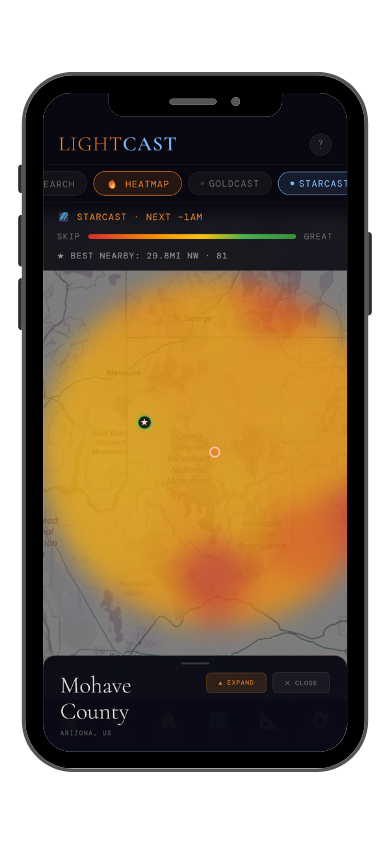
See the sky and the light on one map
Night sky · Nearby Conditions
StarCast scores cloud cover, moon phase, atmospheric transparency, and astronomical seeing. See on a map where skies are clearest before committing to the drive out to Big South Fork or the Red River Gorge.
Get Tonight's Forecast on iPhone
$2.99/mo · 7-day free trial
Learn More →
Frequently asked
Where can I see the Milky Way in Kentucky?
Big South Fork, Red River Gorge, and Land Between the Lakes are Kentucky's best Milky Way destinations. The eastern mountains consistently outperform central and northern Kentucky in darkness and terrain interest. Check StarCast for tonight's conditions free on
web, full features in the
iOS app.
What is the darkest sky in Kentucky?
The darkest accessible skies in Kentucky are in the southeastern mountains, particularly around Harlan County near Black Mountain and the McCreary County section of Big South Fork. These areas reach Bortle 3 under good conditions, with good dark adaptation revealing faint nebulosity in the Milky Way core.
When is the best time for astrophotography in Kentucky?
The Milky Way core is visible from Kentucky latitudes from roughly late March through October, peaking in July. Late summer and early fall tend to offer the best transparency as humidity drops. New moon windows are important at all Kentucky sites. Spring can be excellent if skies clear between storm systems, but cloud frequency is higher.
Does cloud cover matter for astrophotography?
Completely — even thin high cirrus kills deep-sky exposures. Atmospheric transparency matters too, not just cloud-free skies. StarCast scores both cloud cover and transparency separately, so you know whether you're looking at a genuinely good night or just a technically clear one.
What is LightCast StarCast?
StarCast scores night sky conditions using cloud cover, moon phase, atmospheric transparency, and astronomical seeing. GoldCast (same app) handles golden hour timing. Free on web at
lightcastsuite.com/starcast, full features in the
LightCast iOS app — $2.99/month after a 7-day free trial.