Astrophotography locations · Louisiana
Where to Shoot and What to Know Before You Drive
Louisiana's southern half is dominated by New Orleans, Baton Rouge, and the dense petrochemical corridor along the Mississippi, which produces significant skyglow across the lower half of the state. The northern parishes are considerably darker, particularly around Kisatchie National Forest and the reservoirs along the Texas border. Humidity is the dominant constraint in Louisiana — even on clear nights, moisture in the air scatters light and reduces transparency. Winter and early spring offer the best atmospheric conditions. Mosquitoes are a practical field concern from April through October; plan accordingly.
🌲
Kisatchie National Forest, Natchitoches Parish Bortle 3–4
Louisiana's only national forest covers about 604,000 acres of longleaf pine hills in the central part of the state, and its interior reaches some of the darkest skies accessible in Louisiana. The Kisatchie Hills Wilderness near the Longleaf Vista Recreation Area gives open sky above sandstone buttes unusual for this flat state. The surrounding terrain is sparsely populated, and distant glows from Alexandria to the east are low on the horizon. Good year-round access via Forest Road 59.
💧
Toledo Bend Reservoir, Sabine Parish 3
One of the largest man-made lakes in the US, Toledo Bend straddles the Louisiana-Texas border in a remote stretch of forested land far from major population centers. The open water gives wide southern and western horizons, ideal for Milky Way core compositions in summer. The eastern shore in Sabine Parish sees some of the darkest accessible conditions in the state. The Sabine National Wildlife Refuge side of the lake adds wetland foreground options. Transparency after cold fronts in fall and winter is excellent.
🏛️
Poverty Point National Monument, West Carroll Parish 3–4
This UNESCO World Heritage Site in the northeastern corner of Louisiana protects a 3,400-year-old earthwork complex surrounded by flat agricultural land and oxbow lakes. The open terrain provides a wide-open horizon in all directions, and the ancient mounds make a compelling foreground for wide-angle Milky Way compositions. The surrounding parishes are among the least densely populated in the state, and the nearest significant light domes are Monroe (distant south) and Shreveport (distant west).
🌿
Chicot State Park, Evangeline Parish 4
Chicot State Park surrounds one of the largest freshwater lakes in Louisiana, with bald cypress trees extending into the water for excellent long-exposure compositions. The park sits in a rural area of central Louisiana away from major population centers, giving moderate but usable darkness. The cypress-draped water reflections under a Milky Way arc are among the most visually distinctive astrophotography compositions available anywhere in the state. Late fall and winter minimize humidity and insects.
🌾
Atchafalaya Basin, St. Martin and Assumption Parishes 4–5
Not a dark-sky site by strict standards, but the Atchafalaya Basin offers one of the most dramatic and unique night photography foregrounds in the South. Access via boat gives entry to completely isolated swamp interiors where cypress knees, Spanish moss, and still black water create compositions unavailable anywhere else. Some glow from Baton Rouge to the east and Lafayette to the west, but the surreal environment and complete absence of ground-level artificial light make it worthwhile for photographers willing to work around the limitations.
Conditions matter as much as location
Check Before You Make the Drive
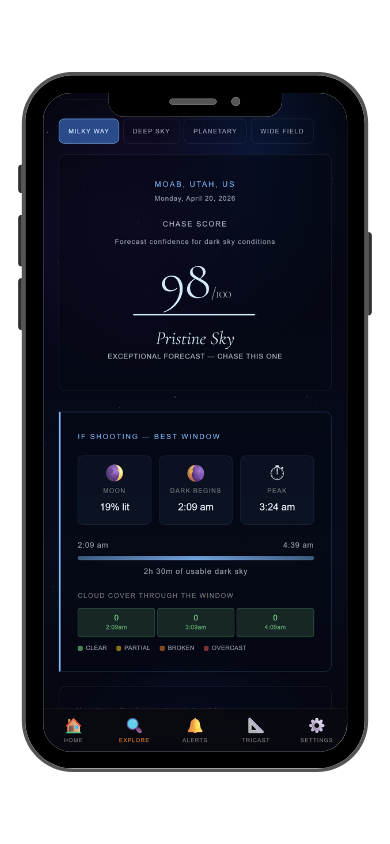
Driving into central Louisiana only to face a humid haze that technically isn't "cloudy" but kills all transparency is a common experience. StarCast scores cloud cover, moon phase, atmospheric transparency, and seeing into a single night-sky verdict — updated daily for any location.
StarCast + More
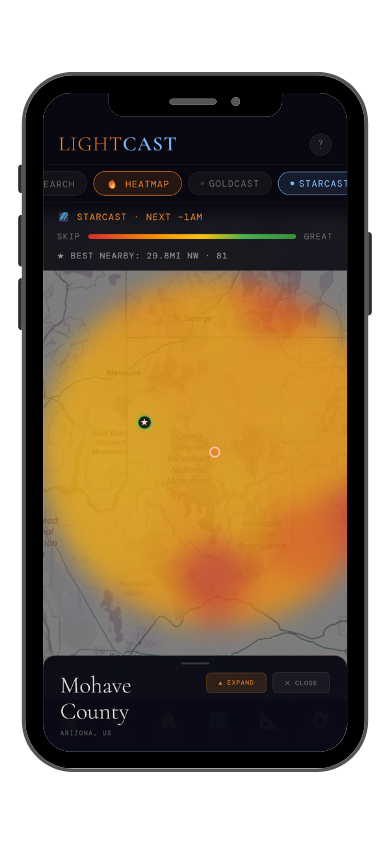
See the sky and the light on one map
Night sky · Nearby Conditions
StarCast scores cloud cover, moon phase, atmospheric transparency, and astronomical seeing. See on a map where skies are clearest before committing to the drive out to Kisatchie or Toledo Bend.
Get Tonight's Forecast on iPhone
$2.99/mo · 7-day free trial
Learn More →
Frequently asked
Where can I see the Milky Way in Louisiana?
Kisatchie National Forest and Toledo Bend Reservoir are Louisiana's best Milky Way destinations. The northern parishes generally outperform the south in darkness. Check StarCast for tonight's conditions free on
web, full features in the
iOS app.
What is the darkest sky in Louisiana?
The darkest accessible skies in Louisiana are in the extreme northwest, around Toledo Bend Reservoir and the rural parishes bordering Texas and Arkansas. These areas can reach Bortle 3 under good conditions, though humidity frequently reduces effective transparency below what Bortle ratings suggest on paper.
When is the best time for astrophotography in Louisiana?
November through February offers the best atmospheric transparency in Louisiana, as humidity and cloud frequency drop significantly after summer. The Milky Way core is not visible in winter, so photographers targeting the galactic center should plan for May through August new moon windows while accepting worse transparency. Fall and winter are best for deep-sky and wide-field work.
Does cloud cover matter for astrophotography?
Completely — even thin high cirrus kills deep-sky exposures. Atmospheric transparency matters too, not just cloud-free skies. StarCast scores both cloud cover and transparency separately, so you know whether you're looking at a genuinely good night or just a technically clear one.
What is LightCast StarCast?
StarCast scores night sky conditions using cloud cover, moon phase, atmospheric transparency, and astronomical seeing. GoldCast (same app) handles golden hour timing. Free on web at
lightcastsuite.com/starcast, full features in the
LightCast iOS app — $2.99/month after a 7-day free trial.