Astrophotography locations · Maine
Where to Shoot and What to Know Before You Drive
Maine is a rare eastern state where genuinely dark skies are accessible without traveling to the desert. The North Maine Woods in the interior reaches Bortle 2–3 in places, and even Acadia National Park on the southern coast holds Bortle 3–4 on the ocean side. Portland and Bangor produce the main light domes to navigate around. Cloud cover and coastal fog are the primary constraints — Maine averages fewer clear nights than most of the US, and marine fog can roll in quickly even on forecast-clear evenings. When skies do clear, the transparency and seeing quality can be exceptional, particularly after cold fronts in fall and winter.
🦞
Acadia National Park, Hancock County Bortle 3–4
Acadia is the premier astrophotography destination on the East Coast and one of the best in the country. The park sits on Mount Desert Island with the Atlantic Ocean to the south and east, providing unobstructed dark ocean horizon in those directions. Cadillac Mountain at 1,530 feet gives summit views above coastal fog layers and is the first place in the US to see sunrise. Jordan Pond, Sand Beach, and Bass Harbor Head Lighthouse all provide iconic foregrounds. The ocean horizon means the Milky Way core rises over dark water in summer. Bar Harbor produces some glow to the north, manageable from southern vantage points.
🏔️
Baxter State Park, Piscataquis County 2–3
Baxter State Park surrounds Katahdin, Maine's highest peak at 5,269 feet, in a remote wilderness setting. The park restricts vehicle access and prohibits artificial lighting in many areas, making it one of the darkest accessible locations in the Northeast. Daicey Pond and Kidney Pond campgrounds have excellent lake reflections. Summit shooting from Baxter Peak requires permit-managed day use, but the surrounding terrain at lower elevations is extraordinary. The park is 2+ hours from Bangor with virtually no light pollution in any direction.
🌲
North Maine Woods, Aroostook and Piscataquis Counties 2
The North Maine Woods is a 3.5-million-acre privately owned but publicly accessible wilderness of boreal forest, lakes, and rivers in the interior of the state. This is one of the darkest land areas east of the Mississippi River. Millinocket, Greenville, and Jackman serve as gateways, but the interior is largely devoid of artificial light. Moosehead Lake near Greenville provides a massive open water foreground. The Allagash Wilderness Waterway gives a protected river corridor with pristine dark sky. Access requires gate fees and often high-clearance vehicles.
💧
Rangeley Lakes Region, Franklin County 3
The Rangeley Lakes area in western Maine combines mountain terrain with large lake systems and a population density low enough to maintain excellent dark sky. Rangeley Lake State Park and the surrounding Oquossoc area provide open water foregrounds with mountain ridgelines. The region sits in a bowl of mountains that blocks distant glows from New Hampshire and Quebec. Fall is an exceptional season here, with clear stable air after summer humidity clears and before winter weather arrives.
🌊
Quoddy Head State Park, Washington County 3
The easternmost point of the contiguous United States, Quoddy Head sits at the tip of a peninsula surrounded by the Bay of Fundy and the Atlantic Ocean, with dark water horizons to the north, south, and east. Washington County is one of the least light-polluted counties in the entire Northeast. The candy-striped lighthouse against a Milky Way sky over the ocean is one of Maine's most compelling astrophotography subjects. The extreme northeastern location means some of the earliest Milky Way rise times of any East Coast site in summer.
Conditions matter as much as location
Check Before You Make the Drive
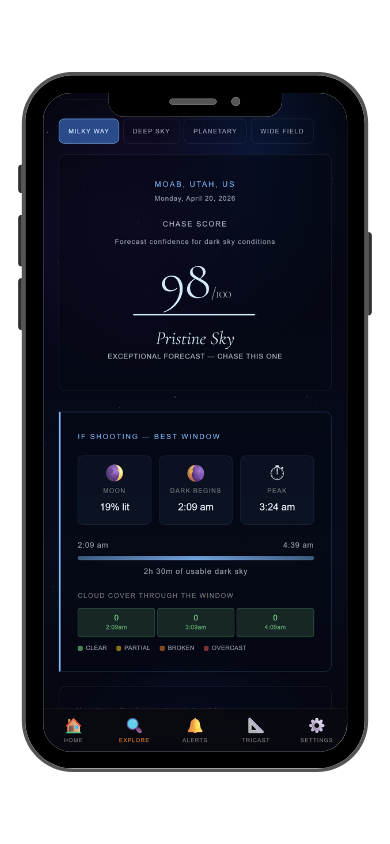
Driving to Acadia or Baxter only to face coastal fog or a cloudy front is a well-known Maine experience. StarCast scores cloud cover, moon phase, atmospheric transparency, and seeing into a single night-sky verdict — updated daily for any location.
StarCast + More
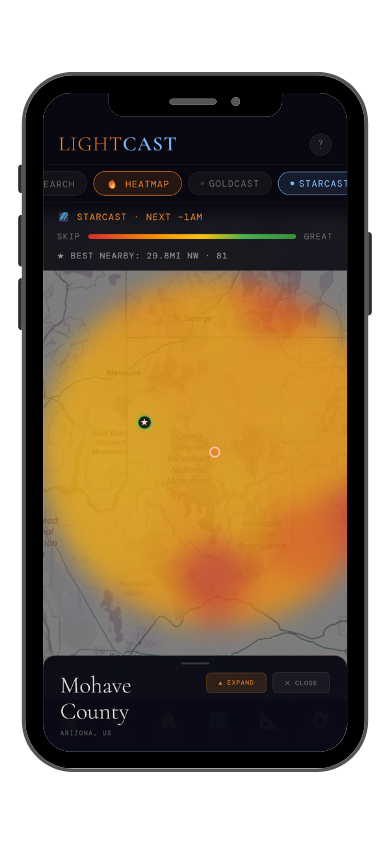
See the sky and the light on one map
Night sky · Nearby Conditions
StarCast scores cloud cover, moon phase, atmospheric transparency, and astronomical seeing. See on a map where skies are clearest before committing to the drive out to Acadia or the north woods.
Get Tonight's Forecast on iPhone
$2.99/mo · 7-day free trial
Learn More →
Frequently asked
Where can I see the Milky Way in Maine?
Acadia National Park is the most accessible option and genuinely excellent. For the darkest skies, Baxter State Park and the North Maine Woods interior reach Bortle 2–3 and are among the best Milky Way sites on the East Coast. Check StarCast for tonight's conditions free on
web, full features in the
iOS app.
What is the darkest sky in Maine?
The interior North Maine Woods, particularly around the Allagash Wilderness Waterway and the remote sections of Aroostook County, holds the darkest accessible sky in the state and rivals much of the rural West. Bortle 2 is achievable in the deep interior under good conditions.
When is the best time for astrophotography in Maine?
The Milky Way core rises above Maine's southern horizon from April through October. September and October offer an excellent balance: the core is still visible, summer humidity has cleared, nights are longer, and fall foliage adds foreground color. Winter gives the longest nights and often excellent transparency, though the galactic core is not visible. New moon windows matter throughout the season.
Can you see the Northern Lights in Maine?
Yes — Maine is one of the best states in the contiguous US for aurora viewing, particularly northern Maine above Bangor. During elevated geomagnetic activity (Kp 4–5+), the aurora can be visible from most of the state. The North Maine Woods and Baxter provide the best combination of darkness and northern sky visibility. StarCast does not currently score aurora probability, but the app's darkness forecasting helps identify nights worth staying out.
What is LightCast StarCast?
StarCast scores night sky conditions using cloud cover, moon phase, atmospheric transparency, and astronomical seeing. GoldCast (same app) handles golden hour timing. Free on web at
lightcastsuite.com/starcast, full features in the
LightCast iOS app — $2.99/month after a 7-day free trial.