Astrophotography locations · Massachusetts
Where to Shoot and What to Know Before You Drive
Massachusetts has some of the densest light pollution in the US along the I-95 and Route 128 corridor surrounding Boston. The Berkshires in the far west and the Quabbin Reservoir region in central MA are the two serious inland dark sky zones, both reaching Bortle 4–5. Cloud cover and atmospheric humidity are the primary constraints year-round — the Northeast coast averages fewer clear nights than most of the country. New moon windows are critical at every Massachusetts site. The payoff for choosing the right night is real: the Berkshires provide mountain terrain with a distinctly different feel from the heavily developed coast.
🏔️
Mount Greylock State Reservation, Berkshire County Bortle 4
At 3,491 feet, Mount Greylock is the highest point in Massachusetts and the crown of the Berkshires. The summit's Veterans War Memorial Tower provides a 360-degree elevated platform above any surrounding terrain interference. The summit road is open seasonally and accessible by car. Light domes from Pittsfield to the south and Adams to the northeast are visible but manageable from the summit. The Hopper, a glacially carved hollow on the western slope, offers dramatic terrain foreground for compositions below treeline. One of the most scenically interesting astrophotography spots in the state.
💧
Quabbin Reservoir, Franklin and Hampshire Counties 4–5
The Quabbin is Massachusetts's largest body of water and one of the largest unprotected public water supplies in the US. The reservoir and surrounding protected watershed form a large dark buffer in central MA, with restricted vehicle access keeping the shoreline largely undeveloped. Enfield Lookout and Windsor Dam overlooks provide open sky over the water. The surrounding protected land blocks much of the suburban glow from Springfield and Worcester. Milky Way core compositions over the water are achievable in summer from the eastern shore access points.
🌊
Monomoy National Wildlife Refuge, Cape Cod 4–5
The tip of Cape Cod and its barrier islands extend south into Nantucket Sound and the Atlantic, providing genuinely dark ocean horizon to the south. Monomoy and the outer cape beaches face south and southeast, meaning the Milky Way core rises directly over dark ocean water in late spring and summer. Light from Chatham and Harwich is present to the north but manageable for southward compositions. Accessible beaches near Stage Harbor or Nauset give similar open southern horizon with easier logistics than the refuge interior.
🌲
Savoy Mountain State Forest, Berkshire County 4
Savoy Mountain State Forest sits at elevation in the northern Berkshires, adjacent to Florida and Monroe State Forests, forming one of the darkest contiguous forest blocks in the state. North Pond provides a lake foreground with minimal surrounding development. The forest's interior roads and clearings give access to open sky with the Hoosac Range terrain blocking some distant light. Shooting here alongside Mount Greylock on a multi-night trip makes the long drive from eastern Massachusetts worthwhile.
🔭
Wachusett Mountain State Reservation, Worcester County 5
Not a dark sky destination, but Wachusett Mountain is the most accessible elevated viewpoint for central Massachusetts residents and gives a wide-open horizon above the surrounding lowland light scatter. The summit at 2,006 feet provides 360-degree views with the Boston metro dome to the east and somewhat cleaner sky to the west. Useful as a relatively short drive from Worcester or Route 495. This is a "better than your backyard" option, not a serious dark-sky site, but the wide horizon and elevation make a real difference over ground-level urban shooting.
Conditions matter as much as location
Check Before You Make the Drive
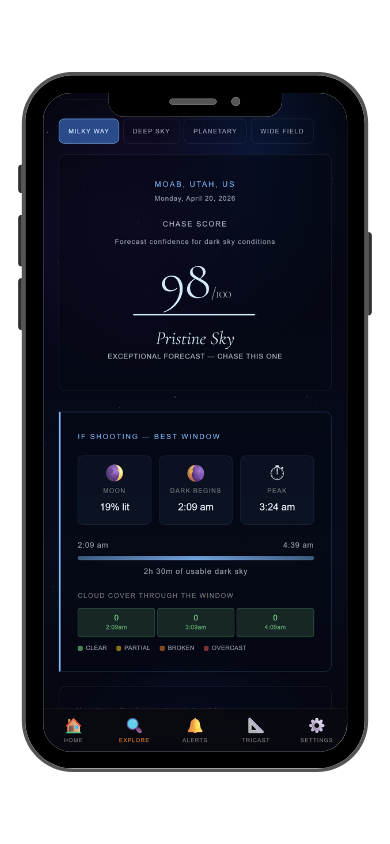
Driving two hours to the Berkshires or Quabbin only to find coastal moisture rolling inland or a high cirrus layer kills the night entirely. StarCast scores cloud cover, moon phase, atmospheric transparency, and seeing into a single night-sky verdict — updated daily for any location.
StarCast + More
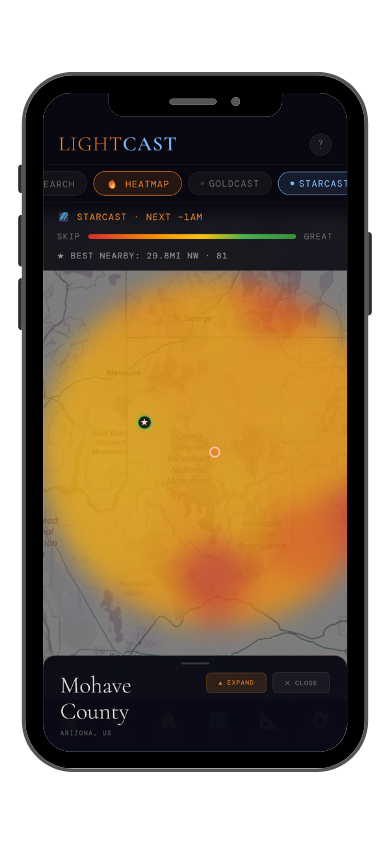
See the sky and the light on one map
Night sky · Nearby Conditions
StarCast scores cloud cover, moon phase, atmospheric transparency, and astronomical seeing. See on a map where skies are clearest before committing to the drive out to Mount Greylock or the Quabbin.
Get Tonight's Forecast on iPhone
$2.99/mo · 7-day free trial
Learn More →
Frequently asked
Where can I see the Milky Way in Massachusetts?
The Berkshires in western Massachusetts are the best in-state option, with Mount Greylock and Savoy Mountain State Forest providing the most accessible dark sky. The Quabbin Reservoir in central MA is closer to Boston and offers a large water foreground. For significantly darker skies, crossing into the Catskills (NY) or Vermont's Northeast Kingdom is worthwhile. Check StarCast free on
web, full features in the
iOS app.
What is the darkest sky in Massachusetts?
The darkest accessible skies in Massachusetts are in Berkshire County, particularly in the northern Berkshires around Savoy Mountain, Monroe, and Florida State Forests. These areas reach Bortle 4 at best. No location in Massachusetts qualifies as Bortle 3 or better due to the density of surrounding metro areas.
When is the best time for astrophotography in Massachusetts?
The Milky Way core is visible from Massachusetts latitudes from roughly late March through October, peaking June–August. New moon windows are essential given the elevated Bortle ratings. September and October tend toward better transparency as humidity drops. Always check atmospheric transparency separately from cloud cover — humid Northeast nights can be technically clear but optically poor.
Does cloud cover matter for astrophotography?
Completely — even thin high cirrus kills deep-sky exposures. Atmospheric transparency matters too, not just cloud-free skies. StarCast scores both cloud cover and transparency separately, so you know whether you're looking at a genuinely good night or just a technically clear one.
What is LightCast StarCast?
StarCast scores night sky conditions using cloud cover, moon phase, atmospheric transparency, and astronomical seeing. GoldCast (same app) handles golden hour timing. Free on web at
lightcastsuite.com/starcast, full features in the
LightCast iOS app — $2.99/month after a 7-day free trial.