Astrophotography locations · Michigan
Where to Shoot and What to Know Before You Drive
Michigan splits cleanly into two very different astrophotography experiences. The Lower Peninsula is compromised by Detroit, Grand Rapids, Lansing, and Flint, with most accessible sites in the Bortle 5–6 range. The Upper Peninsula is a different story: sparse population, dense national forest, and long Great Lakes shorelines produce Bortle 3–4 conditions across much of the region. Lake-effect cloud cover is the dominant constraint — Michigan averages some of the fewest clear nights in the continental US due to proximity to the Great Lakes. When skies do open, the lake horizons, sea stacks, and waterfall foregrounds make for extraordinary images. Michigan also sits at a latitude where the Northern Lights are visible during moderate geomagnetic activity.
🌌
Headlands International Dark Sky Park, Emmet County Bortle 3–4
Headlands is one of only a handful of International Dark Sky Parks in the US and is Michigan's premier designated dark sky site. Located on the northern tip of the Lower Peninsula near Petoskey, the park sits on Lake Michigan with wide northern and western horizons over dark water. The Northern Lights are regularly visible here during active geomagnetic periods. The park has an observation meadow, red-light compliant trails, and a warm building for cold-weather viewing. This is the single most accessible, well-managed dark sky destination in Michigan.
🏔️
Pictured Rocks National Lakeshore, Alger County 3
The sandstone cliffs and sea caves of Pictured Rocks stretch for 42 miles along Lake Superior's southern shore in the central Upper Peninsula. The lake to the north provides a completely dark horizon in that direction, and the surrounding Hiawatha National Forest buffers all other directions. Chapel Rock, Miners Beach, and the sea caves near Munising are iconic foreground subjects. The UP's remoteness means skies here can reach genuine Bortle 3 under good conditions. Winter shooting of the aurora over frozen lake ice is a bucket-list experience.
🌲
Porcupine Mountains Wilderness State Park, Ontonagon County 3
The Porcupine Mountains in Michigan's far western Upper Peninsula represent one of the largest old-growth forest preserves east of the Rockies. Lake of the Clouds, perched in a glacially carved valley, is the park's most photographed subject and delivers stunning foreground for Milky Way arches in summer. Lake Superior's northern horizon extends the dark sky. The park is 6+ hours from Detroit and surrounded by sparsely populated terrain, making it among the most isolated dark sky locations in the Midwest. Superior Dome to the north is consistently aurora-active during geomagnetic storms.
🏖️
Sleeping Bear Dunes National Lakeshore, Benzie and Leelanau Counties 4
The massive perched dunes of Sleeping Bear rise 400 feet above Lake Michigan, giving a sweeping western lake horizon that catches the Milky Way setting over open water in summer. The dune crest at sunset and night offers an elevated platform above any terrain obstructions. Pierce Stocking Scenic Drive overlooks are accessible by car. Some influence from Traverse City to the east, manageable from the western-facing lakeshore. The combination of massive dune scale and lake horizon makes this one of the Lower Peninsula's most distinctive night photography locations.
🌊
Tahquamenon Falls State Park, Chippewa County 3–4
The Upper Tahquamenon Falls — one of the largest waterfalls east of the Mississippi — pour over 50,000 gallons per second in a remote stretch of Michigan's eastern Upper Peninsula. The surrounding boreal forest and proximity to Lake Superior give genuinely dark overhead sky. The falls themselves make for unusual long-exposure foreground with the amber tannin-stained water glowing under star trails. The eastern UP around Paradise and Newberry is remote enough that skies are competitive with anywhere in the Midwest.
Conditions matter as much as location
Check Before You Make the Drive
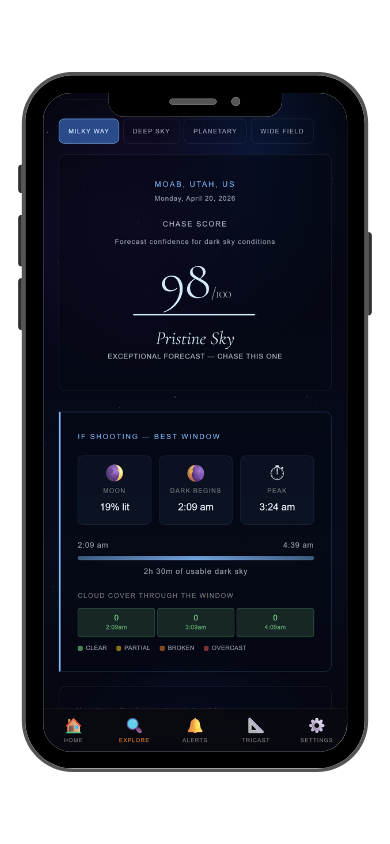
Michigan's lake-effect cloud system means a clear forecast can dissolve quickly after a cold front passes over Lake Superior or Lake Michigan. StarCast scores cloud cover, moon phase, atmospheric transparency, and seeing into a single night-sky verdict — updated daily for any location.
StarCast + More
See the sky and the light on one map
Night sky · Nearby Conditions
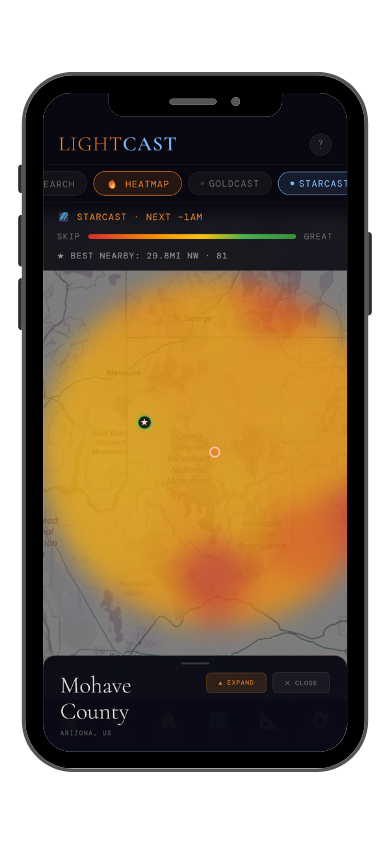
StarCast scores cloud cover, moon phase, atmospheric transparency, and astronomical seeing. See on a map where skies are clearest before committing to the drive up to Pictured Rocks or the Porcupine Mountains.
Get Tonight's Forecast on iPhone
$2.99/mo · 7-day free trial
Learn More →
Frequently asked
Where can I see the Milky Way in Michigan?
The Upper Peninsula is Michigan's best Milky Way region, with Pictured Rocks, Porcupine Mountains, and Tahquamenon Falls all offering Bortle 3 conditions. In the Lower Peninsula, Headlands International Dark Sky Park is the standout destination. Check StarCast for tonight's conditions free on
web, full features in the
iOS app.
Can you see the Northern Lights in Michigan?
Yes — Michigan, particularly the Upper Peninsula, is one of the best states in the contiguous US for aurora viewing. During elevated geomagnetic activity (Kp 4–5+), the aurora is visible across the UP and from dark northern Lower Peninsula sites like Headlands. Kp 7+ events can produce visible aurora as far south as Detroit.
When is the best time for astrophotography in Michigan?
The Milky Way core is visible from Michigan latitudes from roughly April through October, peaking in July. Late summer and early fall offer a good combination of core visibility and lower cloud frequency after summer storms ease. Winter gives the longest nights and aurora opportunities but no galactic core. Lake-effect clouds make spring the least reliable season.
Does cloud cover matter for astrophotography?
Completely — even thin high cirrus kills deep-sky exposures. Atmospheric transparency matters too, not just cloud-free skies. StarCast scores both cloud cover and transparency separately, so you know whether you're looking at a genuinely good night or just a technically clear one.
What is LightCast StarCast?
StarCast scores night sky conditions using cloud cover, moon phase, atmospheric transparency, and astronomical seeing. GoldCast (same app) handles golden hour timing. Free on web at
lightcastsuite.com/starcast, full features in the
LightCast iOS app — $2.99/month after a 7-day free trial.