Astrophotography locations · Minnesota
Where to Shoot and What to Know Before You Drive
Minnesota is anchored in the south by the Minneapolis-St. Paul metro, which produces a significant skyglow dome visible for 100+ miles. North of the Twin Cities, darkness improves steadily as population thins. The Boundary Waters and Voyageurs regions in the far north reach genuine Bortle 2–3 under good conditions, competing with some western states. Cold temperatures and cloud frequency are the practical constraints in the north — Minnesota's interior can hit -30°F in winter, and battery and gear performance degrade rapidly. Summer and early fall combine the best balance of reasonable temperatures, Milky Way visibility, and aurora season. The northern latitude puts Minnesota among the top US states for aurora photography.
🛶
Boundary Waters Canoe Area Wilderness, Cook and Lake Counties Bortle 2–3
The BWCAW is one of the most pristine dark sky wilderness areas east of the Rocky Mountains. Over a million acres of boreal forest and more than a thousand lakes sit in the northern Superior National Forest with no roads, no motorized vehicles, and no artificial light. Entry requires a permit and a canoe, but the reward is Bortle 2 sky reflected in still lake water — a night sky experience unlike almost anything else accessible in the eastern US. Summer nights are short this far north, but the Milky Way and aurora both shine. Plan for mosquitoes in June and July.
🌊
Voyageurs National Park, St. Louis and Koochiching Counties 2–3
Voyageurs is a water-based national park on the Canadian border where the only access to most areas is by boat. The large interconnected lake system — Rainy Lake, Kabetogama Lake, Namakan Lake — gives enormous reflective surfaces under open sky. The park sits at 48° north latitude, high enough that the Northern Lights are visible several times per year. The Rainy Lake Visitor Center area has dock access for sunset-to-dawn sessions. No road-accessible campsites exist in most of the park, which is precisely why the skies are so good.
🏔️
Lake Superior North Shore: Tettegouche and Temperance River State Parks, Lake County 3–4
The Minnesota North Shore of Lake Superior combines dark sky with dramatic basalt cliffs, cobble beaches, and waterfalls. Tettegouche State Park's Shovel Point and Bean and Bear Lakes give elevated viewpoints over dark lake horizons. Temperance River's rocky mouth is one of the most photographed foregrounds on the shore. The lake's northern horizon is completely dark. Some glow from Duluth to the southwest, manageable from sites north of Two Harbors. The North Shore is among the most accessible dark sky areas within a few hours of the Twin Cities.
🌲
Itasca State Park, Clearwater County 3–4
Minnesota's oldest state park, home to the headwaters of the Mississippi River, sits in a large forested block in north-central Minnesota far from major population centers. The old-growth pine stands and Lake Itasca's calm surface provide classic foreground material. The park has a dedicated dark sky observation program and has taken steps to reduce artificial lighting. Bemidji to the east produces some glow, but the forest and distance keep conditions usable. A reasonable option for central Minnesota residents who want to avoid the long drive to the northeast.
🌙
Iron Range: Side Lake and Sturgeon Lake areas, St. Louis County 3
The Iron Range's abandoned mining pits, boreal lake country, and sparse population create an accessible dark sky corridor between Duluth and the BWCAW. The area around Side Lake, Sturgeon Lake, and Crane Lake offers quiet, lake-dotted terrain without the permit requirements of the Boundary Waters. This is a practical option for photographers who want BWCAW-quality sky without the multi-day canoe commitment. The Vermilion Trail and Echo Trail corridors give good road access to launch points for lake-edge shooting.
Conditions matter as much as location
Check Before You Make the Drive
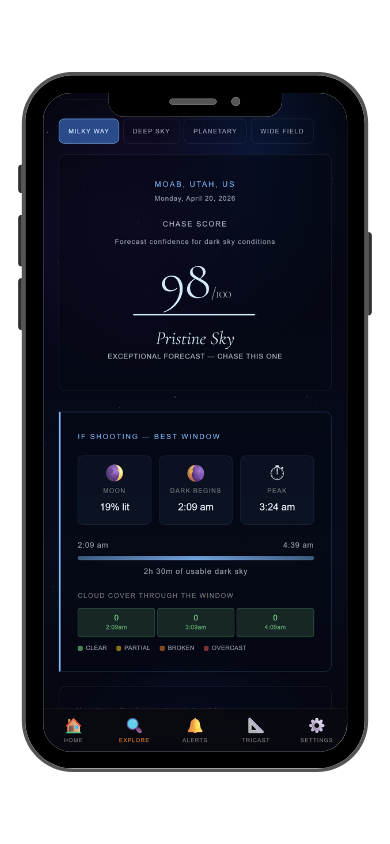
Driving four hours north to the BWCAW only to find a cloud band parked over the border lakes is a real risk. StarCast scores cloud cover, moon phase, atmospheric transparency, and seeing into a single night-sky verdict — updated daily for any location.
StarCast + More
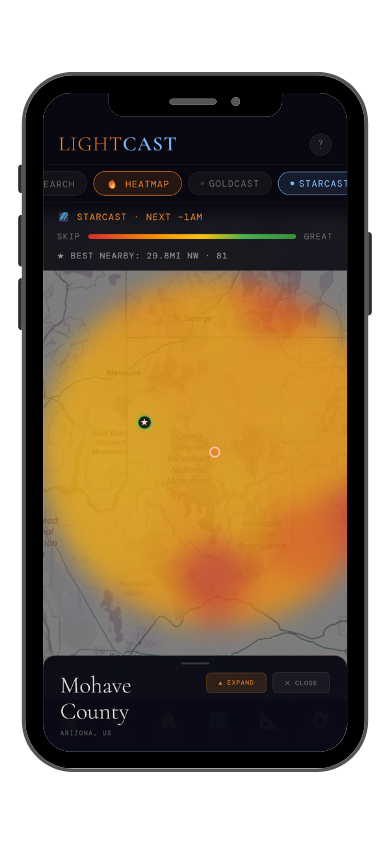
See the sky and the light on one map
Night sky · Nearby Conditions
StarCast scores cloud cover, moon phase, atmospheric transparency, and astronomical seeing. See on a map where skies are clearest before committing to the drive up to Voyageurs or the North Shore.
Get Tonight's Forecast on iPhone
$2.99/mo · 7-day free trial
Learn More →
Frequently asked
Where can I see the Milky Way in Minnesota?
The Boundary Waters Canoe Area Wilderness and Voyageurs National Park are Minnesota's best Milky Way destinations, with Bortle 2–3 skies over lake country. The North Shore and Itasca State Park are more accessible alternatives with solid Bortle 3–4 conditions. Check StarCast free on
web, full features in the
iOS app.
Can you see the Northern Lights in Minnesota?
Yes — northern Minnesota is one of the best places in the contiguous US to see the aurora borealis. At 48° north latitude, Voyageurs and the BWCAW see significant aurora activity several times per year. Even the Twin Cities can see strong displays during major geomagnetic storms. The Iron Range and North Shore are ideal viewing corridors for Kp 4+ events.
When is the best time for astrophotography in Minnesota?
July and August offer the best combination of Milky Way visibility and manageable temperatures. The galactic core is visible from April through October. September and October provide excellent transparency and fewer insects with the core still low in the south. Winter gives the longest nights and excellent aurora opportunities, but extreme cold requires serious gear preparation.
Does cloud cover matter for astrophotography?
Completely — even thin high cirrus kills deep-sky exposures. Atmospheric transparency matters too, not just cloud-free skies. StarCast scores both cloud cover and transparency separately, so you know whether you're looking at a genuinely good night or just a technically clear one.
What is LightCast StarCast?
StarCast scores night sky conditions using cloud cover, moon phase, atmospheric transparency, and astronomical seeing. GoldCast (same app) handles golden hour timing. Free on web at
lightcastsuite.com/starcast, full features in the
LightCast iOS app — $2.99/month after a 7-day free trial.