Astrophotography locations · Mississippi
Where to Shoot and What to Know Before You Drive
Mississippi's main light domes are Jackson in the center, Memphis across the northern border, and the Biloxi-Gulfport metro along the coast. The rural interior — particularly the northeastern hill country and the national forests in the south — holds surprisingly usable darkness. Humidity and cloud cover are the dominant year-round constraints. Mississippi averages high summer cloud frequency and persistent atmospheric moisture that degrades transparency even on nominally clear nights. Fall and winter offer the best conditions. Mosquitoes are a practical consideration from April through October, particularly near wetlands and coastal areas.
🪨
Tishomingo State Park, Tishomingo County Bortle 3–4
Tucked into the extreme northeastern corner of Mississippi where the state meets Alabama and Tennessee, Tishomingo is one of the most geologically unusual parks in the Deep South. Massive Appalachian foothills boulders and rocky outcrops rise above Bear Creek, creating foreground unlike anything else in the state. The surrounding rural terrain is among the least light-polluted in Mississippi, with Memphis glow present to the north but relatively distant. The park's interior gives open sky above the ridgelines. Fall and winter, when deciduous trees lose their canopy, significantly improve horizon access.
🌲
Homochitto National Forest, Franklin and Adams Counties 3–4
This 189,000-acre national forest in the loess hills of southwestern Mississippi sits far from major population centers and holds some of the darker skies in the southern half of the state. The Pipes Lake Recreation Area provides open water foreground. The surrounding counties are among the least densely populated in Mississippi, and the nearest significant light dome is Natchez to the southwest. Old growth longleaf pine areas open the canopy enough for wide foreground compositions. Fall is the optimal season for transparency and insect management.
🌊
Gulf Islands National Seashore, Harrison County 4–5
The barrier islands of Mississippi Sound — Ship Island, Horn Island, and Petit Bois Island — provide genuine ocean horizon to the south and west with no developed land in those directions. Access to the outer islands requires a ferry or private boat, but the reward is open Gulf horizon under a wide sky. The Davis Bayou mainland section near Ocean Springs is more accessible and provides marsh and estuary foreground with a southern horizon. Biloxi and Gulfport produce glow to the west; positioning to face south and east provides cleaner sky.
🌿
Bienville National Forest, Scott and Smith Counties 4
Located in central Mississippi between Jackson and Meridian, Bienville National Forest provides a dark buffer in an otherwise moderately compromised region. The Shongelo Recreation Area and Marathon Lake give water-foreground options within the forest. While the Jackson dome to the west is always present, the forest's interior roads put enough tree screen between the shooter and surrounding scatter to make meaningful improvements over open suburban land. This is the best option for Jackson-area residents looking for a practical nearby alternative.
🏞️
Natchez Trace Parkway, rural sections between Kosciusko and Tupelo 3–4
The Natchez Trace Parkway runs 444 miles through rural Mississippi, Tennessee, and Alabama with no commercial development along its corridor. The central Mississippi sections between Kosciusko and Tupelo pass through some of the most rural terrain in the state, with parkway pullouts giving open meadow foregrounds away from tree cover. The absence of roadside lighting along the entire parkway is an unusual advantage. Mid-week visits minimize vehicle traffic, and the wide preserved corridor buffers surrounding agricultural light scatter.
Conditions matter as much as location
Check Before You Make the Drive
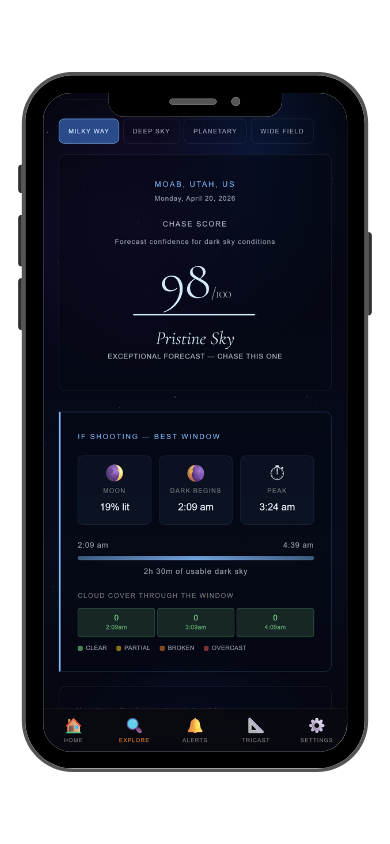
Driving into the Mississippi forest only to face a haze layer that the forecast called "clear" is a common Southern experience. StarCast scores cloud cover, moon phase, atmospheric transparency, and seeing into a single night-sky verdict — updated daily for any location.
StarCast + More
See the sky and the light on one map
Night sky · Nearby Conditions
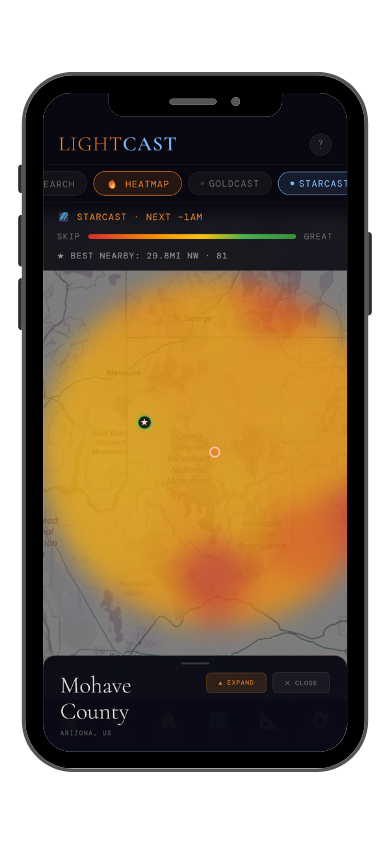
StarCast scores cloud cover, moon phase, atmospheric transparency, and astronomical seeing. See on a map where skies are clearest before committing to the drive out to Tishomingo or Homochitto.
Get Tonight's Forecast on iPhone
$2.99/mo · 7-day free trial
Learn More →
Frequently asked
Where can I see the Milky Way in Mississippi?
Tishomingo State Park in the far northeast and Homochitto National Forest in the southwest hold the state's best dark sky. Rural sections of the Natchez Trace Parkway also provide workable conditions. Check StarCast for tonight's conditions free on
web, full features in the
iOS app.
What is the darkest sky in Mississippi?
The darkest accessible skies in Mississippi are in the extreme northeastern hill country around Tishomingo County, and in the rural southwestern parishes near Homochitto National Forest. These areas reach Bortle 3–4 under good conditions, though humidity regularly degrades effective transparency below what light pollution maps suggest.
When is the best time for astrophotography in Mississippi?
November through February offers the best atmospheric transparency in Mississippi as humidity drops and summer cloud frequency clears. The Milky Way core is not visible in winter, so photographers targeting the galactic center should plan for April through August new moon windows while accepting worse transparency. Fall is the best season for combining reasonable Milky Way visibility with lower humidity.
Does cloud cover matter for astrophotography?
Completely — even thin high cirrus kills deep-sky exposures. Atmospheric transparency matters too, not just cloud-free skies. StarCast scores both cloud cover and transparency separately, so you know whether you're looking at a genuinely good night or just a technically clear one.
What is LightCast StarCast?
StarCast scores night sky conditions using cloud cover, moon phase, atmospheric transparency, and astronomical seeing. GoldCast (same app) handles golden hour timing. Free on web at
lightcastsuite.com/starcast, full features in the
LightCast iOS app — $2.99/month after a 7-day free trial.