Astrophotography locations · Missouri
Where to Shoot and What to Know Before You Drive
Missouri's light pollution concentrates in St. Louis to the east and Kansas City to the west, with Springfield generating a central dome. The Ozark Highlands between these cities — particularly Shannon, Carter, and Reynolds counties — contain some of the darkest accessible land in the Midwest. Cloud cover and summer humidity are the main constraints; Missouri averages high summer storm frequency and persistent atmospheric moisture. Fall offers a strong window: humidity drops, cloud frequency decreases, and the Milky Way core remains low in the southwest through October. The Ozarks terrain — clear spring-fed rivers, dolomite glades, cedar and oak ridges — makes night photography here genuinely distinctive.
🏞️
Ozark National Scenic Riverways, Shannon and Carter Counties Bortle 3
The Current River and Jacks Fork River corridors form the first national riverway in the US, protecting nearly 135 miles of clear Ozark spring-fed streams through the darkest counties in Missouri. The river surface reflects starlight cleanly, and the surrounding bluffs and gravel bars give an enormous variety of foreground compositions. Eminence, Van Buren, and Alley Spring are good base areas. Shannon and Carter counties are among the least light-polluted counties in the entire eastern US. Milky Way core over the Current River in summer is a classic Missouri shot.
🌲
Mark Twain National Forest: Irish Wilderness, Oregon County 3
The Irish Wilderness in the southern Missouri Ozarks is one of the few designated wilderness areas in Missouri's national forest system. The terrain is remote even by Ozark standards, with Oregon County consistently ranking among the darkest counties in the state. The Big Sugar Creek and Eleven Point River corridor nearby adds excellent water foreground. The Eleven Point National Scenic River segment through Oregon County combines dark sky with the Ozarks' distinctive dolomite-clear spring streams. This is a multi-day destination for serious astrophotographers.
💧
Bennett Spring State Park, Dallas County 3–4
Bennett Spring is one of Missouri's largest springs, pumping over 100 million gallons of crystal-clear water daily into a wide pool that reflects sky beautifully. The park sits in a rural stretch of the Niangua River valley in the western Ozarks, far enough from Springfield and Lebanon to maintain good darkness. The blue-tinged spring water and wooded valley walls make for a distinctive foreground. Dallas County as a whole is relatively dark, and the park's overnight camping gives all-night access to the spring pool.
🌄
Ha Ha Tonka State Park, Camden County 4
Ha Ha Tonka combines ruined castle remnants atop a dolomite bluff overlooking the Lake of the Ozarks with a complex of springs, sinkholes, and natural bridges below. The ruins against a star-filled sky are among the most compositionally unusual astrophotography subjects in Missouri. The park sits in the Lake of the Ozarks region, which has moderate but manageable light pollution from the resort corridor. The castle overlook faces west and south, providing access to the Milky Way core in summer. Visit mid-week for minimum light interference from dock lights across the lake.
🏔️
Taum Sauk Mountain State Park, Iron County 3
At 1,772 feet, Taum Sauk Mountain is the highest point in Missouri, sitting in the St. Francois Mountains in the eastern Ozarks. The summit gives an elevated viewpoint with relatively open sky, and Mina Sauk Falls — the tallest waterfall in Missouri — tumbles nearby. Iron County is one of the darkest counties in the state, sitting well away from the St. Louis metro despite being under two hours from the city. The exposed rhyolite glades near the summit create distinctive open foreground above treeline.
Conditions matter as much as location
Check Before You Make the Drive
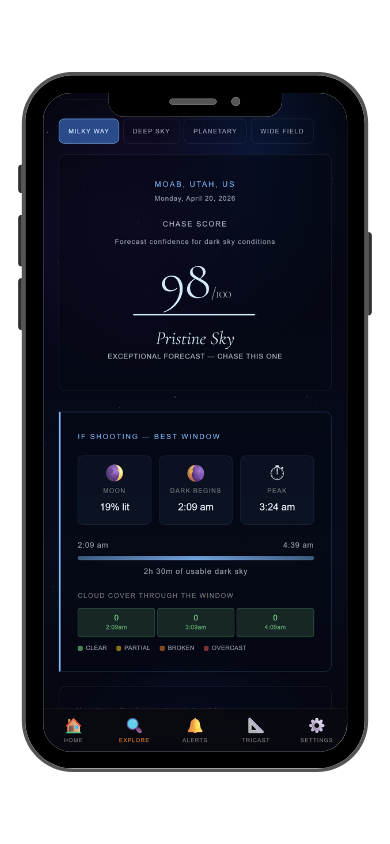
Driving into the Ozarks only to find a summer storm system rolling up from Arkansas or a haze layer pinned over the river valleys is a familiar Missouri frustration. StarCast scores cloud cover, moon phase, atmospheric transparency, and seeing into a single night-sky verdict — updated daily for any location.
StarCast + More
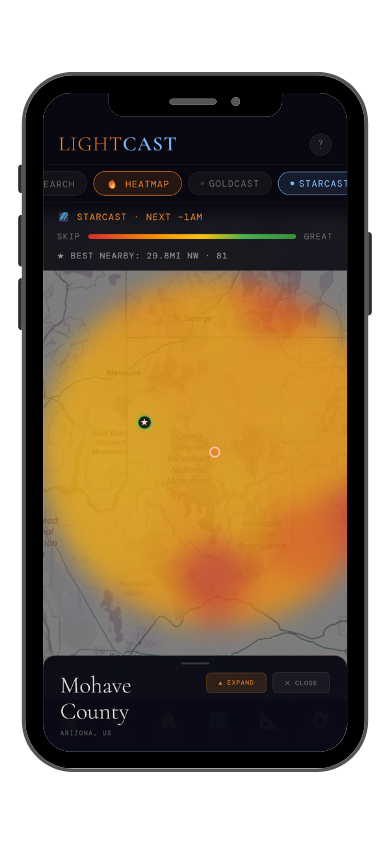
See the sky and the light on one map
Night sky · Nearby Conditions
StarCast scores cloud cover, moon phase, atmospheric transparency, and astronomical seeing. See on a map where skies are clearest before committing to the drive out to the Current River or the Irish Wilderness.
Get Tonight's Forecast on iPhone
$2.99/mo · 7-day free trial
Learn More →
Frequently asked
Where can I see the Milky Way in Missouri?
The Ozark National Scenic Riverways in Shannon and Carter counties, and the Irish Wilderness in Oregon County, are Missouri's best Milky Way destinations with genuine Bortle 3 skies. Bennett Spring and Taum Sauk are strong second options. Check StarCast free on
web, full features in the
iOS app.
What is the darkest sky in Missouri?
Shannon, Carter, and Oregon counties in the southern Missouri Ozarks consistently rank among the least light-polluted counties in the entire eastern US. The area around Eminence and Van Buren can reach Bortle 3 under good conditions, with the Milky Way casting faint shadows and the galactic core showing clear color and structure.
When is the best time for astrophotography in Missouri?
The Milky Way core is well-placed from April through October at Missouri latitudes. September and October offer the best balance of core visibility, lower humidity, and falling cloud frequency after summer storm season. Spring can be excellent when fronts push through and clear the air temporarily, though storm risk is elevated. New moon windows matter throughout the season.
Does cloud cover matter for astrophotography?
Completely — even thin high cirrus kills deep-sky exposures. Atmospheric transparency matters too, not just cloud-free skies. StarCast scores both cloud cover and transparency separately, so you know whether you're looking at a genuinely good night or just a technically clear one.
What is LightCast StarCast?
StarCast scores night sky conditions using cloud cover, moon phase, atmospheric transparency, and astronomical seeing. GoldCast (same app) handles golden hour timing. Free on web at
lightcastsuite.com/starcast, full features in the
LightCast iOS app — $2.99/month after a 7-day free trial.