Astrophotography locations · Montana
Where to Shoot and What to Know Before You Drive
Montana's astrophotography reputation is well-earned. The state has the second-largest total Bortle 1 dark sky area in the continental US, concentrated across the central and eastern high plains where population density drops to near zero. Even the more developed western mountain valleys regularly achieve Bortle 3–4, with Glacier National Park holding some of the best dark sky within a national park in the country. Weather and seasonal access are the main constraints — Montana's high elevations and interior location mean dramatic and fast-moving weather systems. Mountain roads close in winter, and summer afternoons can build afternoon thunderstorms rapidly. The transparency and altitude, when conditions align, produce astrophotography results difficult to replicate anywhere east of the Rockies.
🏔️
Glacier National Park, Flathead and Glacier Counties Bortle 2–3
Glacier is one of the top astrophotography national parks in the country. The park sits at the US-Canada border in the northern Rockies, surrounded by wilderness and national forest with virtually no urban glow in any direction. Many Glacier, Two Medicine, and Lake McDonald give glacially carved lake foregrounds under peak-studded ridgelines. The Going-to-the-Sun Road summit area at Logan Pass is exceptional when accessible. Designated as a Crown of the Continent Dark Sky Reserve, the park actively protects its night sky. August gives the best combination of accessibility, Milky Way positioning, and mountain wildflowers for foreground.
🌾
Missouri River Breaks, Chouteau and Phillips Counties 1–2
The Upper Missouri River Breaks National Monument protects 149 miles of the wild Missouri River through deeply eroded badlands in north-central Montana. This is one of the darkest accessible landscapes in the contiguous United States, with Bortle 1 skies across much of the monument on good nights. The river canyon walls, eroded white rock formations, and cottonwood-lined banks provide dramatic foreground under a sky that can show the Andromeda Galaxy naked-eye and cast faint Milky Way shadows. Access via dirt roads from Winifred or the Fred Robinson Bridge. High-clearance recommended.
🌄
Bighorn Canyon National Recreation Area, Big Horn County 2
Bighorn Canyon slices 2,000 feet through the Pryor Mountains in southern Montana, creating one of the most dramatic canyon landscapes in the northern Rockies. The Ok-A-Beh Marina area and the canyon rim above give perspectives over the reservoir far below. Big Horn County is among the least light-polluted counties in the state, with the nearest city glow (Billings) weak and distant to the northwest. Summer Milky Way arching over the canyon is extraordinary. The Pryor Mountains Wild Horse Range nearby adds an unusual foreground subject possibility with Montana's famous wild horse bands.
🦌
Charles M. Russell National Wildlife Refuge, Phillips County 1–2
This 1.1-million-acre refuge surrounding Fort Peck Reservoir is one of the largest national wildlife refuges in the lower 48 and holds some of the most remote and darkest land in Montana. The Fort Peck Dam impounds a reservoir 134 miles long, giving an enormous open water foreground under pristine dark sky. Malta and Glasgow to the north produce negligible light. The southern shore dirt roads give access to undeveloped shoreline with the reservoir extending west. Milky Way reflections on the flat water surface here rival anything in the state.
🌙
Beartooth Plateau, Carbon County 2
The Beartooth Highway climbs to 10,947 feet at Beartooth Pass on the Montana-Wyoming border, giving access to a high alpine plateau of glacial lakes, tundra, and 360-degree mountain panoramas under some of the darkest sky in the northern Rockies. The plateau sits above most atmospheric moisture, giving exceptional transparency and seeing. Rock Creek valley and the Twin Lakes area provide alpine lake foregrounds at elevation. The highway is only open from late May through early October; conditions close quickly in early fall. This is among the most spectacular high-altitude astrophotography sites accessible by road anywhere in the US.
Conditions matter as much as location
Check Before You Make the Drive
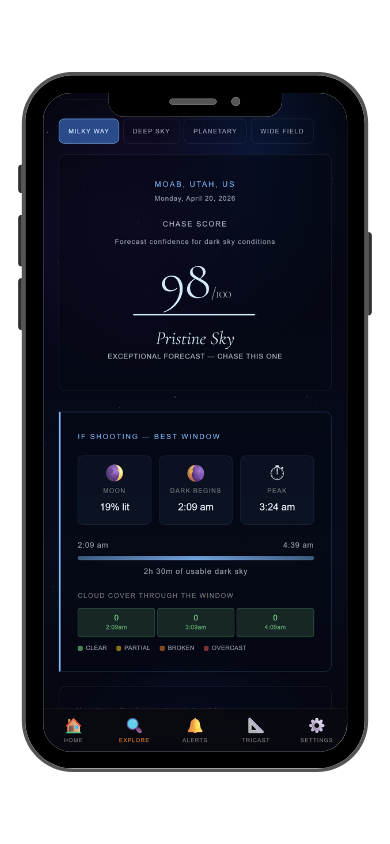
Montana's weather can change dramatically in under an hour, and a clear afternoon does not guarantee a clear night at elevation. StarCast scores cloud cover, moon phase, atmospheric transparency, and seeing into a single night-sky verdict — updated daily for any location.
StarCast + More
See the sky and the light on one map
Night sky · Nearby Conditions
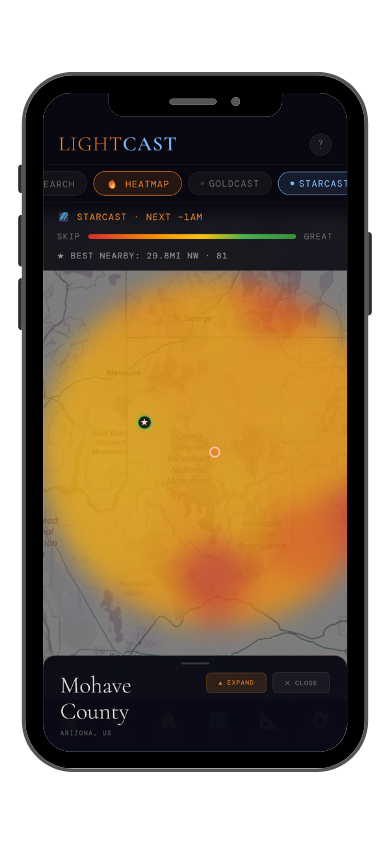
StarCast scores cloud cover, moon phase, atmospheric transparency, and astronomical seeing. See on a map where skies are clearest before committing to the drive out to Glacier or the Missouri Breaks.
Get Tonight's Forecast on iPhone
$2.99/mo · 7-day free trial
Learn More →
Frequently asked
Where can I see the Milky Way in Montana?
Virtually the entire state offers excellent Milky Way viewing, but the Missouri River Breaks, Charles M. Russell National Wildlife Refuge, and Bighorn Canyon reach Bortle 1–2. Glacier National Park is the most visited and still delivers exceptional dark sky. Check StarCast free on
web, full features in the
iOS app.
What is the darkest sky in Montana?
The central and eastern Montana high plains, particularly Phillips, Petroleum, and Garfield counties, hold some of the largest contiguous Bortle 1 dark sky zones in the contiguous United States. On moonless nights with good transparency, the Milky Way is bright enough to cast shadows and show color to the naked eye.
When is the best time for astrophotography in Montana?
July and August offer the best combination of Milky Way core positioning, mountain road access, and reasonable temperatures. The galactic core is visible from April through October. September is excellent in the eastern plains — the core is still up, humidity is low, and summer storm frequency has dropped. High alpine sites like Beartooth are only accessible May through September.
Can you see the Northern Lights in Montana?
Yes — Montana at 45–49° north latitude is well-positioned for aurora viewing during moderate to strong geomagnetic events. Northern Montana near Glacier National Park and the Hi-Line corridor sees the most frequent activity. Kp 4–5 events produce visible aurora from most of the state. The combination of aurora and mountain terrain makes Montana one of the top aurora destinations in the lower 48.
What is LightCast StarCast?
StarCast scores night sky conditions using cloud cover, moon phase, atmospheric transparency, and astronomical seeing. GoldCast (same app) handles golden hour timing. Free on web at
lightcastsuite.com/starcast, full features in the
LightCast iOS app — $2.99/month after a 7-day free trial.