Astrophotography locations · Nebraska
Where to Shoot and What to Know Before You Drive
Nebraska is one of the most underappreciated astrophotography states in the US. Omaha and Lincoln anchor the east, but western Nebraska is genuinely dark, and the Sandhills region in the north-central part of the state reaches Bortle 2 across thousands of square miles. Wind is the primary practical constraint — the Great Plains consistently produce 15–25 mph winds that require a heavy tripod and short exposures. Spring storm season brings risk from April through June. The summer months offer the best combination of Milky Way positioning, reasonable temperatures, and accessible roads. The state's flat terrain gives wide-open foregrounds that let the full arch of the Milky Way dominate compositions.
🌾
Nebraska Sandhills: Cherry and Grant Counties Bortle 2
The Nebraska Sandhills is the largest sand dune formation in the Western Hemisphere, covering about 19,300 square miles of north-central Nebraska with stabilized grass-covered dunes, interdunal lakes, and vast open sky. Cherry County alone is larger than Connecticut and contains almost no significant light sources. The Milky Way here is bright enough to see airglow and zodiacal light on good nights. Lakes like Pelican Lake and the numerous unnamed interdunal ponds provide reflective foreground. Valentine serves as a good base; any county road heading away from town quickly reaches world-class dark sky.
🏛️
Chimney Rock National Historic Site, Morrill County 2–3
Chimney Rock is one of the most iconic geological landmarks on the Oregon Trail, rising 325 feet above the North Platte River valley in western Nebraska. The distinctive spire silhouette against the Milky Way is one of the most compelling astrophotography compositions in the state. Morrill County is exceptionally dark, with Scottsbluff and Gering producing modest glow to the northwest. The surrounding flat plains give an unobstructed 270-degree horizon. Access roads around the base allow close and distant compositions of the formation.
🦕
Toadstool Geologic Park, Dawes County 2
Toadstool is a badlands formation of mushroom-shaped pedestal rocks and eroded clay buttes in the remote northwestern Nebraska panhandle. The formations photograph like a miniature Badlands, and the surrounding Oglala National Grassland extends the dark horizon in all directions. Dawes County is one of the darkest counties in the state, with no significant light sources for 50+ miles in most directions. The remote access road (NE-2 west of Crawford) keeps visitor numbers low. Mid-week summer nights here can feel as remote as anywhere in the Great Plains.
💧
Valentine National Wildlife Refuge, Cherry County 2
Located in the heart of the Sandhills south of Valentine, this refuge protects a mosaic of interdunal wetlands, prairie potholes, and subirrigated meadows. The numerous small lakes reflect the galactic core clearly in summer, and the surrounding grassland extends flat horizon in all directions. Night sky here is consistently among the best in the state. The refuge's interior roads give access far from any road-based light. This is the most accessible combination of Sandhills dark sky and quality water foreground in Nebraska.
🌄
Scotts Bluff National Monument, Scotts Bluff County 3
The sandstone and volcanic ash bluffs of Scotts Bluff rise 800 feet above the North Platte River valley, providing an elevated platform over the surrounding dark plains. Summit Road gives car access to the top, where the wide southern and eastern horizon is clean and unobstructed. Scottsbluff city glow is present to the northeast but manageable from the summit's southern faces. The Milky Way arch over the badlands terrain below makes for a strong compositional anchor. Combine with Chimney Rock on a western Nebraska night trip for a compelling two-site session.
Conditions matter as much as location
Check Before You Make the Drive
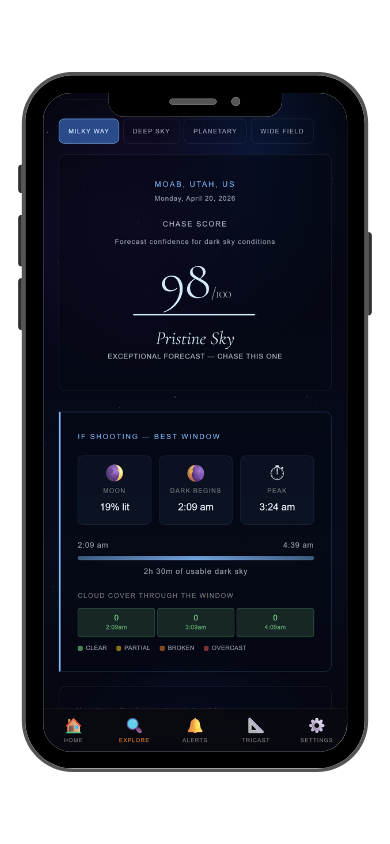
Driving into the Sandhills only to face a sustained 30 mph wind advisory or a spring storm line is a real possibility in Nebraska. StarCast scores cloud cover, moon phase, atmospheric transparency, and seeing into a single night-sky verdict — updated daily for any location.
StarCast + More
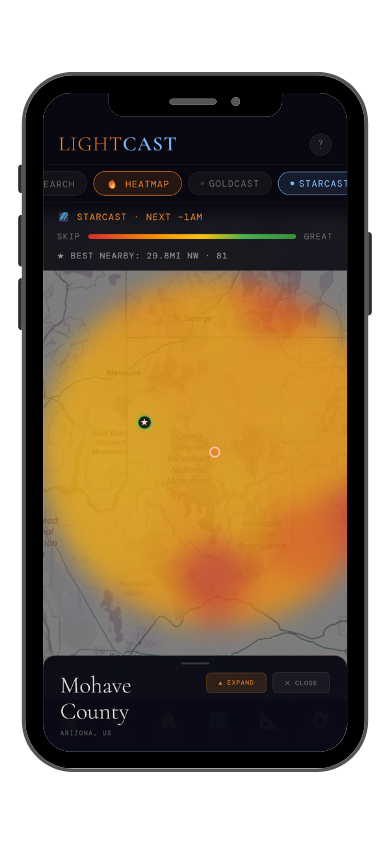
See the sky and the light on one map
Night sky · Nearby Conditions
StarCast scores cloud cover, moon phase, atmospheric transparency, and astronomical seeing. See on a map where skies are clearest before committing to the drive out to the Sandhills or Chimney Rock.
Get Tonight's Forecast on iPhone
$2.99/mo · 7-day free trial
Learn More →
Frequently asked
Where can I see the Milky Way in Nebraska?
The Nebraska Sandhills in Cherry and Grant counties offer Bortle 2 skies over some of the most open terrain in the US. Toadstool Geologic Park and Chimney Rock in the panhandle are excellent for geological foreground. Any rural area west of North Platte is a significant improvement over eastern Nebraska. Check StarCast free on
web, full features in the
iOS app.
What is the darkest sky in Nebraska?
Cherry County in the Sandhills consistently ranks among the darkest counties in the United States. The combination of low population density, no major towns for 60+ miles in any direction, and flat prairie giving full horizon access makes this Bortle 2 territory on good nights, with zodiacal light and airglow visible to the naked eye.
When is the best time for astrophotography in Nebraska?
July and August provide the best Milky Way positioning at Nebraska latitudes, with the core high in the south and nights warm enough for extended sessions. Spring (April through June) brings storm risk. September is excellent — the core is still visible, storm frequency drops, and temperatures are comfortable. New moon windows matter most in eastern Nebraska; western sites are productive even with a quarter moon.
Does wind affect astrophotography in Nebraska?
Yes, significantly. Nebraska's exposed plains and Sandhills terrain channel persistent wind, often 15–30 mph. A heavy tripod and sandbag or hanging counterweight are recommended. Shooting during the few hours around local midnight when surface winds often calm slightly can help. StarCast does not score wind, but your local forecast should always be checked alongside the sky quality score.
What is LightCast StarCast?
StarCast scores night sky conditions using cloud cover, moon phase, atmospheric transparency, and astronomical seeing. GoldCast (same app) handles golden hour timing. Free on web at
lightcastsuite.com/starcast, full features in the
LightCast iOS app — $2.99/month after a 7-day free trial.