Astrophotography locations · Nevada
Where to Shoot and What to Know Before You Drive
Nevada is the most sparsely populated state in the contiguous US by area and contains more mountain ranges than any other state outside Alaska. The result is an almost continuous sheet of dark sky interrupted only by the Las Vegas valley and the Reno-Sparks metro in the northwest. The empty quarter of central Nevada along US-93 and US-50 — dubbed "the Loneliest Road in America" — holds Bortle 1 sky for hundreds of miles. Heat, remote distances, and washboard dirt roads are the primary field constraints in summer. Carry extra water and verify fuel range before driving to remote sites. Monsoon moisture can push into southern Nevada in July and August, bringing surprise clouds and humidity. Spring and fall offer the most reliable conditions across the state.
🏔️
Great Basin National Park, White Pine County Bortle 1–2
Great Basin is one of the premier dark sky national parks in the country and holds an International Dark Sky Park designation. Wheeler Peak rises to 13,063 feet at the edge of the Snake Range, and the combination of high elevation, extreme remoteness, and complete absence of nearby urban areas produces Bortle 1 sky on good nights. The Wheeler Peak Scenic Drive gives car access to 10,000 feet, where ancient bristlecone pines provide foreground under a sky that shows the full galactic core in color with the naked eye. Baker, Nevada (pop. ~70) is the nearest town. This is the most dramatically dark accessible national park site east of the Great Basin's deepest interior.
🌋
Valley of Fire State Park, Clark County 2–3
Just 50 miles from the Las Vegas Strip, Valley of Fire's ancient Aztec sandstone formations glow orange-red in Milky Way compositions in a way few desert landscapes can match. The park sits northeast of Lake Mead with dark sky to the north, east, and west, while Las Vegas glow remains on the southwestern horizon. The Wave, Elephant Rock, and Fire Wave formations are all within a short hike of parking areas. This is one of the most visually photogenic dark-sky-adjacent sites in the western US for photographers who want dramatic foreground without a full remote expedition.
🌾
Black Rock Desert, Humboldt County 1–2
The Black Rock playa is a 400-square-mile ancient lake bed in northwestern Nevada and one of the flattest, most expansive open terrains on Earth. The unbroken horizon in all directions gives a 360-degree sky view with nothing to block the galactic arch overhead. The playa reflects faint Milky Way light like a dark mirror. Hot springs rim the playa edge, adding unusual foreground options. Access is via gravel road from Gerlach; the playa surface can become impassable after rain. The area is Bortle 1 over most of its surface and among the most extraordinary wide-field astrophotography environments in North America.
🛣️
US-50 Corridor (The Loneliest Road): Eureka and Lander Counties 1
US Highway 50 crosses central Nevada through a series of basin-and-range valleys and mountain passes with no significant towns for over 300 miles. Eureka County is routinely cited as one of the darkest counties in the contiguous US. Any paved pullout along this corridor gives immediate access to Bortle 1 sky. The Diamond Mountains, Roberts Mountains, and Monitor Range provide silhouetted backdrops. No phone signal, sparse fuel, and extreme remoteness are genuine concerns; plan accordingly. The reward is a sky quality that approaches the most isolated observatories in the world.
🏜️
Cathedral Gorge State Park, Lincoln County 1–2
Cathedral Gorge protects a canyon of pale bentonite clay formations carved into vertical walls, spires, and slot canyons in Lincoln County, one of the darkest accessible counties in Nevada. The surrounding Great Basin desert has virtually no artificial light in any direction, and the canyon walls themselves block any distant horizon glow. Night photography inside the canyon slots gives dramatic framed compositions of star trails or the Milky Way between towering clay walls. The campground provides all-night access, and the formations are only a short walk from parking. This is the easiest access point to genuine Bortle 1 sky in southern Nevada.
Conditions matter as much as location
Check Before You Make the Drive
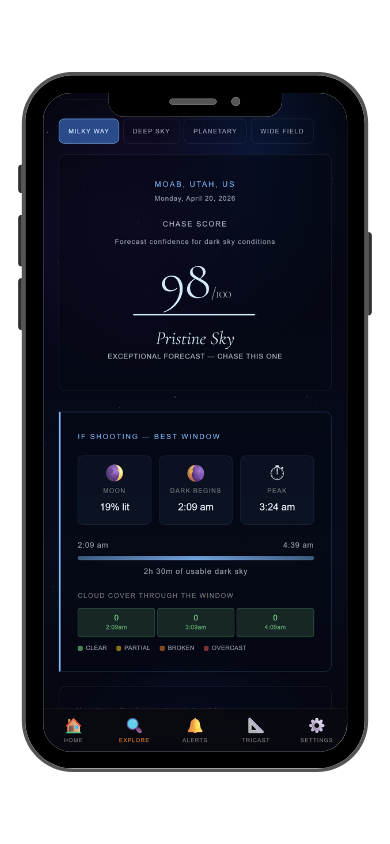
Nevada's remoteness means a bad night represents real wasted effort. Monsoon moisture in late summer, winter storm systems, and rare but impactful smoke events from California fires can compromise otherwise extraordinary sites. StarCast scores cloud cover, moon phase, atmospheric transparency, and seeing into a single night-sky verdict — updated daily for any location.
StarCast + More
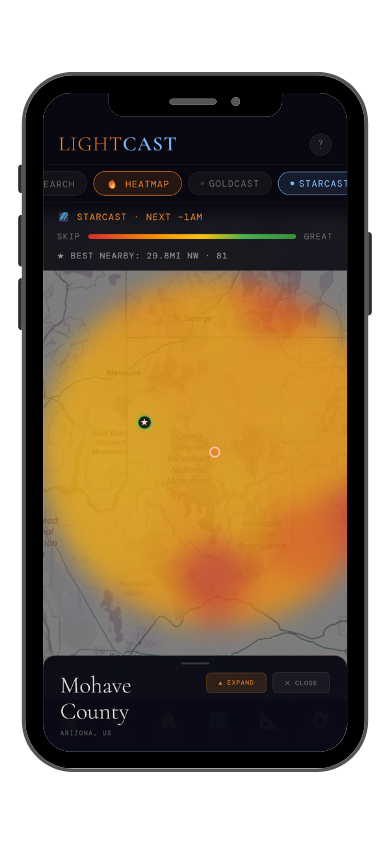
See the sky and the light on one map
Night sky · Nearby Conditions
StarCast scores cloud cover, moon phase, atmospheric transparency, and astronomical seeing. See on a map where skies are clearest before committing to the long drive out to Great Basin or the Black Rock Desert.
Get Tonight's Forecast on iPhone
$2.99/mo · 7-day free trial
Learn More →
Frequently asked
Where can I see the Milky Way in Nevada?
Almost anywhere outside of Las Vegas or Reno. Great Basin National Park is the most accessible world-class destination. The US-50 corridor through central Nevada and the Black Rock Desert in the north hold some of the most genuinely dark sky in the lower 48. Check StarCast free on
web, full features in the
iOS app.
What is the darkest sky in Nevada?
Eureka County along US-50 and Lincoln County in the south routinely rank among the darkest counties in the continental US. Bortle 1 sky is accessible here without leaving paved roads. The Milky Way casts visible shadows, zodiacal light is easily seen on appropriate nights, and even the Andromeda Galaxy is a naked-eye object.
When is the best time for astrophotography in Nevada?
Spring (March through May) and fall (September through November) offer the best combination of mild temperatures and reliable transparency across most of Nevada. Summer brings heat and occasional monsoon moisture in the south. Winter provides the longest nights and excellent transparency but requires preparation for cold temperatures, particularly at Great Basin's elevation.
Does smoke affect astrophotography in Nevada?
Yes — wildfire smoke from California and Oregon can dramatically reduce transparency in Nevada, particularly in late summer. Even on smoke-affected nights that look "clear," star counts and Milky Way contrast drop noticeably. StarCast's transparency score reflects atmospheric conditions including smoke-related degradation, making it especially useful during fire season.
What is LightCast StarCast?
StarCast scores night sky conditions using cloud cover, moon phase, atmospheric transparency, and astronomical seeing. GoldCast (same app) handles golden hour timing. Free on web at
lightcastsuite.com/starcast, full features in the
LightCast iOS app — $2.99/month after a 7-day free trial.