StarCast · New Hampshire
LightCast

Best Astrophotography Locations in New Hampshire

New Hampshire punches above its size for astrophotography. The White Mountains and the remote North Country offer genuinely dark sky, dramatic alpine terrain, and some of the best accessible summit views in the East.

iOS app: $2.99/mo · 7-day free trial


Astrophotography locations · New Hampshire

Where to Shoot and What to Know Before You Drive

New Hampshire's southern tier is compromised by the Manchester-Nashua corridor and Boston's glow to the southeast. The White Mountains and Coos County in the far north represent a meaningful jump in darkness, with Coos County reaching Bortle 3–4 in its interior. Cloud cover and summit weather are the dominant constraints — Mount Washington has some of the most extreme and changeable weather of any accessible summit in the world, and conditions that look fine in the valley can be violent at 6,000 feet. When skies clear in the North Country, conditions are genuinely excellent for the Northeast. The aurora is visible from northern New Hampshire during moderate geomagnetic events, adding a seasonal dimension beyond the Milky Way season.

🏔️
White Mountains: Franconia Notch and Lonesome Lake, Grafton County Bortle 3–4
Franconia Notch is New Hampshire's most iconic alpine terrain, with Cannon Mountain, Echo Lake, and the Profile Lake below offering excellent night foregrounds. Lonesome Lake, reached by a 1.6-mile hike from the Lafayette Campground, sits at 2,743 feet with open views above the notch walls. The surrounding national forest suppresses surrounding scatter significantly. Echo Lake State Park in nearby North Conway gives direct car access to a lake surface under open sky. These sites are 2–3 hours from Boston, making them the most practical White Mountain options for urban astrophotographers.

🌲
Cherry Pond, Pondicherry National Wildlife Refuge, Coos County 3
Cherry Pond in the Pondicherry refuge near Jefferson is recognized as one of the best accessible dark sky sites in New Hampshire, with an open floating bog mat surrounding a reflective pond under a wide sky dominated by the Presidential Range silhouette to the south. The low surrounding terrain gives an almost unobstructed 360-degree horizon, and Coos County's sparse population keeps darkness levels competitive with much of upstate New York. A flat 1-mile trail leads to the pond edge. The combination of mountain silhouette, bog reflection, and genuinely dark overhead sky makes this a premier northeastern astrophotography location.
💧
Connecticut Lakes, Coos County 3
The four Connecticut Lakes near Pittsburg in the extreme north of New Hampshire sit just miles from the Canadian border in the most remote corner of the state. The surrounding boreal forest and complete absence of development produces some of the darkest sky in New England. First Connecticut Lake and Second Connecticut Lake both have accessible shorelines. The Northern Pass area near Stewartstown gives wide bog and meadow foregrounds. This is NH's most competitive dark sky region, and the latitude at 45° north makes aurora viewing a realistic possibility during active geomagnetic periods.
⛰️
Mount Washington Auto Road Summit, Coos County 3
At 6,288 feet, Mount Washington is the highest peak in the Northeast and one of the windiest places on Earth. The summit auto road is open seasonally and gives car access to a rocky alpine plateau above the cloud layer on clear nights. When weather allows, the views extend to horizons 100+ miles in every direction, above any terrain-based interference. The Milky Way from the summit on a stable night is dramatically different from any valley site in the region. Check summit weather independently of valley forecasts — conditions diverge often and dramatically.
🌙
Weeks State Park, Lancaster, Coos County 3–4
Weeks State Park occupies the summit of Mount Prospect (1,420 feet) outside Lancaster, with a stone observation tower giving 360-degree views across the Connecticut River Valley and Presidential Range. The park sits in the Connecticut River valley corridor with relatively dark sky in all directions from this elevated vantage. Lancaster and Littleton produce minimal glow. A good accessible option for photographers who want an elevated view in Coos County without committing to the full White Mountains drive. Open seasonally; check access before visiting.

Conditions matter as much as location

Check Before You Make the Drive

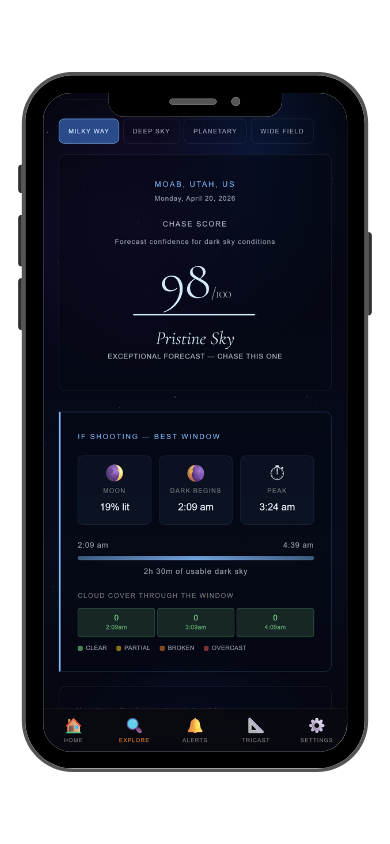
Valley conditions in New Hampshire frequently diverge from summit conditions, and coastal moisture patterns can push clouds inland quickly. StarCast scores cloud cover, moon phase, atmospheric transparency, and seeing into a single night-sky verdict — updated daily for any location.

LightCast StarCast StarCast conditions map
LightCast
StarCast + More
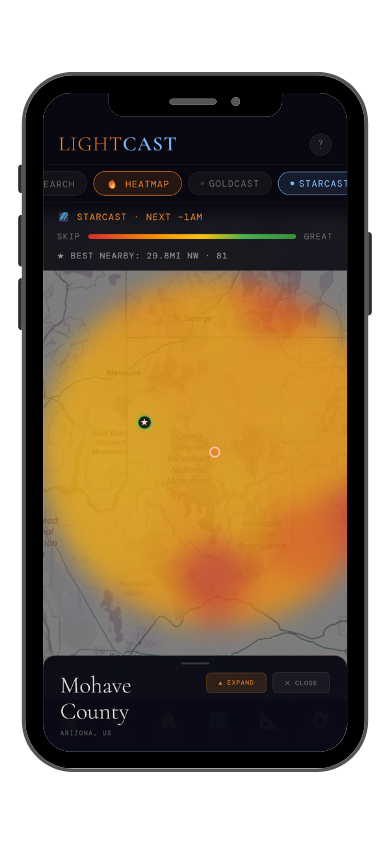
See the sky and the light on one map
Night sky · Nearby Conditions
StarCast scores cloud cover, moon phase, atmospheric transparency, and astronomical seeing. See on a map where skies are clearest before committing to the drive up to Franconia Notch or the Connecticut Lakes.
Get Tonight's Forecast on iPhone
$2.99/mo · 7-day free trial
Learn More →

Frequently asked
Where can I see the Milky Way in New Hampshire?
Cherry Pond in Pondicherry Wildlife Refuge and the Connecticut Lakes region in Coos County are New Hampshire's best options. Franconia Notch is more accessible from southern NH and still delivers solid conditions. Check StarCast free on web, full features in the iOS app.
What is the darkest sky in New Hampshire?
The Connecticut Lakes area near Pittsburg in far northern Coos County is the darkest accessible region in the state, reaching Bortle 3 under good conditions. It is among the top three or four darkest accessible locations in all of New England.
When is the best time for astrophotography in New Hampshire?
The Milky Way core is visible from NH latitudes April through October. September and October offer the best transparency as summer humidity clears and before winter snow closes high roads. Fall foliage adds compelling foreground color in late September and early October. Winter gives the longest nights but closes many summit and forest roads.
Can you see the Northern Lights in New Hampshire?
Yes — northern New Hampshire near Coos County can see the aurora during moderate geomagnetic events (Kp 4+). The Connecticut Lakes area and the Presidential Range north side offer the best views. Strong events (Kp 6+) are occasionally visible even from Manchester. The fall aurora season coincides well with good transparency after summer humidity drops.
What is LightCast StarCast?
StarCast scores night sky conditions using cloud cover, moon phase, atmospheric transparency, and astronomical seeing. GoldCast (same app) handles golden hour timing. Free on web at lightcastsuite.com/starcast, full features in the LightCast iOS app — $2.99/month after a 7-day free trial.
LightCast
Check tonight's sky before you make the drive.

Cloud cover · Moon phase · Transparency · Seeing

Get Tonight's Forecast on iPhone
or
Check free on web →

$2.99/mo after 7-day free trial