Astrophotography locations · New Jersey
Where to Shoot and What to Know Before You Drive
New Jersey's light pollution is some of the worst in the country, with NYC, Philadelphia, Trenton, and Newark creating overlapping domes that compromise most of the state. The two genuine exceptions are the Pine Barrens in the south — a million-acre forested wilderness with some of the darkest sky in the state — and the Kittatinny Ridge in the northwest, which provides elevation and some separation from the metro corridor. Realistic expectations are important: even the best NJ sites rarely exceed Bortle 5, and the NYC glow is visible from almost everywhere. New moon timing is critical at all NJ locations. The benefit is accessibility — Wharton State Forest is under 2 hours from midtown Manhattan.
🌲
Wharton State Forest, Burlington and Atlantic Counties Bortle 5
Wharton is the largest state forest in New Jersey, covering over 122,000 acres of Pine Barrens in the south-central part of the state. Its interior reaches some of the darkest sky accessible in NJ, with the NYC glow on the northern horizon and Atlantic City's dome to the southeast. Batsto Lake and Atsion Lake provide reflective foreground within the forest. Interior sand roads give access deep into the protected pitch pine and scrub oak landscape that buffers surrounding scatter. New moon nights here can produce Milky Way core photography that would be impossible anywhere near the state's metro centers.
🌊
Island Beach State Park, Ocean County 5–6
Island Beach is a 10-mile undeveloped barrier island south of Seaside Heights, with the Atlantic Ocean providing a completely dark southern horizon. The beach faces southeast to south, meaning the Milky Way core rises directly over dark open ocean water in late spring and summer. Toms River and Seaside produce glow to the north and northwest, but the ocean direction is clean. The wide beach and surf foreground elevates night photography beyond what pure darkness scores suggest. The southward-facing ocean horizon is the key asset — and it's uniquely accessible for such a populated state.
🏔️
High Point State Park, Sussex County 4–5
High Point is New Jersey's highest elevation at 1,803 feet, sitting on the Kittatinny Ridge in the far northwest near the New York and Pennsylvania borders. The summit monument and Lake Marcia below give elevated and lake-surface foreground options. The ridge blocks some metro glow from the east, and Sussex County is the least light-polluted county in NJ. The western Kittatinny view toward the Delaware River Valley is the cleanest direction. For NJ residents, this represents a meaningful step up from any site in the southern or central part of the state.
🏞️
Delaware Water Gap National Recreation Area, Warren County 4–5
The NJ side of the Delaware Water Gap follows the Kittatinny Ridge and Delaware River through a federally protected recreation area with minimal development. The Appalachian Trail along the ridge gives access to overlooks above the river valley with somewhat cleaner western horizons. Sunfish Pond, a glacially carved lake atop the ridge, is accessible via a 4.5-mile hike and gives the best dark-sky lake foreground accessible in northwestern New Jersey. Worth combining with High Point on the same night trip for photographers making the drive from the Newark-NYC corridor.
🌙
Belleplain State Forest, Cape May and Cumberland Counties 5
Belleplain State Forest in the southern Pine Barrens is the southernmost significant dark sky site in New Jersey. Lake Nummy within the forest provides a quiet lake foreground accessible from the campground. Cape May County's southern location means the Milky Way core rises higher in the sky than it does from northern NJ, providing stronger compositions. Atlantic City's dome is visible to the northeast. Belleplain gives a comparable Bortle rating to Wharton but with a slightly better southern sky angle and the convenience of established camping facilities.
Conditions matter as much as location
Check Before You Make the Drive
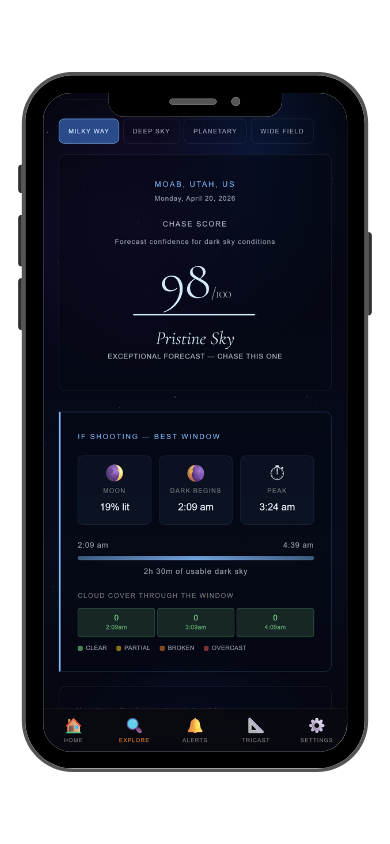
In a state where dark sky is already limited, spending a new moon night under clouds or a humidity haze is a real loss. StarCast scores cloud cover, moon phase, atmospheric transparency, and seeing into a single night-sky verdict — updated daily for any location.
StarCast + More
See the sky and the light on one map
Night sky · Nearby Conditions
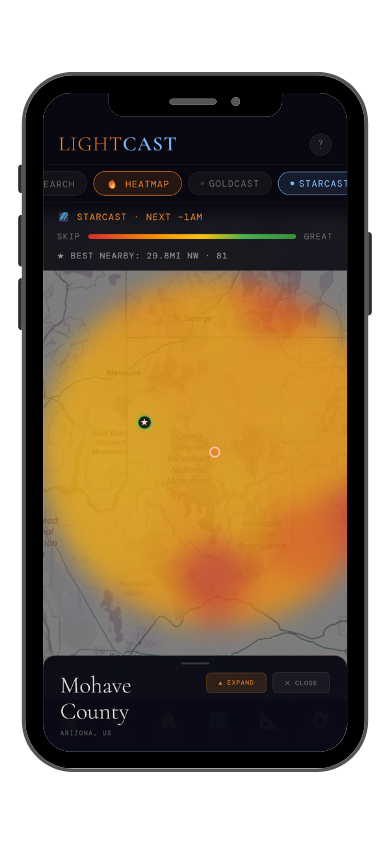
StarCast scores cloud cover, moon phase, atmospheric transparency, and astronomical seeing. See on a map where skies are clearest before committing to the drive out to the Pine Barrens or the Kittatinny Ridge.
Get Tonight's Forecast on iPhone
$2.99/mo · 7-day free trial
Learn More →
Frequently asked
Where can I see the Milky Way in New Jersey?
Wharton State Forest in the Pine Barrens is the best in-state option. High Point State Park in the northwest is the best for photographers wanting elevation. Island Beach State Park provides a dark southern ocean horizon unique in the state. New moon timing is essential everywhere in NJ. Check StarCast free on
web, full features in the
iOS app.
What is the darkest sky in New Jersey?
The interior of the Pine Barrens, particularly Wharton and Belleplain State Forests, holds the darkest accessible sky in the state, reaching Bortle 5 at best. Sussex County in the northwest is the least light-polluted county. No location in New Jersey qualifies as Bortle 4 or better in all directions given the surrounding metro density.
When is the best time for astrophotography in New Jersey?
The Milky Way core is visible from NJ latitudes from late March through October. New moon windows are far more important in NJ than in darker states — a quarter moon washes out what little darkness is available at these Bortle levels. September and October provide the best transparency. Summer humidity degrades effective sky quality significantly even on nominally clear nights.
Does cloud cover matter for astrophotography?
Completely — even thin high cirrus kills deep-sky exposures. Atmospheric transparency matters too, not just cloud-free skies. StarCast scores both cloud cover and transparency separately, so you know whether you're looking at a genuinely good night or just a technically clear one.
What is LightCast StarCast?
StarCast scores night sky conditions using cloud cover, moon phase, atmospheric transparency, and astronomical seeing. GoldCast (same app) handles golden hour timing. Free on web at
lightcastsuite.com/starcast, full features in the
LightCast iOS app — $2.99/month after a 7-day free trial.