Astrophotography locations · New Mexico
Where to Shoot and What to Know Before You Drive
New Mexico's average elevation of 5,700 feet puts most of the state above the thickest atmospheric moisture layer, producing transparency levels that eastern photographers rarely encounter. The main light domes to navigate around are Albuquerque in the center and El Paso across the southern border. The southeastern quadrant — the Lincoln National Forest, Guadalupe Mountains, and the Tularosa Basin — is consistently one of the best dark sky regions in the continental US. Monsoon season from July through September is the primary constraint, bringing afternoon thunderstorms and elevated humidity that can compromise transparency even on nominally clear nights. The pre-monsoon window in May and early June is often exceptional. The state's varied terrain — white gypsum dunes, ancient volcanic calderas, canyon badlands, alpine peaks — gives photographic variety unmatched in the Southwest.
🏜️
White Sands National Park, Otero County Bortle 2
White Sands is one of the most visually arresting astrophotography locations in the world. The 275 square miles of brilliant white gypsum dunes reflect moonlight and starlight uniquely among all landscapes on Earth, giving a luminous quality to foreground that is simply not available anywhere else. The park sits in the Tularosa Basin far from major cities, with Alamogordo's modest glow to the northeast being the only real compromise. The park holds occasional moonlit night photography programs. On new moon nights, the white dunes under a Bortle 2 sky with the Milky Way arching overhead produce images of extraordinary impact.
🌋
Valles Caldera National Preserve, Sandoval County 2–3
The Valles Caldera is a 13-mile-wide volcanic caldera at 8,900 feet elevation in the Jemez Mountains northwest of Santa Fe. The surrounding mountains shield the caldera from all surrounding light domes, and the open meadow floor gives a wide sky with clean horizon in all directions. The elevation places most atmospheric moisture below the observation point. The caldera is only accessible via permitted entry, limiting crowds. Evening programs are offered in summer. Few landscapes in the Southwest combine this combination of elevation, enclosure, scientific grandeur, and genuine darkness within driving range of a major city.
🦕
Bisti/De-Na-Zin Wilderness, San Juan County 2
The Bisti Badlands in northwestern New Mexico rival the most alien-looking landscapes on Earth: hoodoos, egg-shaped concretions, fossil beds, and layered mudstone buttes eroded into surreal forms under a sky that reaches Bortle 2. The wilderness area is roadless and permit-free, with access from a dirt road off NM-371 near Farmington. Farmington's glow is present to the north, manageable if you position south or east. The cracked earth formations at the base of hoodoos under a Milky Way arch produce astrophotography compositions unlike those at any other location in the Southwest.
🌲
Lincoln National Forest: Sacramento Mountains, Otero County 1–2
The Sacramento Mountains in southern New Mexico rise to nearly 9,000 feet in the Lincoln National Forest, placing observers well above the desert basin and close to some of the most world-renowned observatories in the US, including Apache Point Observatory near Sunspot. The observatory siting is no accident: the sky here is among the best in the continental US, with Bortle 1 achievable on good nights. Cloudcroft and the surrounding forest provide lodging and base camp access. The combination of elevation, southern latitude (giving high galactic core altitude), and minimal regional development makes this area exceptional.
🏔️
Gila Wilderness, Grant and Catron Counties 1–2
The Gila Wilderness was the first designated wilderness area in the US (1924) and remains one of the most remote and roadless landscapes in the lower 48. Grant and Catron counties are among the darkest counties in the continental US by any measure. The Gila River canyon, hot springs, and ponderosa pine mountains above 8,000 feet give varied foreground in a landscape that sees few night photographers. Silver City serves as the nearest base. A serious backcountry trip into the Gila interior gives access to Bortle 1 sky over terrain that genuinely earns the term wilderness.
Conditions matter as much as location
Check Before You Make the Drive
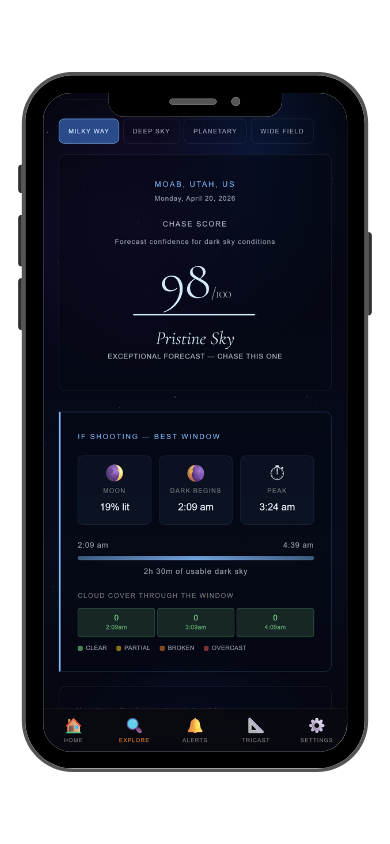
New Mexico's monsoon season can build storms quickly over mountains that looked clear at sunset. Smoke from nearby wildfires and cross-state transport from Arizona and Colorado can also compromise transparency without obvious cloud cover. StarCast scores cloud cover, moon phase, atmospheric transparency, and seeing into a single night-sky verdict — updated daily for any location.
StarCast + More
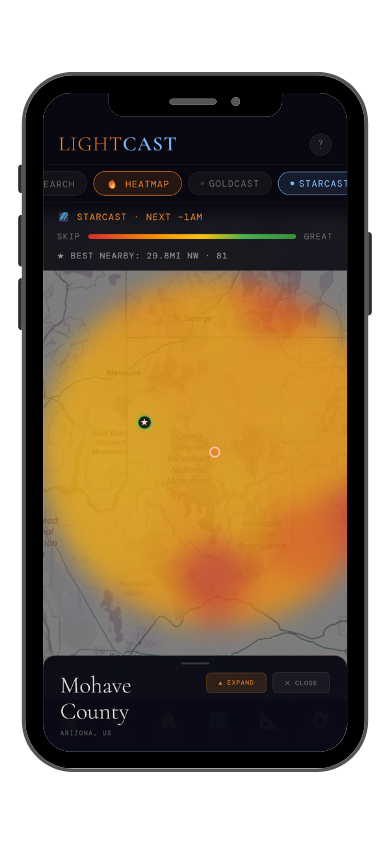
See the sky and the light on one map
Night sky · Nearby Conditions
StarCast scores cloud cover, moon phase, atmospheric transparency, and astronomical seeing. See on a map where skies are clearest before committing to the drive out to White Sands or the Sacramento Mountains.
Get Tonight's Forecast on iPhone
$2.99/mo · 7-day free trial
Learn More →
Frequently asked
Where can I see the Milky Way in New Mexico?
Almost anywhere outside of Albuquerque. White Sands National Park is the most visually distinctive destination. The Sacramento Mountains near Cloudcroft and the Gila Wilderness in the southwest reach Bortle 1 and are among the finest dark sky sites in the country. Check StarCast free on
web, full features in the
iOS app.
What is the darkest sky in New Mexico?
Grant and Catron counties in the southwest, encompassing the Gila Wilderness, are among the darkest accessible areas in the contiguous US. The Sacramento Mountains near Sunspot and the Lincoln National Forest reach Bortle 1 on good nights. These are sites where major professional observatories choose to build, which is the most reliable endorsement of sky quality.
When is the best time for astrophotography in New Mexico?
The pre-monsoon window from late April through June is often the best of the year — low humidity, minimal clouds, and the galactic core rising higher each week. October through early December offers excellent post-monsoon transparency with long nights. The monsoon months of July through September bring afternoon storms but often clear dramatically after midnight, creating a high-risk, high-reward window for experienced photographers willing to monitor conditions closely.
Does elevation matter for astrophotography in New Mexico?
Significantly. New Mexico's average elevation already places most sites above the thickest moisture layer, but gaining 3,000–4,000 additional feet in the mountains further reduces atmospheric column depth and improves transparency and seeing noticeably. The difference between shooting at 4,000 feet on the southern desert and 9,000 feet in the Sacramento Mountains is measurable in star count, Milky Way contrast, and effective limiting magnitude.
What is LightCast StarCast?
StarCast scores night sky conditions using cloud cover, moon phase, atmospheric transparency, and astronomical seeing. GoldCast (same app) handles golden hour timing. Free on web at
lightcastsuite.com/starcast, full features in the
LightCast iOS app — $2.99/month after a 7-day free trial.