Astrophotography locations · New York
Where to Shoot and What to Know Before You Drive
New York's astrophotography landscape splits dramatically between the NYC metro and upstate. The NYC glow affects skies within 100+ miles of the city but fades rapidly beyond the Hudson Valley and Catskill foothills. The Adirondack Park — at 6.1 million acres, the largest publicly protected area in the contiguous US — contains vast wilderness where Bortle 3–4 is achievable and aurora is occasionally visible. Franklin and Hamilton counties in the High Peaks interior reach genuine darkness by northeastern US standards. Cloud cover is the primary constraint throughout the state — New York averages fewer clear nights than most of the country, and lake-effect systems from the Great Lakes add further variability to western and northern regions.
🏔️
Adirondack High Peaks: Lake Placid and Keene Valley area, Essex County Bortle 3–4
The High Peaks region of the Adirondacks centers on Essex County, where 46 peaks exceed 4,000 feet and the surrounding wilderness is vast enough to substantially suppress all surrounding light domes. Heart Lake at Adirondack Loj, Mirror Lake in Lake Placid, and the open summit of Mount Marcy all provide exceptional night-sky foreground. The interior of the High Peaks Wilderness area achieves some of the darkest sky accessible in New York State. The altitude, combined with surrounding protected land, produces transparency and seeing quality that surprises photographers expecting the dense atmospheric moisture typical of the Northeast.
🌲
Cranberry Lake and Five Ponds Wilderness, St. Lawrence County 3
The Five Ponds Wilderness and surrounding Cranberry Lake area in the northwestern Adirondacks represent some of the most remote and darkest accessible terrain in New York. Cranberry Lake itself is the third-largest lake entirely within the Adirondack Park, with shorelines accessible by foot and water. The nearest significant light domes are Watertown and Massena, both far enough away to be negligible. Interior wilderness campsites along the Oswegatchie River give truly remote access to Bortle 3 sky with old-growth forest foreground. This area rivals the Maine north woods for eastern US darkness.
🌄
Catskill Mountains: Slide Mountain and Balsam Lake Mountain, Ulster County 4–5
The Catskills offer the most accessible improvement over NYC skyglow for photographers in the metro area. Slide Mountain, the highest Catskill peak at 4,180 feet, and the Balsam Lake Mountain fire tower give elevated viewpoints above valley light scatter. The Catskill Center for Conservation supports dark sky efforts. NYC's dome is detectable to the southeast, but from the summit ridges the overhead and northern sky is significantly cleaner than anywhere below. Worth combining with Palenville or Haines Falls for distinctive lower-elevation foreground compositions near the escarpment cliffs.
💧
Raquette Lake and Blue Mountain Lake, Hamilton County 3
Hamilton County is the least populated county in New York State and the least light-polluted county east of the Mississippi River. Raquette Lake and Blue Mountain Lake sit in the heart of the county surrounded by protected wilderness with no highway lighting or commercial development along their shorelines. The large open lake surfaces give reflective foreground under clean overhead sky. State Route 28 through the county passes with minimal light interruption for miles. Mid-week in fall gives near-solitude and excellent post-summer transparency for this reliably dark Adirondack interior region.
🏞️
Allegany State Park, Cattaraugus County 4
Allegany State Park in the far southwestern corner of New York is the largest state park in the state and sits in a surprisingly dark stretch of the Allegheny Plateau near the Pennsylvania border. Red House Lake and Quaker Lake provide accessible water foreground within the park. The surrounding Allegany Reservation and Allegany National Forest in Pennsylvania extend the dark buffer. Erie and Buffalo produce glow to the north and northwest, manageable from the park's southern sections. A practical option for western New York residents who want dark sky without the longer Adirondack drive.
Conditions matter as much as location
Check Before You Make the Drive
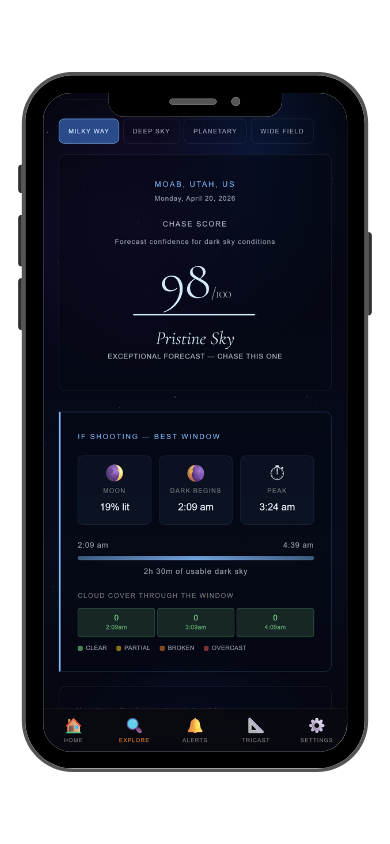
Driving 3 hours to the Adirondacks only to find lake-effect clouds sitting over the High Peaks is a well-known New York experience. StarCast scores cloud cover, moon phase, atmospheric transparency, and seeing into a single night-sky verdict — updated daily for any location.
StarCast + More
See the sky and the light on one map
Night sky · Nearby Conditions
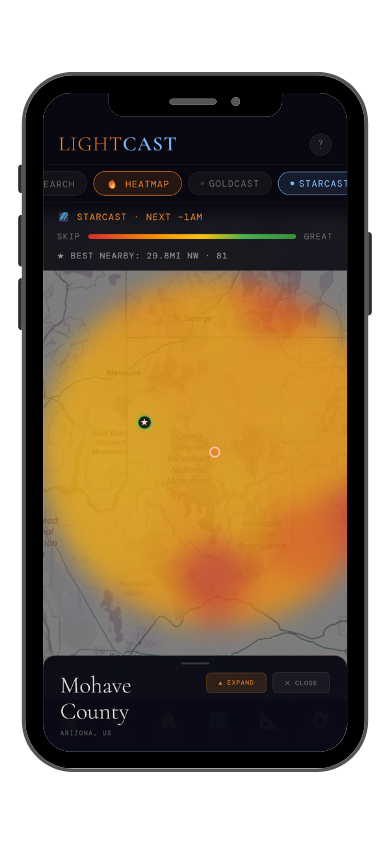
StarCast scores cloud cover, moon phase, atmospheric transparency, and astronomical seeing. See on a map where skies are clearest before committing to the drive up to the Adirondacks or out to the Catskills.
Get Tonight's Forecast on iPhone
$2.99/mo · 7-day free trial
Learn More →
Frequently asked
Where can I see the Milky Way in New York?
Hamilton County in the Adirondacks interior is the darkest accessible region in the state, with Raquette Lake and Blue Mountain Lake as top destinations. The High Peaks area around Heart Lake is more visited but still genuinely dark. The Catskills are the closest meaningful escape from NYC glow. Check StarCast free on
web, full features in the
iOS app.
What is the darkest sky in New York?
Hamilton County in the central Adirondacks is consistently cited as the least light-polluted county east of the Mississippi River. The Five Ponds Wilderness in St. Lawrence County is a close second. Both areas reach Bortle 3 under good conditions, competitive with much of the rural Midwest and Southeast.
When is the best time for astrophotography in New York?
September and October offer the best balance of Milky Way visibility, lower humidity, and fall foliage foreground color. The core is visible from April through October. Winter provides aurora opportunity and long nights but closes many forest roads and adds serious cold weather logistics. New moon windows are particularly important in the Catskills and anywhere within 150 miles of NYC.
Can you see the Northern Lights from New York?
Yes — from the Adirondacks and the North Country near the Canadian border, aurora is visible during moderate geomagnetic events (Kp 4–5). Strong events (Kp 6+) can produce visible aurora from the Catskills and even Long Island. The fall aurora season overlaps well with the best atmospheric conditions upstate.
What is LightCast StarCast?
StarCast scores night sky conditions using cloud cover, moon phase, atmospheric transparency, and astronomical seeing. GoldCast (same app) handles golden hour timing. Free on web at
lightcastsuite.com/starcast, full features in the
LightCast iOS app — $2.99/month after a 7-day free trial.