Astrophotography locations · North Carolina
Where to Shoot and What to Know Before You Drive
North Carolina's light pollution concentrates around Charlotte, the Raleigh-Durham Triangle, and the I-85 corridor. The western mountains and the central coast both offer real escape, just in opposite directions. Elevation helps in the mountains, isolation helps on the coast — Mayland Earth to Sky Park near Burnsville is a certified Dark Sky Park, and Cape Lookout's barrier island has almost no fixed light sources at all. Humidity and haze build through summer afternoons, so check atmospheric transparency separately from cloud cover before driving out.
🏔️
Mayland Earth to Sky Park, Burnsville Bortle 2
An International Dark Sky Park certified site at the Bare Dark Sky Observatory, sitting in the Blue Ridge high country near Mount Mitchell. The site was built specifically for astronomy, with an open viewing field and minimal surrounding development. One of the most reliably dark certified sites east of the Mississippi. Public viewing nights are common; check ahead for events that may limit open shooting.
🌲
Pisgah National Forest, Brevard area Bortle 2–3
Over 500,000 acres of national forest spanning the Blue Ridge Escarpment west of Asheville. Looking Glass Rock and the Pisgah Ridge corridor offer elevated overlooks with minimal light intrusion. The forest's size and topography shield most interior viewpoints from Asheville's glow to the north. Best foreground options sit along the Davidson River area and higher ridge pull-offs.
🪨
Linville Gorge Wilderness Bortle 2
One of the deepest gorges in the eastern US, with steep walls that block ambient light from every direction. Wiseman's View and the Table Rock area give wide southern sky exposure over the gorge for Milky Way core shots in summer. Trails are rugged and unmarked in places; a daylight scouting trip before a night shoot is worth the extra drive.
🌊
Cape Lookout National Seashore Bortle 2
A remote, undeveloped barrier island accessible only by ferry, with a true 360-degree horizon and almost no artificial light beyond the lighthouse itself. The flat, treeless terrain makes it one of the few East Coast spots where the full Milky Way arch is unobstructed in every direction. Logistics are the real constraint here: ferry schedules, tides, and camping permits all need planning ahead.
🌌
Uwharrie National Forest Bortle 3–4
The closest meaningful dark sky to the Triangle and Charlotte metro, sitting in the rural hills between Asheboro and Albemarle. Not as dark as the mountains or coast, but a workable option for Piedmont residents who don't want a multi-hour drive. Badin Lake's shoreline gives open foreground with some water reflection on calm nights.
Conditions matter as much as location
Check Before You Make the Drive
Driving three hours to Mayland only to find a humid haze layer sitting over the ridge is a real risk in summer.
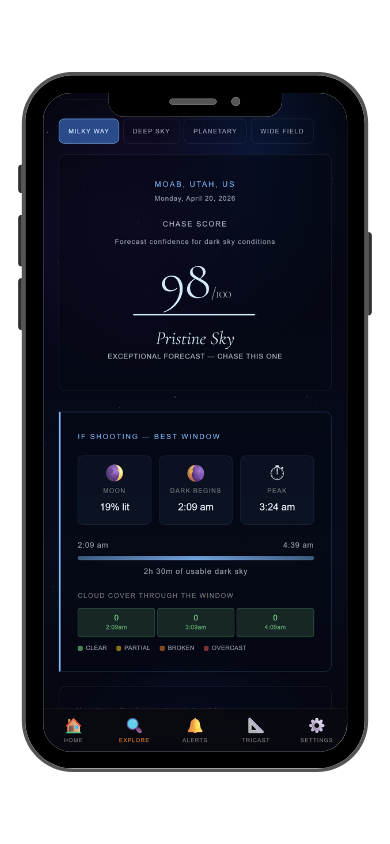
StarCast scores cloud cover, moon phase, atmospheric transparency, and seeing into a single night-sky verdict, updated daily for any location.
StarCast + More
See the sky and the light on one map
Night sky · Nearby Conditions
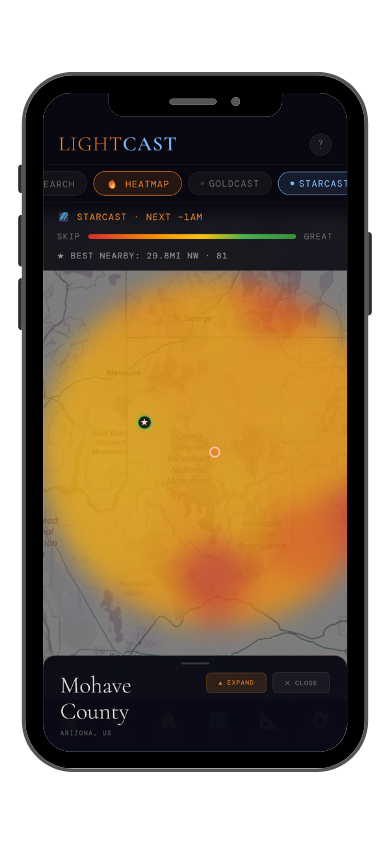
StarCast scores cloud cover, moon phase, atmospheric transparency, and astronomical seeing. See on a map where skies are clearest before committing to the drive out to Pisgah or Linville Gorge.
Get Tonight's Forecast on iPhone
$2.99/mo · 7-day free trial
Learn More →
Frequently asked
Where can I see the Milky Way in North Carolina?
Mayland Earth to Sky Park and the Pisgah National Forest backcountry are the most reliable mountain options, while Cape Lookout National Seashore offers the darkest coastal sky in the state. Check StarCast for tonight's conditions free on
web, full features in the
iOS app.
What is the darkest sky in North Carolina?
Cape Lookout National Seashore and the Linville Gorge Wilderness both reach Bortle 2, among the darkest readings on the East Coast. Mayland Earth to Sky Park is officially certified and offers the easiest public access to that level of darkness.
When is the best time for astrophotography in North Carolina?
The Milky Way core is visible from North Carolina from late March through October, peaking June through August. New moon windows matter most in the Piedmont and coastal areas, where ambient light is higher. In the mountains, watch for afternoon convective haze that can linger into early evening even on cloud-free nights.
Does cloud cover matter for astrophotography?
Yes, even thin cirrus degrades deep-sky exposures, and the Appalachian ridgelines generate their own localized cloud patterns that don't always show up in regional forecasts. StarCast scores both cloud cover and transparency separately, so you know whether a night is genuinely good or just technically clear.
What is LightCast StarCast?
StarCast scores night sky conditions using cloud cover, moon phase, atmospheric transparency, and astronomical seeing. GoldCast (same app) handles golden hour timing. Free on web at
lightcastsuite.com/starcast, full features in the
LightCast iOS app — $2.99/month after a 7-day free trial.