Astrophotography locations · North Dakota
Where to Shoot and What to Know Before You Drive
North Dakota's population is small and concentrated in a handful of cities, which leaves most of the state genuinely dark. Fargo and Bismarck create the only meaningful glow domes, and both fade fast outside city limits. The badlands in the southwest hold the darkest, most dramatic skies in the state, with terrain that adds real foreground interest. Wind is the dominant practical obstacle here, not clouds, so check conditions before setting up a tripod on an exposed ridge.
🏜️
Theodore Roosevelt National Park, Medora Bortle 1–2
The badlands terrain of the South Unit gives dramatic eroded buttes as Milky Way foreground, with almost no light pollution for hundreds of miles in any direction. Scenic overlooks along the park loop road provide easy pull-off access without backcountry hiking. The North Unit is even more remote and even darker, though facilities are sparser.
🥾
Maah Daah Hey Trail corridor Bortle 1–2
A 144-mile trail running through the badlands between the park's North and South Units, with trailhead access points offering some of the darkest, most isolated sky in the state. Little Missouri National Grassland surrounds much of the trail, adding a buffer of undeveloped land on every side. Best suited to those comfortable with remote, unlit gravel roads at night.
💧
Lake Sakakawea State Park Bortle 2
A massive reservoir in central North Dakota with open water giving a true flat horizon and reflective foreground on calm nights. The lake's size keeps shorelines far from any town glow. Best Milky Way core shots come from the south-facing shoreline in summer, when the core arcs over open water.
🌾
Turtle River State Park Bortle 3
Closer to Grand Forks than the badlands sites, this wooded river valley park is a reasonable option for eastern North Dakota residents who don't want the full drive west. Not as dark as the badlands, but a workable compromise with easy camping access and marked trails for night navigation.
🦬
Sully's Hill National Game Preserve Bortle 2–3
A small, lesser-known preserve near Devils Lake with rolling hills and minimal development nearby. The elevated terrain gives a decent horizon view, and the preserve's protected status keeps surrounding light development low. A good option for those exploring the Devils Lake region.
Conditions matter as much as location
Check Before You Make the Drive
Driving out to the badlands only to get pinned down by wind gusts is the most common ruined night in North Dakota.
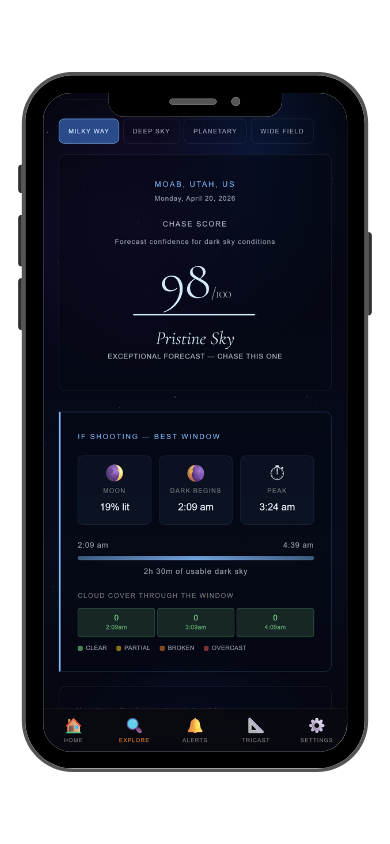
StarCast scores cloud cover, moon phase, atmospheric transparency, and seeing into a single night-sky verdict, updated daily for any location.
StarCast + More
See the sky and the light on one map
Night sky · Nearby Conditions
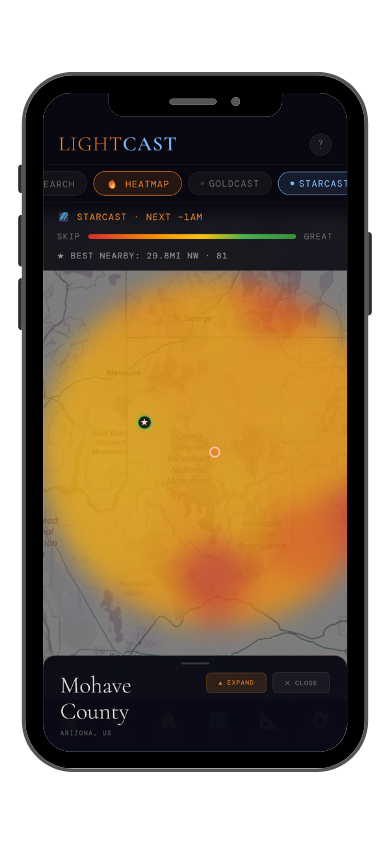
StarCast scores cloud cover, moon phase, atmospheric transparency, and astronomical seeing. See on a map where skies are clearest before committing to the drive out to Theodore Roosevelt National Park or the Maah Daah Hey corridor.
Get Tonight's Forecast on iPhone
$2.99/mo · 7-day free trial
Learn More →
Frequently asked
Where can I see the Milky Way in North Dakota?
Theodore Roosevelt National Park's North and South Units offer the most dramatic foreground with some of the darkest sky in the state. Check StarCast for tonight's conditions free on
web, full features in the
iOS app.
What is the darkest sky in North Dakota?
Most of the western badlands, including Theodore Roosevelt National Park and the Maah Daah Hey Trail corridor, reads Bortle 1–2. North Dakota has some of the darkest measured sky of any state outside the Mountain West.
When is the best time for astrophotography in North Dakota?
The Milky Way core is visible from late March through early October, peaking June through August. Winters offer exceptional transparency on clear nights but extreme cold is a real safety factor for long exposure sessions. Spring and fall winds can be intense on exposed badlands terrain, so check conditions before committing to a remote shoot.
Does cloud cover matter for astrophotography?
Yes, though North Dakota sees fewer humidity-driven haze nights than the eastern US. Wind and rapidly moving frontal systems are the bigger variable here. StarCast scores both cloud cover and transparency separately, so you know whether a night is genuinely good or just technically clear.
What is LightCast StarCast?
StarCast scores night sky conditions using cloud cover, moon phase, atmospheric transparency, and astronomical seeing. GoldCast (same app) handles golden hour timing. Free on web at
lightcastsuite.com/starcast, full features in the
LightCast iOS app — $2.99/month after a 7-day free trial.