Astrophotography locations · Ohio
Where to Shoot and What to Know Before You Drive
Ohio's three major metros, Columbus, Cleveland, and Cincinnati, plus Dayton and Akron, leave the state heavily light polluted overall. Southern Ohio's Appalachian foothills hold the darkest sky in the state, well away from the I-70 and I-71 corridors. Moon phase matters more than usual here, since even the best Ohio sites top out around Bortle 4, so new moon windows make a real difference. Lake Erie's north shore offers a different kind of opportunity entirely, with open water horizon despite moderate light pollution.
🌲
Shawnee State Forest, Portsmouth area Bortle 3–4
Ohio's largest state forest, often called the 'Little Smokies' for its rugged hill terrain, sits in the rural southern tip of the state near the Ohio River. The forest's remoteness and low population density make it the most consistently dark site in Ohio. Multiple overlooks along the forest's scenic drives give open sky access without much hiking.
🪨
Mohican State Forest and State Park Bortle 4
Central Ohio's deepest gorge terrain, with hemlock forest and the Clear Fork River cutting through sandstone. Closer to Columbus than Shawnee, making it a more practical option for central Ohio residents. The covered bridge and gorge overlooks provide interesting foreground, though tree cover limits open sky in places.
🌊
Geneva State Park, Lake Erie shoreline Bortle 4–5
Not a dark-sky destination, but the open water horizon over Lake Erie gives an unobstructed northern sky view that's rare in Ohio. Best used for shooting toward the lake away from Cleveland's glow to the west. A reasonable option for northeast Ohio residents without a long drive south.
🏞️
Wayne National Forest, Athens area Bortle 3–4
Ohio's only national forest spans several disconnected units across the southeastern hill country. The Athens-area sections offer dark, rural sky with minimal development, similar in character to Shawnee but with easier access from the Athens-Marietta corridor. Logging roads and forest tracts give multiple shooting locations.
🌌
John Bryan State Park & Clifton Gorge Bortle 5
Closer to Dayton and Columbus, this limestone gorge along the Little Miami River won't deliver the darkest sky in the state, but it's a workable option for residents who want a shorter drive. The gorge itself makes a dramatic foreground for wider compositions even with moderate sky quality.
Conditions matter as much as location
Check Before You Make the Drive
Driving two hours to Shawnee only to hit a band of Ohio Valley haze is a familiar disappointment.
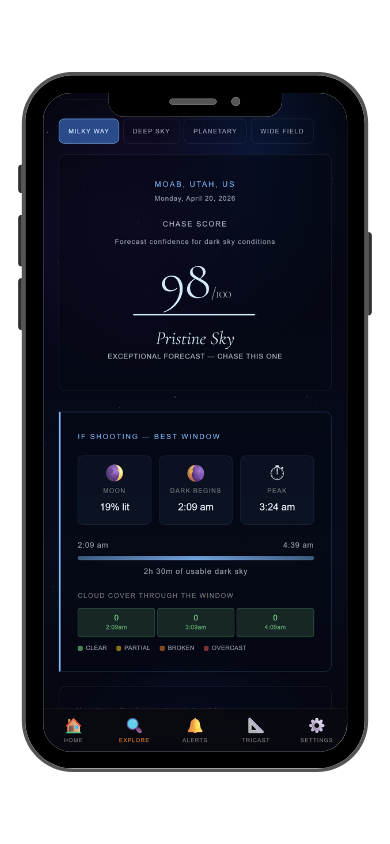
StarCast scores cloud cover, moon phase, atmospheric transparency, and seeing into a single night-sky verdict, updated daily for any location.
StarCast + More
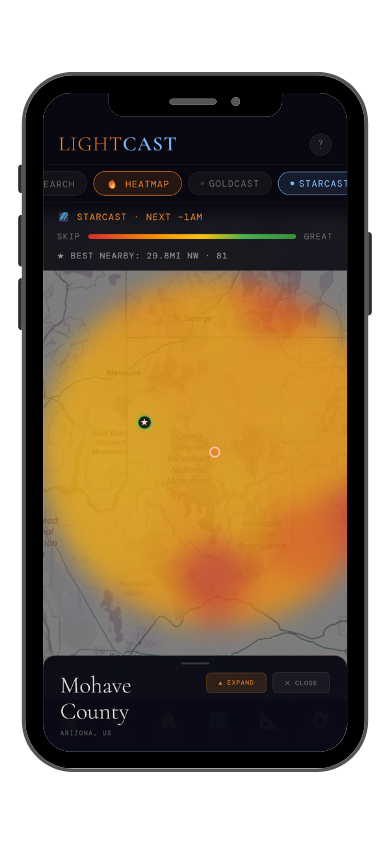
See the sky and the light on one map
Night sky · Nearby Conditions
StarCast scores cloud cover, moon phase, atmospheric transparency, and astronomical seeing. See on a map where skies are clearest before committing to the drive out to Shawnee or Mohican.
Get Tonight's Forecast on iPhone
$2.99/mo · 7-day free trial
Learn More →
Frequently asked
Where can I see the Milky Way in Ohio?
Shawnee State Forest in the southern hill country offers the darkest, most reliable sky in the state. Mohican State Forest is a closer option for central Ohio residents. Check StarCast for tonight's conditions free on
web, full features in the
iOS app.
What is the darkest sky in Ohio?
Shawnee State Forest near Portsmouth holds the darkest measured sky in Ohio, typically Bortle 3 to 4. No site in Ohio reaches Bortle 2 due to the state's population density and surrounding regional light domes from Columbus, Cincinnati, and Cleveland.
When is the best time for astrophotography in Ohio?
The Milky Way core is visible from Ohio roughly late March through October, peaking June through August. Given Ohio's elevated Bortle ratings statewide, new moon windows are essential for getting usable core detail. Summer humidity can reduce transparency even on cloud-free nights, so check both metrics before driving.
Does cloud cover matter for astrophotography?
Yes, completely. Ohio Valley humidity creates frequent haze layers that can look clear to the eye but kill contrast in long exposures. StarCast scores both cloud cover and transparency separately, so you know whether a night is genuinely good or just technically clear.
What is LightCast StarCast?
StarCast scores night sky conditions using cloud cover, moon phase, atmospheric transparency, and astronomical seeing. GoldCast (same app) handles golden hour timing. Free on web at
lightcastsuite.com/starcast, full features in the
LightCast iOS app — $2.99/month after a 7-day free trial.