Astrophotography locations · Rhode Island
Where to Shoot and What to Know Before You Drive
Rhode Island's size works against it: Providence's light dome reaches a meaningful share of the state, and there's nowhere truly remote left. The western edge of the state, away from the I-95 corridor, holds the best remaining darkness, particularly Arcadia Management Area near the Connecticut border. Coastal sites trade darkness for horizon, giving an unobstructed sky view even without the deepest Bortle rating. New moon timing matters more here than almost anywhere else on this list.
🌲
Arcadia Management Area, Exeter/Richmond Bortle 4
Rhode Island's largest state-managed forest, sitting in the rural southwestern corner near the Connecticut border. Interior gravel roads and the Beach Pond area give the darkest accessible sky in the state, helped by the low population density of neighboring Connecticut towns. The best realistic option for Milky Way work without leaving Rhode Island.
🏕️
Burlingame State Park, Charlestown Bortle 4–5
South county forest terrain with Watchaug Pond providing open water foreground. Closer to the coast than Arcadia, with a slightly brighter sky but easier access for shooters based near Westerly or South Kingstown. A practical middle option between Arcadia's darkness and coastal accessibility.
🌊
Ninigret National Wildlife Refuge & Conservation Area Bortle 5
Not a dark-sky site, but the coastal refuge gives an open Atlantic horizon facing south, useful for Milky Way core shots in summer when the core sits low over the water. The flat salt pond terrain provides a true, unobstructed sightline rarely available elsewhere in the state.
🪨
Beavertail State Park, Jamestown Bortle 5
A rocky coastal point at the southern tip of Conanicut Island, with sweeping ocean views in multiple directions. Light pollution from Newport limits deep darkness, but the open horizon and dramatic rocky foreground make it worth a visit for wider-field shots, especially around new moon.
🌌
Great Swamp Management Area, South Kingston Bortle 4
A large protected wetland in southern Rhode Island with minimal nearby development. Open marsh terrain gives a wider horizon than the forested Arcadia sites, with similar darkness levels. A solid alternative for those already in South County.
Conditions matter as much as location
Check Before You Make the Drive
Driving forty minutes out to Arcadia only to hit a coastal haze layer rolling in off the Sound is a familiar Rhode Island letdown.
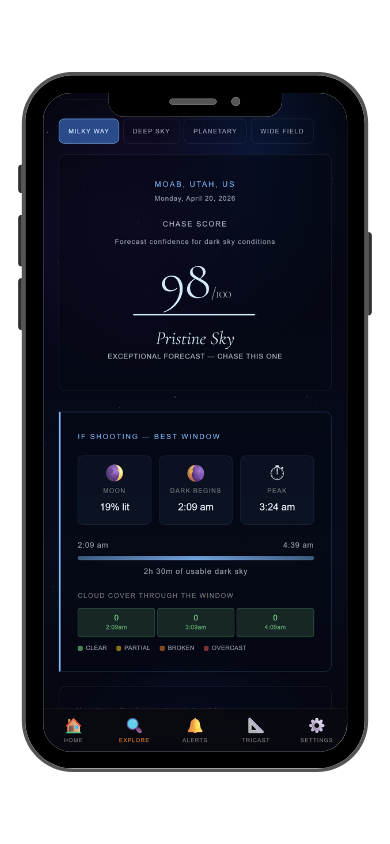
StarCast scores cloud cover, moon phase, atmospheric transparency, and seeing into a single night-sky verdict, updated daily for any location.
StarCast + More
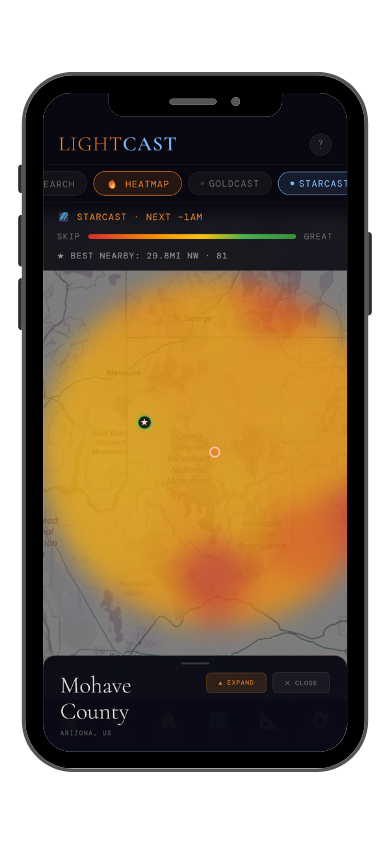
See the sky and the light on one map
Night sky · Nearby Conditions
StarCast scores cloud cover, moon phase, atmospheric transparency, and astronomical seeing. See on a map where skies are clearest before committing to the drive out to Arcadia or Burlingame.
Get Tonight's Forecast on iPhone
$2.99/mo · 7-day free trial
Learn More →
Frequently asked
Where can I see the Milky Way in Rhode Island?
Arcadia Management Area near the Connecticut border holds the darkest sky accessible in the state. Burlingame State Park is a slightly brighter but more central alternative. Check StarCast for tonight's conditions free on
web, full features in the
iOS app.
What is the darkest sky in Rhode Island?
Arcadia Management Area in the state's southwestern corner reads around Bortle 4, the darkest measured sky in Rhode Island. No site in the state reaches Bortle 3 given its size and population density.
When is the best time for astrophotography in Rhode Island?
The Milky Way core is visible from late March through October, peaking June through August. New moon windows are essential given Rhode Island's elevated Bortle ratings statewide. Coastal humidity can reduce transparency even on cloud-free nights, especially in late summer.
Does cloud cover matter for astrophotography?
Completely, and coastal proximity means humidity and marine haze are constant variables here. A clear sky over Providence doesn't guarantee the same conditions at Arcadia or the coast. StarCast scores both cloud cover and transparency separately, so you know whether a night is genuinely good or just technically clear.
What is LightCast StarCast?
StarCast scores night sky conditions using cloud cover, moon phase, atmospheric transparency, and astronomical seeing. GoldCast (same app) handles golden hour timing. Free on web at
lightcastsuite.com/starcast, full features in the
LightCast iOS app — $2.99/month after a 7-day free trial.