Astrophotography locations · South Carolina
Where to Shoot and What to Know Before You Drive
Columbia, Charleston, and the Greenville-Spartanburg area form South Carolina's main light domes, with the coast adding a secondary band of resort and city glow. The Blue Ridge Escarpment in the upstate gives the most dramatic dark sky in the state, with elevation working in your favor at sites like Caesars Head. The interior national forests and Congaree's old-growth floodplain offer a flatter, equally dark alternative for those not near the mountains. Humidity is a year-round consideration across the entire state.
🏔️
Caesars Head State Park, Blue Ridge Escarpment Bortle 2–3
A dramatic overlook at the edge of the Blue Ridge Escarpment in the far upstate, with sweeping views across the Piedmont below. The elevation and remote position near the North Carolina border give some of the darkest, clearest sky in South Carolina. The main overlook is easily accessible by car, a rare combination of darkness and convenience.
🌳
Congaree National Park Bortle 3–4
One of the largest intact old-growth bottomland hardwood forests remaining in the US, sitting in the floodplain southeast of Columbia. The park's protected status and low surrounding development keep light pollution well controlled despite its proximity to the capital. Boardwalk trails give limited but usable open-sky access; backcountry sites offer more.
🌲
Francis Marion National Forest, near Charleston Bortle 3–4
A large coastal plain forest northeast of Charleston, offering meaningful escape from the city's light dome without a long drive. The flat terrain and dense pine cover keep light pollution low across a wide area. A practical option for Lowcountry photographers who want dark sky without leaving the coastal region entirely.
🌲
Sumter National Forest, multiple units Bortle 3
Spanning several disconnected units across the upstate and midlands, Sumter National Forest's Long Cane and Enoree units offer rural, low-population dark sky away from the I-26 corridor. Less dramatic terrain than Caesars Head but reliably dark and easy to access from multiple directions.
🏝️
Hunting Island State Park, Beaufort County Bortle 4
A barrier island near Beaufort with a long, undeveloped beach giving an open Atlantic horizon. Not the darkest site on this list, but the wide ocean view and minimal foreground obstruction make it a strong option for Milky Way core shots over water during summer new moon windows.
Conditions matter as much as location
Check Before You Make the Drive
Driving up to Caesars Head only to find the escarpment socked in with valley fog is a common upstate frustration.
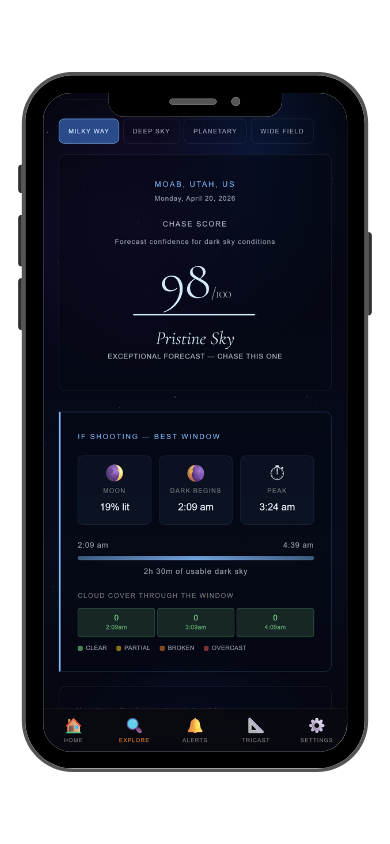
StarCast scores cloud cover, moon phase, atmospheric transparency, and seeing into a single night-sky verdict, updated daily for any location.
StarCast + More
See the sky and the light on one map
Night sky · Nearby Conditions
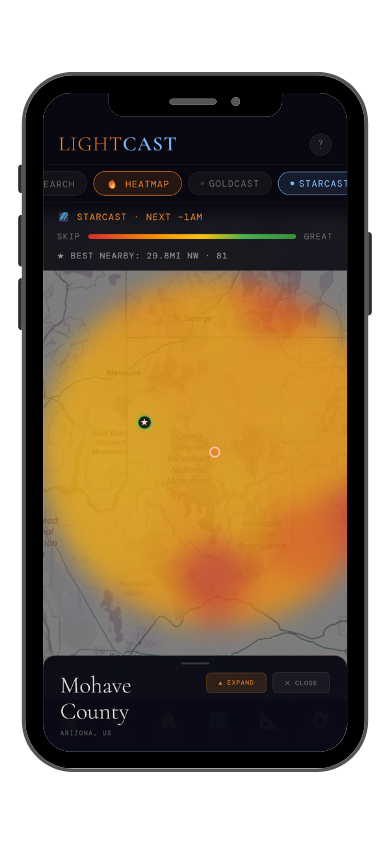
StarCast scores cloud cover, moon phase, atmospheric transparency, and astronomical seeing. See on a map where skies are clearest before committing to the drive out to Caesars Head or Congaree.
Get Tonight's Forecast on iPhone
$2.99/mo · 7-day free trial
Learn More →
Frequently asked
Where can I see the Milky Way in South Carolina?
Caesars Head State Park on the Blue Ridge Escarpment offers the darkest, most elevated sky in the state. Congaree National Park is a strong flatland alternative closer to Columbia. Check StarCast for tonight's conditions free on
web, full features in the
iOS app.
What is the darkest sky in South Carolina?
Caesars Head State Park and the surrounding upstate escarpment region read around Bortle 2 to 3, the darkest measured sky in South Carolina, due to elevation and distance from major metro areas.
When is the best time for astrophotography in South Carolina?
The Milky Way core is visible from late March through October, peaking June through August. Upstate elevation sites can see valley fog form overnight even on clear forecasts, so check transparency close to your shoot time. Coastal and Midlands sites deal with higher year-round humidity.
Does cloud cover matter for astrophotography?
Yes, and South Carolina's humid subtropical climate means hazy-but-clear nights are common, especially near the coast. StarCast scores both cloud cover and transparency separately, so you know whether a night is genuinely good or just technically clear.
What is LightCast StarCast?
StarCast scores night sky conditions using cloud cover, moon phase, atmospheric transparency, and astronomical seeing. GoldCast (same app) handles golden hour timing. Free on web at
lightcastsuite.com/starcast, full features in the
LightCast iOS app — $2.99/month after a 7-day free trial.