Astrophotography locations · South Dakota
Where to Shoot and What to Know Before You Drive
South Dakota's population centers around Sioux Falls and Rapid City, leaving the vast majority of the state genuinely dark. Badlands National Park is one of the best Milky Way destinations in the Midwest, combining near-pristine sky with otherworldly eroded terrain. The Black Hills add elevation and forest cover to the mix in the southwest, while the surrounding grasslands offer wide-open, unobstructed horizon almost everywhere else in the state.
🏜️
Badlands National Park Bortle 1–2
Dramatic eroded buttes and spires across 244,000 acres, with some of the darkest, most consistently clear sky in the Midwest. The park's overlooks along the Badlands Loop Road give easy access without backcountry hiking. Ranger-led night sky programs run in summer. Genuinely one of the best Milky Way destinations in the country, foreground included.
⛰️
Custer State Park, Black Hills Bortle 2–3
Granite peaks, pine forest, and open grassland combine in this Black Hills park southwest of Rapid City. The Needles Highway and Sylvan Lake area give elevated, varied foreground options. Slightly brighter than the Badlands due to proximity to Rapid City and the Black Hills tourist corridor, but still excellent.
🦬
Buffalo Gap National Grassland Bortle 1–2
Vast, sparsely populated grassland surrounding Badlands National Park, offering similar darkness with more solitude and fewer visitors. Wide open terrain gives an unobstructed horizon in every direction, ideal for full Milky Way arch panoramas.
🕳️
Wind Cave National Park, Black Hills Bortle 2
Mixed-grass prairie and ponderosa pine on the southern edge of the Black Hills, with free-ranging bison herds and minimal nearby development. The rolling prairie terrain gives a wide, open sky view distinct from the more enclosed forest sites elsewhere in the Hills.
🌲
Black Hills National Forest, general backcountry Bortle 2–3
The broader national forest surrounding Custer State Park and Mount Rushmore offers numerous dark, elevated overlooks beyond the more visited sites. Forest roads provide access to quieter locations with similar darkness and more solitude during peak tourist season.
Conditions matter as much as location
Check Before You Make the Drive
Driving out to the Badlands only to get caught in a sudden plains thunderstorm is the classic South Dakota risk.
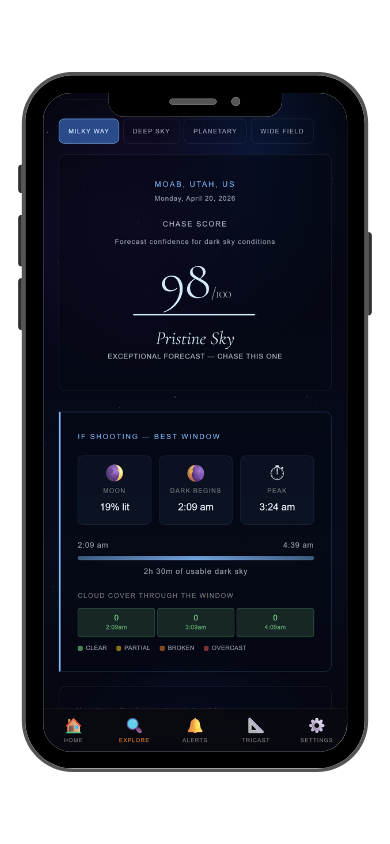
StarCast scores cloud cover, moon phase, atmospheric transparency, and seeing into a single night-sky verdict, updated daily for any location.
StarCast + More
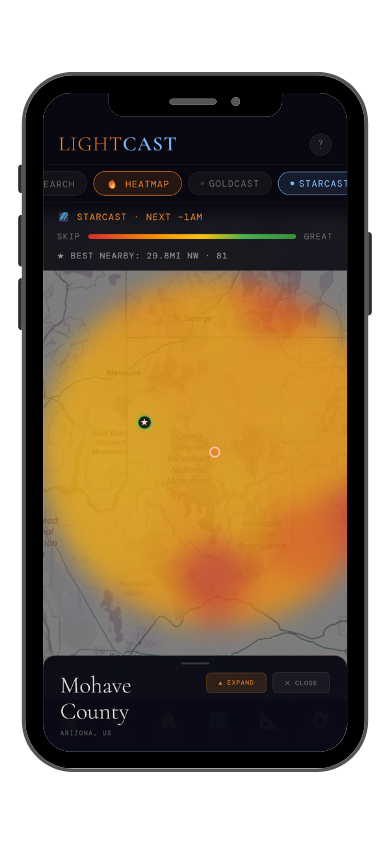
See the sky and the light on one map
Night sky · Nearby Conditions
StarCast scores cloud cover, moon phase, atmospheric transparency, and astronomical seeing. See on a map where skies are clearest before committing to the drive out to the Badlands or Custer State Park.
Get Tonight's Forecast on iPhone
$2.99/mo · 7-day free trial
Learn More →
Frequently asked
Where can I see the Milky Way in South Dakota?
Badlands National Park offers some of the darkest, most dramatic Milky Way foreground in the Midwest. Custer State Park and Wind Cave National Park in the Black Hills are excellent nearby alternatives. Check StarCast for tonight's conditions free on
web, full features in the
iOS app.
What is the darkest sky in South Dakota?
Badlands National Park and the surrounding Buffalo Gap National Grassland read Bortle 1 to 2 across most of their footprint, among the darkest sky available in the central United States.
When is the best time for astrophotography in South Dakota?
The Milky Way core is visible from late March through October, peaking June through August. Summer brings the highest risk of fast-moving plains thunderstorms, so check conditions close to your shoot time rather than relying on an early forecast. Fall often delivers the most stable, predictable clear nights.
Does cloud cover matter for astrophotography?
Yes, and Great Plains weather can change quickly, with storm cells forming with little warning in summer. StarCast scores both cloud cover and transparency separately, so you know whether a night is genuinely good or just technically clear.
What is LightCast StarCast?
StarCast scores night sky conditions using cloud cover, moon phase, atmospheric transparency, and astronomical seeing. GoldCast (same app) handles golden hour timing. Free on web at
lightcastsuite.com/starcast, full features in the
LightCast iOS app — $2.99/month after a 7-day free trial.