Astrophotography locations · Tennessee
Where to Shoot and What to Know Before You Drive
Nashville and Memphis create Tennessee's main light domes, with Knoxville and Chattanooga adding smaller ones in the east. Pickett CCC Memorial State Park on the Cumberland Plateau is a certified Dark Sky Park, one of the best documented dark sites in the Southeast. The Cherokee National Forest along the North Carolina border adds elevation to the mix, useful for clearer, more transparent air above valley haze. Humidity is the constant variable across the entire state.
🔭
Pickett CCC Memorial State Park & Forest Bortle 2
An International Dark Sky Park on the Cumberland Plateau near the Kentucky border, certified for its consistently dark, rural sky. The park borders Big South Fork, extending the dark footprint across a wide area. Pogue Creek Canyon overlooks give dramatic foreground without much hiking. One of the most reliable Milky Way destinations in the Southeast.
🏞️
Big South Fork National River and Recreation Area Bortle 2–3
Adjoining Pickett State Park, this sprawling river gorge area on the Cumberland Plateau shares similar darkness with more backcountry terrain to explore. Sandstone bluffs and overlooks along the gorge rim provide dramatic compositions over the river valley below.
🌲
Cherokee National Forest, eastern Tennessee Bortle 2–3
Spanning the Appalachian ridgeline along the North Carolina border, this forest gives elevated, mountainous terrain with minimal nearby development. Roan Mountain's bald summits offer some of the best high-elevation, open-sky shooting in the East. Distance from Knoxville and Johnson City keeps light pollution low.
🏔️
Great Smoky Mountains National Park, Tennessee side Bortle 3–4
Clingmans Dome and other high-elevation overlooks give wide views above valley haze, though the park sees significant visitor traffic. Cades Cove offers an open valley floor with mountain silhouettes as foreground. Best results come from weeknight visits during new moon to avoid both light and crowd interference.
🌾
Frozen Head State Park, Cumberland Plateau Bortle 3
Closer to Knoxville than Pickett, this rugged plateau park offers a shorter drive with still-solid darkness. Steep ridgeline trails lead to overlooks above the surrounding valley haze, making it a reasonable option for east Tennessee shooters without a long drive west.
Conditions matter as much as location
Check Before You Make the Drive
Driving out to Pickett only to find the plateau wrapped in valley haze by midnight is a familiar Tennessee letdown.
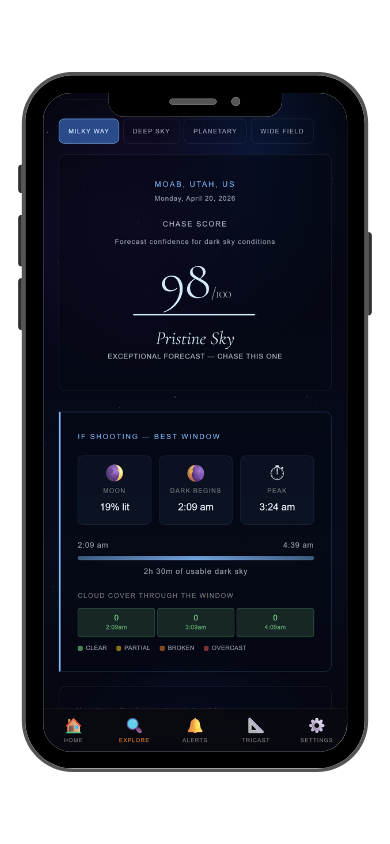
StarCast scores cloud cover, moon phase, atmospheric transparency, and seeing into a single night-sky verdict, updated daily for any location.
StarCast + More
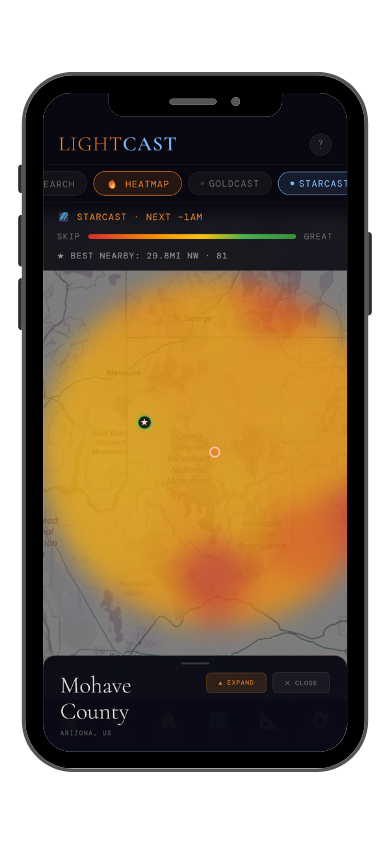
See the sky and the light on one map
Night sky · Nearby Conditions
StarCast scores cloud cover, moon phase, atmospheric transparency, and astronomical seeing. See on a map where skies are clearest before committing to the drive out to Pickett State Park or Big South Fork.
Get Tonight's Forecast on iPhone
$2.99/mo · 7-day free trial
Learn More →
Frequently asked
Where can I see the Milky Way in Tennessee?
Pickett CCC Memorial State Park on the Cumberland Plateau is a certified Dark Sky Park and the most reliable Milky Way destination in the state. Big South Fork shares similar darkness with more backcountry options. Check StarCast for tonight's conditions free on
web, full features in the
iOS app.
What is the darkest sky in Tennessee?
Pickett CCC Memorial State Park holds International Dark Sky Park certification and reads around Bortle 2, the darkest documented sky in the state.
When is the best time for astrophotography in Tennessee?
The Milky Way core is visible from late March through October, peaking June through August. Humidity-driven haze is a year-round concern, particularly in the valleys, so transparency matters as much as cloud cover when planning a shoot.
Does cloud cover matter for astrophotography?
Yes, completely. Appalachian valley fog and humid haze can sit below a technically clear sky, especially at lower elevations. StarCast scores both cloud cover and transparency separately, so you know whether a night is genuinely good or just technically clear.
What is LightCast StarCast?
StarCast scores night sky conditions using cloud cover, moon phase, atmospheric transparency, and astronomical seeing. GoldCast (same app) handles golden hour timing. Free on web at
lightcastsuite.com/starcast, full features in the
LightCast iOS app — $2.99/month after a 7-day free trial.