Astrophotography locations · Texas
Where to Shoot and What to Know Before You Drive
Texas is enormous, and its light pollution map reflects that: Dallas, Houston, San Antonio, and Austin dominate, but the Trans-Pecos region in the far west stays remarkably dark. Big Bend National Park is one of the darkest national parks in the lower 48, and the surrounding area forms the Greater Big Bend International Dark Sky Reserve. The Hill Country offers a much closer alternative for central Texas residents, with Enchanted Rock standing out as a certified site.
🏜️
Big Bend National Park Bortle 1–2
One of the darkest national parks in the country, sitting at the heart of the Greater Big Bend International Dark Sky Reserve. The Chisos Basin and Rio Grande overlooks give dramatic desert mountain foreground. The park's remote location, hours from any city, means almost no measurable artificial light interference. A genuine bucket-list astrophotography destination.
🔭
McDonald Observatory / Davis Mountains, Fort Davis Bortle 1–2
Home to one of the world's premier research observatories, chosen for this exact reason: exceptionally dark, stable air. The surrounding Davis Mountains State Park offers public-accessible overlooks with similarly excellent conditions. Observatory star parties run regularly and are worth checking before a visit.
🪨
Enchanted Rock State Natural Area, Hill Country Bortle 3
A massive pink granite dome rising from the Hill Country between Austin and San Antonio, popular for its accessible darkness relative to Texas's two largest metros. The summit gives a 360-degree open horizon. Permits are required for night access; plan ahead since sites can sell out on weekends.
🌵
Caprock Canyons State Park, Panhandle Bortle 2–3
A dramatic red-rock canyon system in the Texas Panhandle, offering Palo Duro-style scenery with less crowding and equally dark sky. The isolated rural panhandle setting keeps light pollution minimal across a wide surrounding area.
🌌
Devils River State Natural Area, southwest Texas Bortle 1–2
One of the most remote and least visited parks in Texas, with a free-flowing river canyon and almost no nearby development. Permits and reservations are required given limited access points, but the payoff is genuinely pristine sky comparable to Big Bend.
Conditions matter as much as location
Check Before You Make the Drive
Driving six hours out to Big Bend only to hit a dust haze rolling through the basin is a real Trans-Pecos risk.
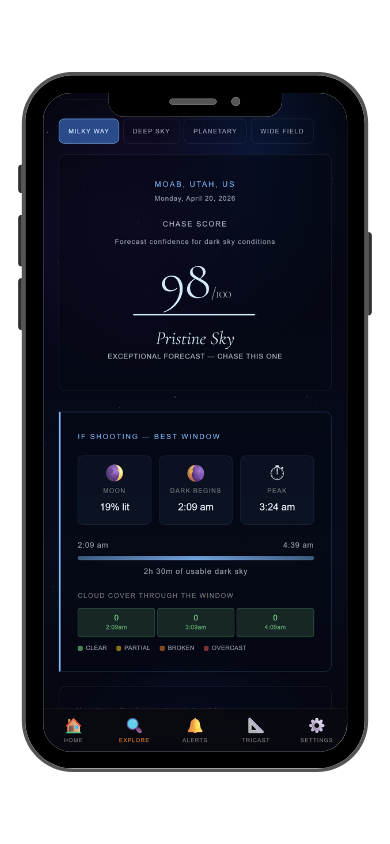
StarCast scores cloud cover, moon phase, atmospheric transparency, and seeing into a single night-sky verdict, updated daily for any location.
StarCast + More
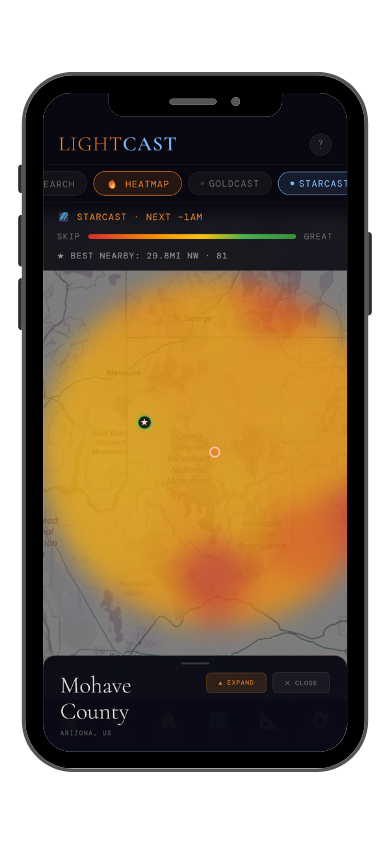
See the sky and the light on one map
Night sky · Nearby Conditions
StarCast scores cloud cover, moon phase, atmospheric transparency, and astronomical seeing. See on a map where skies are clearest before committing to the drive out to Big Bend or the Davis Mountains.
Get Tonight's Forecast on iPhone
$2.99/mo · 7-day free trial
Learn More →
Frequently asked
Where can I see the Milky Way in Texas?
Big Bend National Park and the surrounding Greater Big Bend International Dark Sky Reserve offer some of the darkest sky in the country. Enchanted Rock is a much closer option for central Texas residents. Check StarCast for tonight's conditions free on
web, full features in the
iOS app.
What is the darkest sky in Texas?
Big Bend National Park and the Davis Mountains near the McDonald Observatory both read Bortle 1 to 2, among the darkest sky measured anywhere in the continental US.
When is the best time for astrophotography in Texas?
The Milky Way core is visible from late March through October, peaking June through August. West Texas offers exceptionally stable, dry air much of the year, though spring winds can be intense in the high desert. Check transparency before committing to a long drive west.
Does cloud cover matter for astrophotography?
Yes, though West Texas generally sees far fewer humidity-driven haze nights than the rest of the state. Dust and wind are bigger localized factors in the desert. StarCast scores both cloud cover and transparency separately, so you know whether a night is genuinely good or just technically clear.
What is LightCast StarCast?
StarCast scores night sky conditions using cloud cover, moon phase, atmospheric transparency, and astronomical seeing. GoldCast (same app) handles golden hour timing. Free on web at
lightcastsuite.com/starcast, full features in the
LightCast iOS app — $2.99/month after a 7-day free trial.