Astrophotography locations · Vermont
Where to Shoot and What to Know Before You Drive
Vermont's low population density makes it one of the darker states in the Northeast overall, with Burlington as the only meaningful light dome. The Northeast Kingdom in the state's far corner holds the darkest sky in New England, rural and sparsely populated even by Vermont standards. The Green Mountains add elevation down the state's spine, useful for getting above valley humidity and haze that builds on summer nights.
🌲
Northeast Kingdom, Island Pond area Bortle 2
Vermont's most remote, least populated region, bordering New Hampshire and Quebec. Island Pond and the surrounding state forests offer some of the darkest sky in New England, with minimal light pollution from any direction. The region's isolation is the whole appeal here: fewer roads, fewer towns, more genuine darkness.
🏔️
Green Mountain National Forest, central spine Bortle 2–3
Running the length of the state, this forest offers elevated ridgeline access away from valley towns. Breadloaf Wilderness and other backcountry sections give some of the most remote terrain in the forest. Elevation helps clear summer haze that tends to settle in lower valleys.
💧
Groton State Forest Bortle 3
A cluster of ponds and forest in north-central Vermont, offering reflective water foreground with reasonably dark sky. Closer to Montpelier than the Northeast Kingdom, making it a practical option for central Vermont residents without the full drive northeast.
🏔️
Mount Mansfield & Smugglers' Notch Bortle 3
Vermont's highest peak, with the notch road (seasonal) giving elevated access between steep cliff walls. Closer to Burlington than the more remote sites, so some light dome influence remains, but the elevation and terrain still deliver solid results on clear nights.
🌾
Victory Basin Wildlife Management Area Bortle 2
A remote boreal wetland in the Northeast Kingdom, among the most undeveloped tracts of land in the state. Open bog terrain gives a wider horizon than the surrounding forest, with darkness on par with the best sites in New England.
Conditions matter as much as location
Check Before You Make the Drive
Driving up to the Northeast Kingdom only to hit a valley fog layer rolling in by midnight is a familiar Vermont letdown.
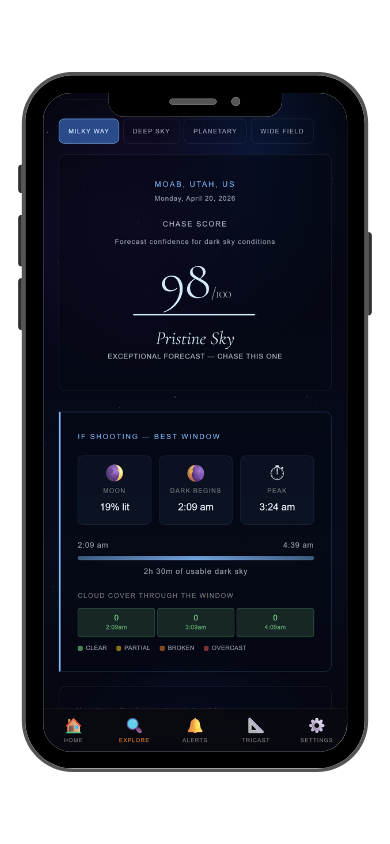
StarCast scores cloud cover, moon phase, atmospheric transparency, and seeing into a single night-sky verdict, updated daily for any location.
StarCast + More
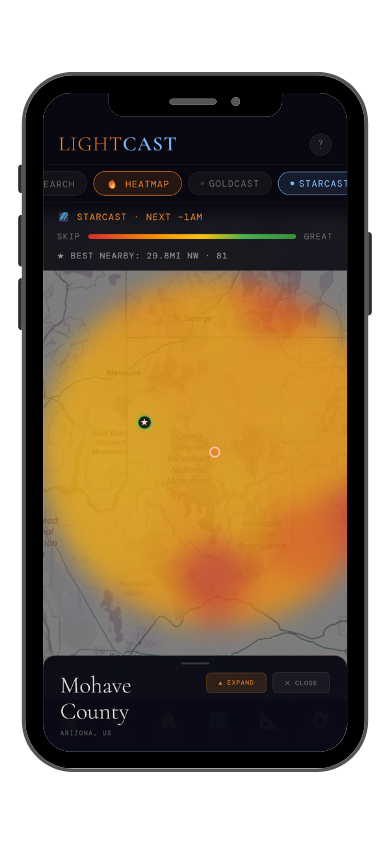
See the sky and the light on one map
Night sky · Nearby Conditions
StarCast scores cloud cover, moon phase, atmospheric transparency, and astronomical seeing. See on a map where skies are clearest before committing to the drive out to the Northeast Kingdom or Groton State Forest.
Get Tonight's Forecast on iPhone
$2.99/mo · 7-day free trial
Learn More →
Frequently asked
Where can I see the Milky Way in Vermont?
The Northeast Kingdom, particularly around Island Pond, holds the darkest sky in Vermont and in much of New England. Check StarCast for tonight's conditions free on
web, full features in the
iOS app.
What is the darkest sky in Vermont?
The Northeast Kingdom region, including Island Pond and Victory Basin Wildlife Management Area, reads around Bortle 2, the darkest measured sky in Vermont.
When is the best time for astrophotography in Vermont?
The Milky Way core is visible from late March through October, peaking June through August. New moon windows matter most given the state's elevated Bortle ratings outside the Northeast Kingdom. Watch for valley fog forming overnight, even on clear forecasts.
Does cloud cover matter for astrophotography?
Yes, even thin cirrus degrades deep-sky exposures, and Vermont's mountainous terrain generates localized cloud and fog patterns that don't always show up in regional forecasts. StarCast scores both cloud cover and transparency separately, so you know whether a night is genuinely good or just technically clear.
What is LightCast StarCast?
StarCast scores night sky conditions using cloud cover, moon phase, atmospheric transparency, and astronomical seeing. GoldCast (same app) handles golden hour timing. Free on web at
lightcastsuite.com/starcast, full features in the
LightCast iOS app — $2.99/month after a 7-day free trial.