Astrophotography locations · Virginia
Where to Shoot and What to Know Before You Drive
Northern Virginia and the DC metro create the state's largest light dome by far, with Richmond and Hampton Roads adding two more. The Blue Ridge and Allegheny Mountains in the west hold the state's darkest sky, with Shenandoah National Park's elevated ridgeline offering the most accessible option. The further southwest you go, the darker it gets, with Grayson Highlands near the North Carolina and Tennessee borders standing out as the best in the state.
🏔️
Shenandoah National Park, Skyline Drive overlooks Bortle 3–4
A long ridgeline park running the spine of the Blue Ridge, with over 75 overlooks along Skyline Drive offering easy roadside access to elevated, open sky. Big Meadows is a popular dedicated viewing spot with ranger-led astronomy programs in summer. Some DC glow is visible on the eastern horizon from northern sections of the park.
🌲
George Washington and Jefferson National Forest Bortle 2–3
Spanning much of western Virginia, this national forest offers darker, more remote sky than Shenandoah, particularly in its southwestern reaches. Less visitor traffic and more backcountry terrain make it a strong option for those wanting genuine solitude alongside the darkness.
⛰️
Grayson Highlands State Park, southwest Virginia Bortle 2
High-elevation balds near the North Carolina and Tennessee borders, with free-ranging wild ponies and sweeping open terrain rare for the eastern US. The combination of elevation, remoteness, and minimal regional light pollution makes this the darkest, most reliable site in the state.
🌊
False Cape State Park, coastal Virginia Bortle 3–4
A remote, undeveloped barrier beach south of Virginia Beach, accessible only by foot, bike, or boat. The isolation keeps light pollution surprisingly low for a coastal site this close to the Hampton Roads metro, and the open ocean horizon gives a true unobstructed sightline.
🏕️
Mount Rogers National Recreation Area Bortle 2
Home to Virginia's highest peak, adjacent to Grayson Highlands in the southwestern mountains. High-elevation balds and spruce-fir forest give some of the clearest, darkest air in the state, with multiple backcountry camping options for overnight shoots.
Conditions matter as much as location
Check Before You Make the Drive
Driving out to Shenandoah only to find DC haze drifting up the ridge is a familiar Virginia frustration.
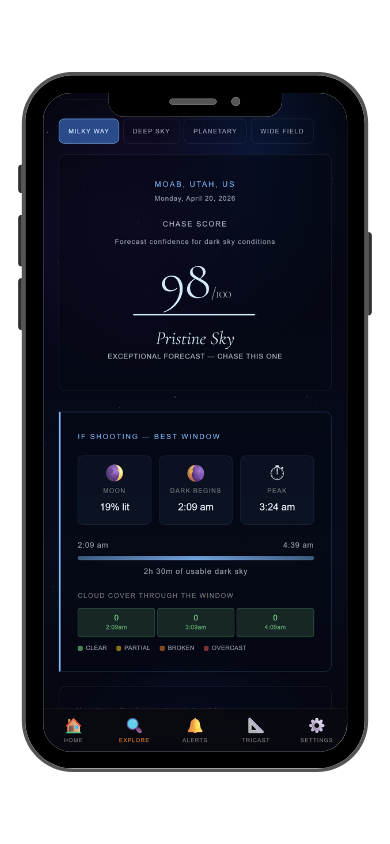
StarCast scores cloud cover, moon phase, atmospheric transparency, and seeing into a single night-sky verdict, updated daily for any location.
StarCast + More
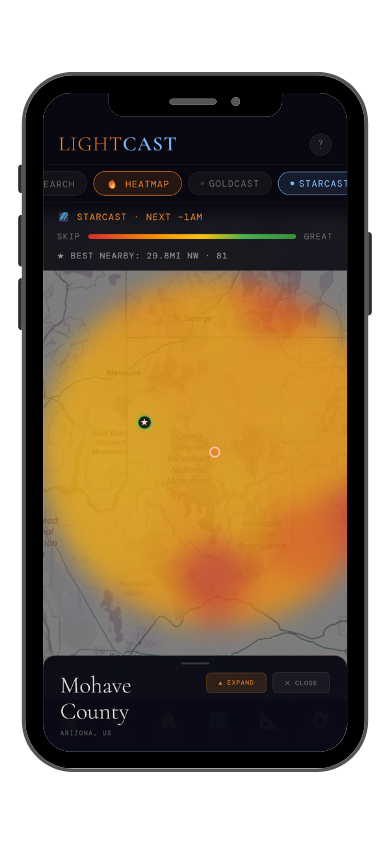
See the sky and the light on one map
Night sky · Nearby Conditions
StarCast scores cloud cover, moon phase, atmospheric transparency, and astronomical seeing. See on a map where skies are clearest before committing to the drive out to Shenandoah or Grayson Highlands.
Get Tonight's Forecast on iPhone
$2.99/mo · 7-day free trial
Learn More →
Frequently asked
Where can I see the Milky Way in Virginia?
Grayson Highlands State Park in the far southwest holds the darkest sky in Virginia. Shenandoah National Park's Skyline Drive overlooks are the most accessible option for those closer to DC or Richmond. Check StarCast for tonight's conditions free on
web, full features in the
iOS app.
What is the darkest sky in Virginia?
Grayson Highlands State Park and the adjacent Mount Rogers National Recreation Area read around Bortle 2, the darkest measured sky in Virginia, thanks to elevation and distance from any major metro.
When is the best time for astrophotography in Virginia?
The Milky Way core is visible from late March through October, peaking June through August. New moon windows matter more in eastern and central Virginia, where light pollution is higher. Summer humidity can reduce transparency even on cloud-free nights statewide.
Does cloud cover matter for astrophotography?
Yes, completely. Appalachian valley haze and DC-area humidity both reduce transparency even when the sky looks clear to the eye. StarCast scores both cloud cover and transparency separately, so you know whether a night is genuinely good or just technically clear.
What is LightCast StarCast?
StarCast scores night sky conditions using cloud cover, moon phase, atmospheric transparency, and astronomical seeing. GoldCast (same app) handles golden hour timing. Free on web at
lightcastsuite.com/starcast, full features in the
LightCast iOS app — $2.99/month after a 7-day free trial.