Astrophotography locations · Washington
Where to Shoot and What to Know Before You Drive
Seattle and the Puget Sound corridor create Washington's main light dome, but persistent Pacific cloud cover is often the bigger obstacle west of the Cascades. Crossing east into the Columbia Basin changes everything, with dry, clear desert air and a fraction of the light pollution. The Olympic Peninsula offers a different kind of opportunity on the west side, remote enough to escape Seattle's glow even under more variable skies.
🌲
Olympic National Park, Hoh Rain Forest & coast Bortle 2
One of the most remote regions in the contiguous US, with rainforest, mountains, and wild coastline combining for dramatic foreground options. Cloud cover is the dominant variable here, more than light pollution, since the peninsula sits in a temperate rainforest. When skies do clear, darkness is exceptional.
🏜️
Channeled Scablands, eastern Washington Bortle 1–2
Dramatic basalt coulees and canyons carved by ancient ice age floods, sitting in the dry, sparsely populated Columbia Basin. Sun Lakes-Dry Falls State Park offers easy access to this terrain with minimal nearby development. East of the Cascades sees far more clear nights annually than the coast.
🏔️
North Cascades National Park Bortle 2
Rugged, glaciated peaks in one of the least visited national parks in the lower 48, with minimal nearby development given the area's remoteness. Diablo Lake offers reflective foreground when accessible. Weather here can be unpredictable, so check conditions carefully before a trip.
🌋
Mount Rainier National Park, eastern approaches Bortle 2–3
The Sunrise area on Rainier's drier eastern side sees more clear nights than the wetter western approaches. High elevation and the mountain's massive silhouette make for dramatic Milky Way compositions in summer when the road is open.
🌵
Steptoe Butte State Park, Palouse region Bortle 2
A solitary butte rising from the rolling wheat fields of the Palouse in far eastern Washington, giving 360-degree open views over agricultural terrain. The region's low population and dry climate make it one of the most reliably clear, dark spots in the state.
Conditions matter as much as location
Check Before You Make the Drive
Driving out to the Olympic coast only to hit the marine layer rolling back in is the most common ruined night in western Washington.
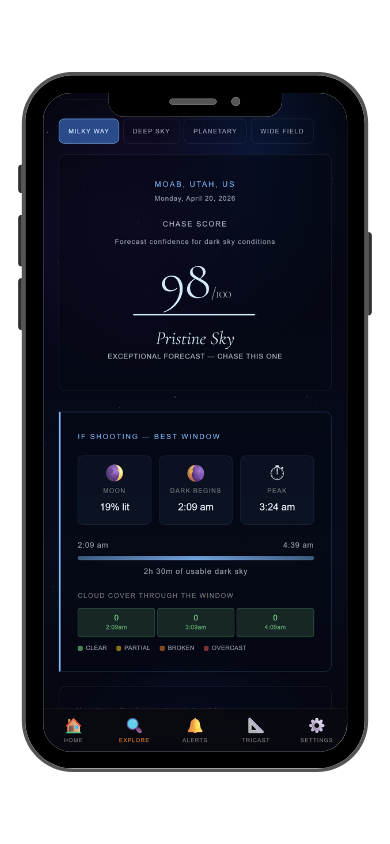
StarCast scores cloud cover, moon phase, atmospheric transparency, and seeing into a single night-sky verdict, updated daily for any location.
StarCast + More
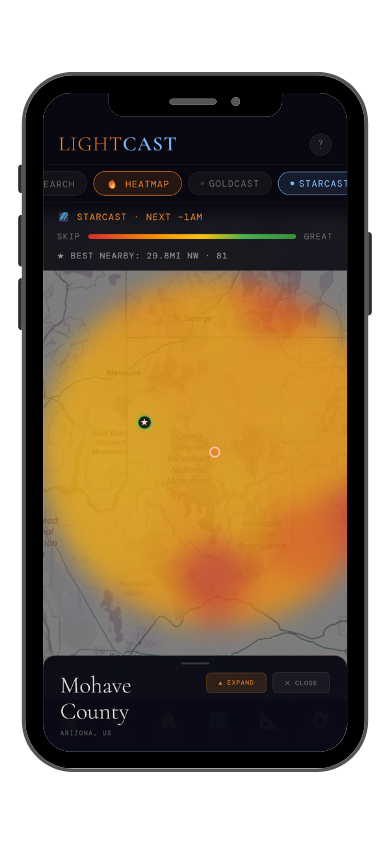
See the sky and the light on one map
Night sky · Nearby Conditions
StarCast scores cloud cover, moon phase, atmospheric transparency, and astronomical seeing. See on a map where skies are clearest before committing to the drive out to the Scablands or the Olympic Peninsula.
Get Tonight's Forecast on iPhone
$2.99/mo · 7-day free trial
Learn More →
Frequently asked
Where can I see the Milky Way in Washington?
The Channeled Scablands and Palouse region in eastern Washington see far more clear nights than the coast. Olympic National Park offers exceptional darkness on the rare clear night west of the Cascades. Check StarCast for tonight's conditions free on
web, full features in the
iOS app.
What is the darkest sky in Washington?
The Channeled Scablands and Steptoe Butte in eastern Washington both read Bortle 1 to 2, among the darkest measured sky in the state, helped by low population density and dry desert air.
When is the best time for astrophotography in Washington?
The Milky Way core is visible from late March through October, peaking June through August. East of the Cascades, summer offers the driest, clearest conditions of the year. West of the Cascades, persistent marine cloud cover makes clear nights less predictable even in summer.
Does cloud cover matter for astrophotography?
Yes, more so in Washington than almost anywhere else on this list, given the dramatic split between the cloudy coast and the dry eastern desert. A clear Seattle forecast says nothing about the Scablands. StarCast scores both cloud cover and transparency separately, so you know whether a night is genuinely good or just technically clear.
What is LightCast StarCast?
StarCast scores night sky conditions using cloud cover, moon phase, atmospheric transparency, and astronomical seeing. GoldCast (same app) handles golden hour timing. Free on web at
lightcastsuite.com/starcast, full features in the
LightCast iOS app — $2.99/month after a 7-day free trial.