Astrophotography locations · West Virginia
Where to Shoot and What to Know Before You Drive
West Virginia's mountainous terrain and low population density combine to make it one of the darkest states east of the Mississippi. The National Radio Quiet Zone around Green Bank restricts both radio and light emissions, an unusual federal protection that happens to be a huge win for astrophotographers. Spruce Knob and the high Alleghenies add elevation on top of that darkness, giving some of the best transparency in the eastern US.
📡
Green Bank, National Radio Quiet Zone Bortle 1–2
Home to the Green Bank Observatory and a federally mandated radio quiet zone that also keeps light pollution unusually low across the surrounding region. The combination of legal protection and genuine remoteness makes this one of the darkest, most consistent sites in the eastern US. Public stargazing events run periodically at the observatory.
⛰️
Spruce Knob, Monongahela National Forest Bortle 2
West Virginia's highest point, at 4,863 feet, with an observation tower giving a true 360-degree horizon above the surrounding ridgelines. The elevation puts shooters above much of the valley haze and humidity that affects lower-elevation sites in the region.
🌲
Dolly Sods Wilderness Bortle 2
A high-elevation plateau with sub-alpine bog terrain unlike anywhere else in the state, inside the broader Monongahela National Forest. Open, treeless sections of the plateau give wide sky access without much foreground obstruction. Weather can shift quickly at this elevation, so check conditions before committing.
🏞️
Canaan Valley National Wildlife Refuge Bortle 2–3
A high mountain valley known for frequent fog, which makes timing more important than at other sites on this list, but on clear nights the surrounding ridges block light from every direction. Open wetland terrain gives a wide horizon when conditions cooperate.
🌌
New River Gorge National Park Bortle 3
Closer to population centers in southern West Virginia, this deep river gorge offers dramatic foreground with reasonably dark sky. Overlooks along the gorge rim give elevated views over the canyon, a solid option for those not near the Quiet Zone.
Conditions matter as much as location
Check Before You Make the Drive
Driving out to Spruce Knob only to find the summit socked in with cloud is a real risk at that elevation.
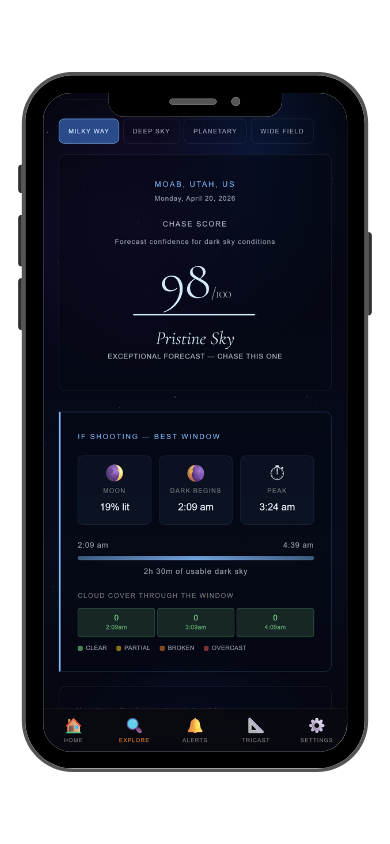
StarCast scores cloud cover, moon phase, atmospheric transparency, and seeing into a single night-sky verdict, updated daily for any location.
StarCast + More
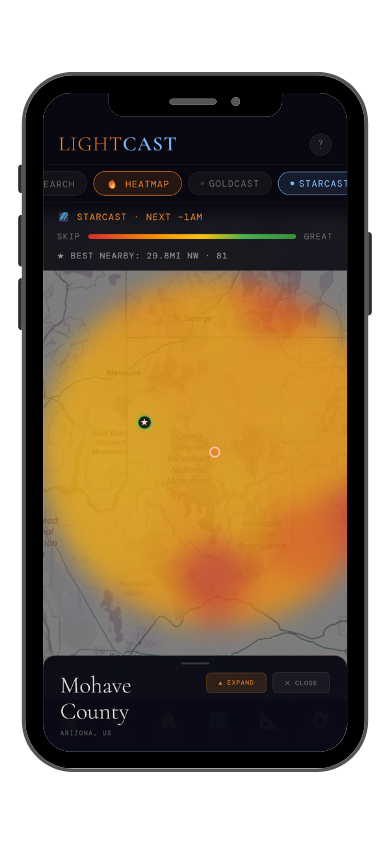
See the sky and the light on one map
Night sky · Nearby Conditions
StarCast scores cloud cover, moon phase, atmospheric transparency, and astronomical seeing. See on a map where skies are clearest before committing to the drive out to Spruce Knob or Green Bank.
Get Tonight's Forecast on iPhone
$2.99/mo · 7-day free trial
Learn More →
Frequently asked
Where can I see the Milky Way in West Virginia?
The Green Bank area inside the National Radio Quiet Zone and Spruce Knob in the Monongahela National Forest both offer exceptional, reliable darkness. Check StarCast for tonight's conditions free on
web, full features in the
iOS app.
What is the darkest sky in West Virginia?
The Green Bank National Radio Quiet Zone and Spruce Knob both read around Bortle 1 to 2, among the darkest measured sky in the eastern United States.
When is the best time for astrophotography in West Virginia?
The Milky Way core is visible from late March through October, peaking June through August. High-elevation sites like Spruce Knob and Dolly Sods can see fast-changing weather, so check conditions close to your shoot time rather than relying on an early forecast.
Does cloud cover matter for astrophotography?
Yes, and the Allegheny Highlands generate their own localized cloud and fog patterns that don't always show up in regional forecasts, particularly around Canaan Valley. StarCast scores both cloud cover and transparency separately, so you know whether a night is genuinely good or just technically clear.
What is LightCast StarCast?
StarCast scores night sky conditions using cloud cover, moon phase, atmospheric transparency, and astronomical seeing. GoldCast (same app) handles golden hour timing. Free on web at
lightcastsuite.com/starcast, full features in the
LightCast iOS app — $2.99/month after a 7-day free trial.