LightCast · Alaska

Best Landscape Photography Locations in Alaska
Midnight sun, aurora, and towering alpine terrain — the top spots in Alaska, and how to know when conditions are right before you make the drive.
iOS app: $2.99/mo · 7-day free trial
🌅 Sunset & Golden Hour · Alaska
Best Sunset Locations
Alaska's golden hour is unlike anywhere else in the lower 48. In summer, the sun barely sets — the low angle produces hours of warm directional light across glacier, tundra, and alpine terrain. In fall and winter, the sun tracks low all day, meaning nearly every clear hour is a golden hour. Cloud cover and mountain obscuration are the primary variables. The Alaska Range creates its own weather; peaks that were clear at noon can vanish into clouds by 4pm. Check GoldCast before committing to a location.
🏔️
Denali National Park: Wonder Lake & Reflection Pond Interior Alaska
Wonder Lake at Mile 85 of the park road is one of the most iconic landscape photography compositions in North America: Denali's north face reflected in the calm lake surface at dusk. The light at 11pm in June is genuinely golden, not just lingering. The catch is access — only bus transit travels the park road beyond Savage River. Book the camper bus well in advance and plan for multiple nights to get a clear mountain view. When it's clear, no other location in Alaska competes.
🌊
Kachemak Bay, Homer Spit Kenai Peninsula
Homer Spit juts four miles into Kachemak Bay, with Grewingk Glacier and the Kenai Mountains forming a dramatic backdrop to the southwest. Evening light hits the glacier face in summer, turning the ice pink and orange while the bay catches the reflection. The Spit itself has wide sightlines in every direction. September is the strongest month: the mountains have fresh snow, the crowds are gone, and sunsets start at a reasonable hour again after the endless summer evenings.
GoldCast
Golden hour timing + fog & cloud forecast
Sunset · Sunrise · Marine Layer · Cloud Cover
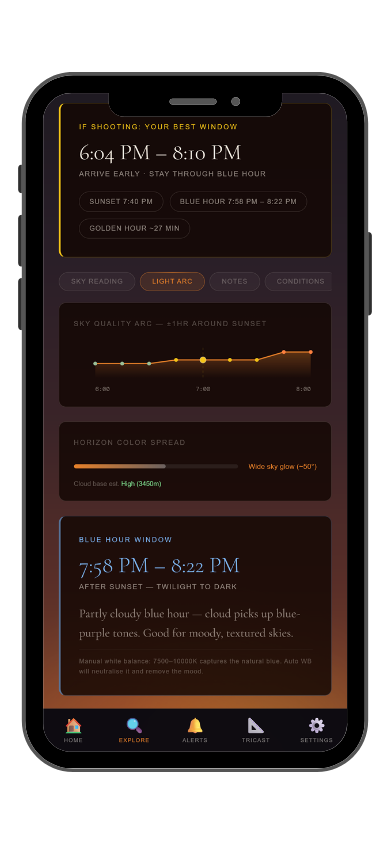
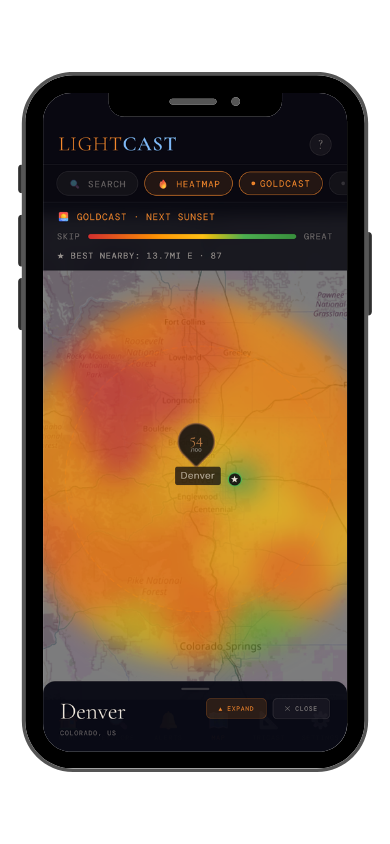
GoldCast shows exact golden hour and blue hour windows, plus cloud cover so you know whether the light will actually reach your subject. Check conditions for any Alaska location before you head out.
Get LightCast on iPhone
$2.99/mo · 7-day free trial
Check GoldCast on web →
GoldCast: golden hour forecast (left) · conditions heatmap (right)
🌌 Astrophotography · Alaska
Best Astrophotography Locations
Alaska above 60°N is aurora territory first. The Milky Way galactic core never rises high enough to be a practical target at these latitudes, but Bortle 1 skies are common across the interior, and the aurora borealis more than compensates. The window for actual darkness is September through March — summer has no astronomical night north of about 55°N. Fall is the sweet spot: clear fronts, dark skies by 10pm, and aurora activity picking up as the season progresses.
🌌
Fairbanks: Cleary Summit & Chena River State Recreation Area Bortle 2–3
Fairbanks sits directly under the auroral oval and is one of the most reliable aurora photography destinations in North America. Cleary Summit on the Steese Highway puts you above the valley inversion layer and provides a foreground ridge for composition. Chena River State Recreation Area east of town offers open meadows and calm river reflections. The aurora season runs September through March; February and March add snow-covered spruce as foreground. Check the Kp index the night before: Kp 3 or higher from Fairbanks typically means visible aurora overhead.
🏔️
Wrangell-St. Elias National Park Bortle 1–2
The largest national park in the US has some of the darkest skies on the continent. McCarthy Road leads into the park's accessible edge, where the Kennicott Glacier and the abandoned Kennecott Mine buildings provide extraordinary foregrounds for night sky shooting. The park is remote: McCarthy is a 60-mile gravel road from the highway. Plan for two or three nights minimum to account for weather. September and October are the practical window before roads deteriorate in winter conditions.
StarCast
Night sky score · moon · transparency · seeing
Cloud Cover · Moon Phase · Atmospheric Transparency · Seeing
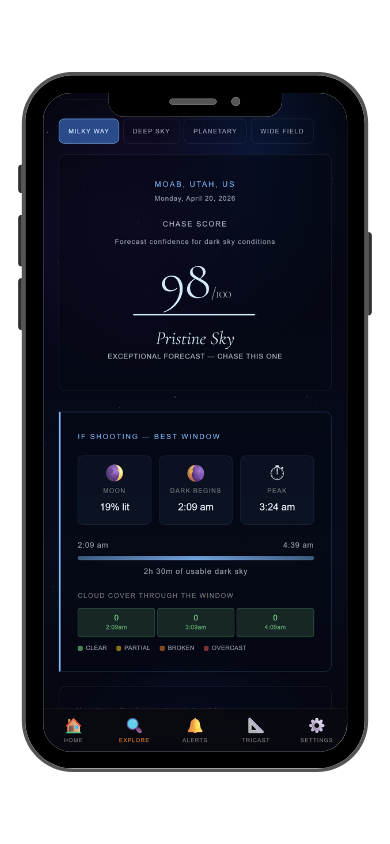
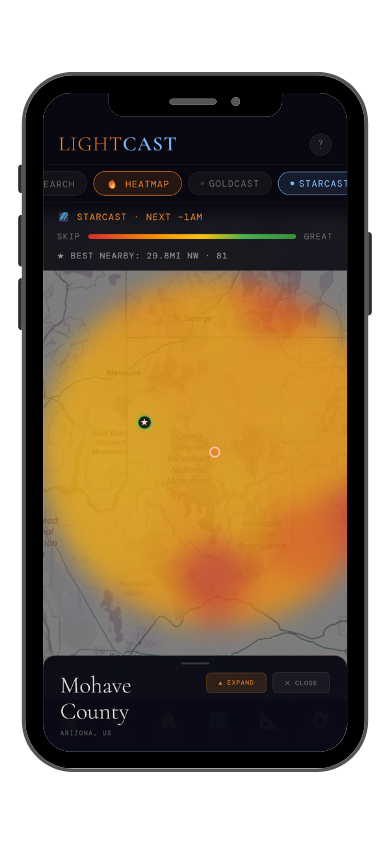
StarCast scores cloud cover, moon phase, atmospheric transparency, and astronomical seeing into a single verdict — updated daily for any location. See on a map where skies are clearest before committing to the drive.
Get LightCast on iPhone
$2.99/mo · 7-day free trial
Check StarCast on web →
StarCast: night sky score (left) · conditions heatmap (right)
🚁 Drone Photography · Alaska
Best Drone Locations
Alaska has vast areas of unrestricted airspace outside national park and FAA controlled zones — more accessible drone territory than virtually any other state. The visual payoff is extraordinary: glacier surfaces, braided rivers, coastal fjords. Always verify NPS rules before flying in any park unit, and check Dronecast for wind and gusts. Alaskan weather moves fast and unpredictably; calm morning conditions can shift to dangerous gusts within an hour at altitude.
🧊
Matanuska Glacier Matanuska-Susitna Valley
Matanuska Glacier is the largest glacier accessible by car in the US. The privately operated access road (fee required) allows you to walk on the ice — and drone flight is permitted on private land sections outside any park boundary. From altitude, the blue ice fractures and lateral moraines are genuinely unlike anything else in North America. Morning launches before the valley wind builds are essential. The glacier is retreating visibly year to year, making current imagery both photographically compelling and historically significant.
🌊
Resurrection Bay, Seward Kenai Peninsula
Resurrection Bay cuts deep into the Kenai Mountains south of Seward, flanked by steep fjord walls and tidewater glaciers. From the air, the scale of the terrain is immediately apparent in a way it isn't from the water. Exit Glacier Road and the area around Lowell Point provide good launch points outside the Kenai Fjords NPS boundary. Wind is channeled through the bay: early morning before 9am is the most reliable window. Harbor seals and sea otters are common in the bay and appear clearly from altitude against the dark water.
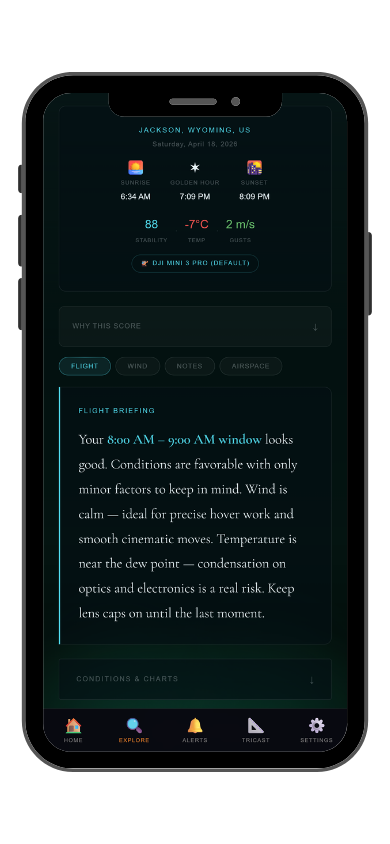
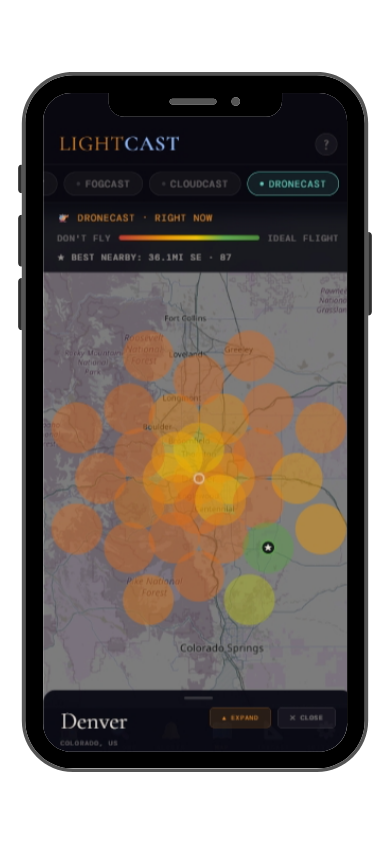
Dronecast
Wind, gusts, visibility & flight score
Wind Speed · Gusts · Visibility · Cloud Base
Dronecast scores wind speed, gusts, visibility, and cloud base into a single flight verdict — updated hourly. See window-by-window when conditions are safe and stable for your launch.
Get LightCast on iPhone
$2.99/mo · 7-day free trial
Check Dronecast on web →
Dronecast: flight score (left) · conditions heatmap (right)
LightCast · All tools
5 Forecasts in 1 App
🌫️
Fog Cast
Coastal fog, hour by hour
See when marine layer is expected to roll in or clear — so a fog bank doesn't end your golden hour session before it starts.
☁️
Cloud Cast
Cloud cover that matters to photographers
Not just "cloudy or clear" — see cloud type and coverage so you know whether you're getting dramatic texture or a blown-out white sky.
✦ Fog Cast and Cloud Cast are app-exclusive features
Frequently asked
Where is the best place to photograph sunset in Alaska?
Wonder Lake in Denali National Park is the most iconic sunset composition in the state, with Denali's north face reflected in the water. Homer Spit on the Kenai Peninsula delivers glacier-backed bay sunsets through September. Check
GoldCast for cloud cover and mountain obscuration forecasts before committing to either location.
Where can I photograph the aurora borealis in Alaska?
Fairbanks is the most reliable aurora destination, sitting directly under the auroral oval. Cleary Summit and Chena River State Recreation Area are the most accessible shooting locations from town. Aurora season runs September through March; check the Kp index and cloud cover via
StarCast the night you plan to shoot.
Can I fly a drone in Alaska's national parks?
Most NPS units in Alaska prohibit drone use without a permit. Denali, Kenai Fjords, and Wrangell-St. Elias all have drone restrictions. Alaska's vast state land and private land outside park boundaries offer enormous amounts of legal and accessible drone territory — Matanuska Glacier and Resurrection Bay are good examples.
What is the best time of year to photograph in Alaska?
It depends on the subject. For aurora: February and March. For landscape and golden hour: late August through September, when dark skies return after the midnight sun, fall color starts, and the mountains get their first snow. For drone work in accessible terrain: June and July. Summer is the busiest season logistically but has the fewest hours of darkness for night sky work.
What is LightCast?
LightCast is a suite of sky and weather tools built specifically for photographers.
GoldCast handles sunset and sunrise timing with cloud and fog forecasts.
StarCast scores night sky conditions for astrophotography.
Dronecast gives wind and visibility forecasts for drone pilots. All three are free on web; full features are available in the
LightCast iOS app — $2.99/month after a 7-day free trial.