🌅 Sunset & Golden Hour · Arkansas
Best Sunset Locations
Arkansas doesn't get the attention it deserves as a landscape photography destination. The Ozark and Ouachita ranges aren't high by western standards, but their densely forested ridgelines, exposed bluffs, and river valley overlooks deliver legitimate golden hour photography. Morning fog in the river valleys is the hidden asset — the Buffalo and Kings Rivers collect dense ground fog on cool mornings, which clears by midday to leave sparkling water and green banks. Check GoldCast to time both the fog burn-off and the evening light.
🏔️
Hawksbill Crag (Whitaker Point), Boxley Valley Newton County · Ozark NF
Hawksbill Crag is the most photographed spot in Arkansas: a sandstone outcropping that juts over a 150-foot drop above the Boxley Valley. The 2.8-mile trail is straightforward, and the overlook faces south and west for clean evening light. October morning fog filling the valley below is the classic composition. Fall color peaks in mid-October, when the valley maple and sycamore turn orange and yellow against the evergreen ridgelines. Arrive at the trailhead by dawn for morning shoots; the parking area fills on weekends.
🌊
Buffalo National River: Steel Creek & Ponca Newton County
The upper Buffalo River corridor around Ponca and Steel Creek is Arkansas's most photogenic river landscape. The limestone bluffs rise several hundred feet above the river, catching warm light from mid-afternoon through sunset. Steel Creek meadow gives a wide-angle view of the bluffs with the river in the foreground. Low-water season (late summer through fall) is best for foreground access. Morning mist rising off the river in September and October can be exceptional, but it burns off fast — be there by sunrise.
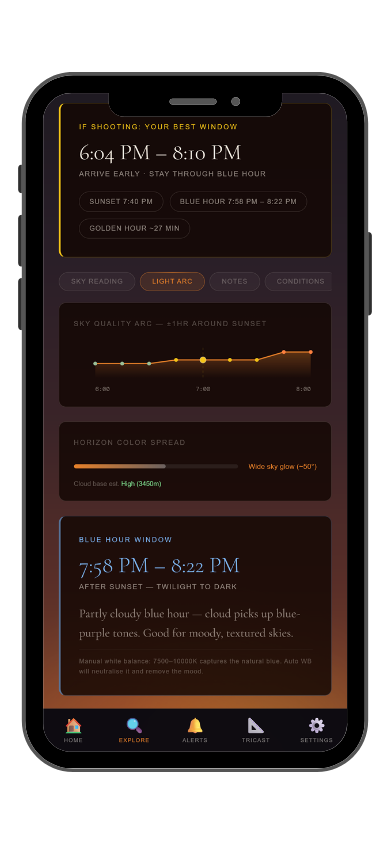
GoldCast
Golden hour timing + fog & cloud forecast
Sunset · Sunrise · Fog · Cloud Cover
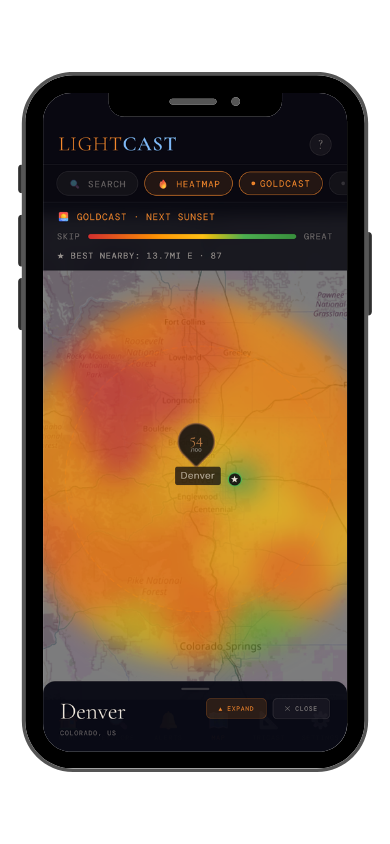
GoldCast shows exact golden hour and blue hour windows, plus cloud cover and fog so you know whether the light will actually reach your subject. Check conditions for any Arkansas location before you leave.
Get LightCast on iPhone
$2.99/mo · 7-day free trial
Check GoldCast on web →
GoldCast: golden hour forecast (left) · conditions heatmap (right)
🌌 Astrophotography · Arkansas
Best Astrophotography Locations
Arkansas is surprisingly workable for astrophotography. The Ozark Plateau's rural core is mostly Bortle 3–4, far enough from Little Rock, Fayetteville, and Memphis to shoot the Milky Way clearly on a good night. Summer humidity is the main enemy — even clear nights in July and August often have enough moisture in the air to reduce transparency significantly. Fall is the most reliable season: cooler air, drier fronts, and a galactic core that sets earlier but is still up for a few hours after dark.
🌲
Boxley Valley, Buffalo National River Bortle 3–4
The valley floor meadows between Ponca and Boxley are some of Arkansas's darkest accessible locations. Elk are common in the meadows at night — they make striking foreground subjects with enough ambient light for focus. The valley walls block some horizon, but the open sky overhead is genuinely dark. March through May is the best Milky Way window; the galactic core rises in the south by 11pm in April. Bring a headlamp with a red mode and avoid leaving your vehicle's lights on in the meadow during elk season.
🏞️
Ouachita National Forest: Lake Ouachita Bortle 3
Lake Ouachita in west-central Arkansas sits in one of the state's most light-pollution-free corridors, equidistant from Hot Springs and the Oklahoma border. The lake's irregular shoreline creates countless foreground options, and the pine-covered hillsides give a clean southern horizon. Crystal Recreation Area and Brady Mountain Road are accessible launch points. September and October are the most reliable for both sky conditions and comfortable temperatures. The lake is also Arkansas's clearest: underwater visibility up to 40 feet, which makes it distinctive in long-exposure foreground shots.
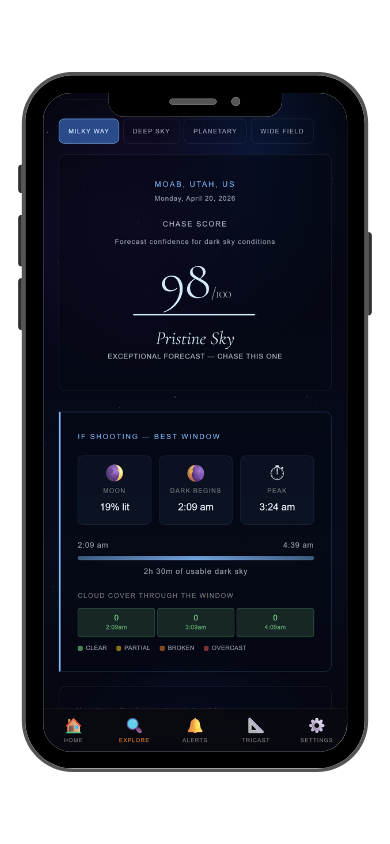
StarCast
Night sky score · moon · transparency · seeing
Cloud Cover · Moon Phase · Atmospheric Transparency · Seeing
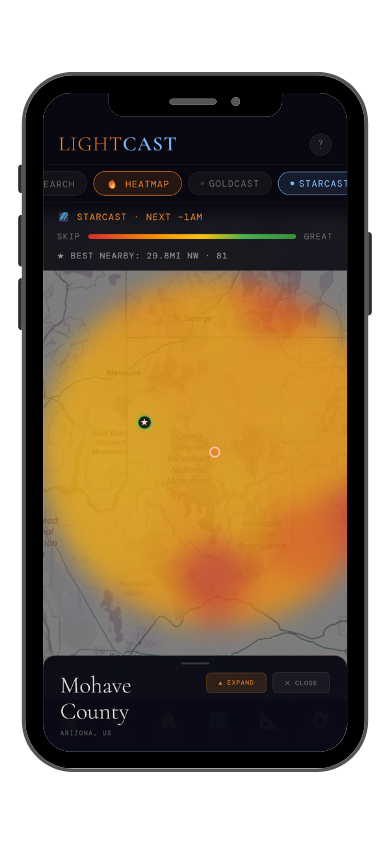
StarCast scores cloud cover, moon phase, atmospheric transparency, and astronomical seeing into a single verdict — updated daily for any location. See on a map where skies are clearest before committing to the drive.
Get LightCast on iPhone
$2.99/mo · 7-day free trial
Check StarCast on web →
StarCast: night sky score (left) · conditions heatmap (right)
🚁 Drone Photography · Arkansas
Best Drone Locations
Arkansas has generous open airspace across its rural interior, and the Ozark and Ouachita terrain reads dramatically from the air. Buffalo National River is federally managed and restricts drone use; always verify NPS rules before flying in any river corridor. Ozark National Forest land outside wilderness areas and state park open sections provide the most accessible legal territory. Check Dronecast for wind; ridge and valley terrain creates localized turbulence that ground-level conditions don't always predict.
🏔️
Mount Magazine State Park Logan County · Highest Point in Arkansas
At 2,753 feet, Magazine Mountain is the highest point in Arkansas, and the aerial view from the summit plateau covers an extraordinary range of the Arkansas River valley and surrounding Ouachita terrain. The Cameron Bluff overlook at the western end gives the widest vista. State park drone rules vary: check with park management before flying. Wind on the summit ridge is the primary challenge — the exposure is significant and gusts that barely register at the visitor center can be substantial at altitude. Morning launches from the east end of the park avoid the strongest afternoon ridge winds.
🌊
Arkansas River Valley, Ozark Area Franklin & Johnson Counties
The Arkansas River's wide floodplain between Fort Smith and Russellville is excellent drone territory: farmland, river bends, and the distinctive flat-topped mesas of the Arkansas River Valley are all most legible from altitude. The river's broad sandbars and oxbow lakes create natural compositions. BLM and Army Corps of Engineers land along the river corridor is generally accessible for drone use, but verify before flying and check FAA for any temporary flight restrictions near Lock and Dam facilities. Early morning in fall gives the best light and the calmest air.
Dronecast
Wind, gusts, visibility & flight score
Wind Speed · Gusts · Visibility · Cloud Base
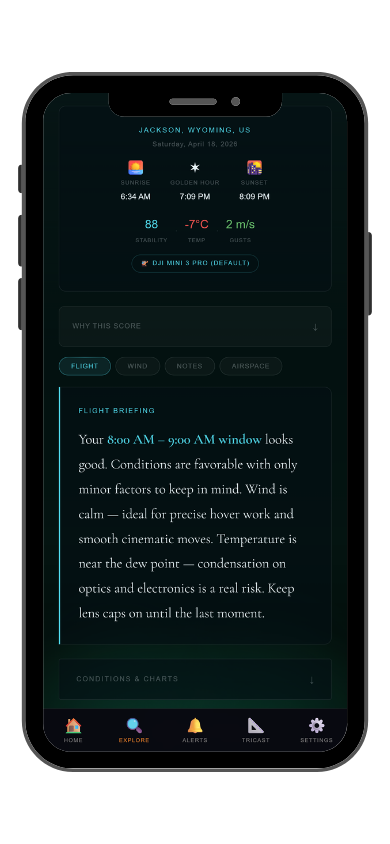
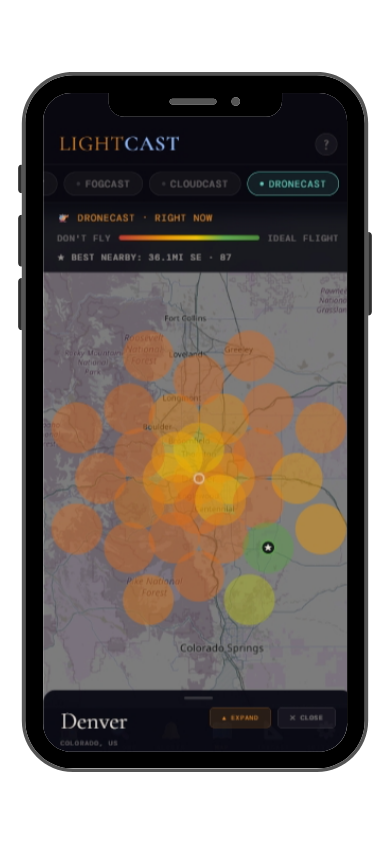
Dronecast scores wind speed, gusts, visibility, and cloud base into a single flight verdict — updated hourly. See window-by-window when conditions are safe and stable for your launch.
Get LightCast on iPhone
$2.99/mo · 7-day free trial
Check Dronecast on web →
Dronecast: flight score (left) · conditions heatmap (right)
Frequently asked
Where is the best place to photograph sunset in Arkansas?
Hawksbill Crag in Newton County is the most iconic viewpoint in the state, with a sandstone overlook above the Boxley Valley. Steel Creek along the Buffalo National River is a close second. Fall delivers the best combination of color and clear evenings. Check
GoldCast for cloud cover and fog forecasts before making the drive into the Ozarks.
Where can I see the Milky Way in Arkansas?
Boxley Valley and Lake Ouachita are the most accessible dark sky locations. Neither requires four-wheel drive, and both offer Bortle 3 skies on clear nights. Spring (March through May) is the best window for the galactic core. Check
StarCast for moon phase and atmospheric transparency first.
Can I fly a drone at Buffalo National River?
Buffalo National River is federally managed by the NPS, which restricts drone use in most areas. Check directly with the park for current permit rules. Ozark National Forest land and state land adjacent to the park are generally accessible, but verify FAA authorization for the specific airspace before flying.
What is the best time of year for fall color in Arkansas?
Peak fall color in the Ozarks typically runs mid-October through early November, with higher elevations (Hawksbill Crag, Mount Magazine) usually peaking first. The Buffalo River valley maples tend to peak around October 15–25 most years. Fog in the valleys adds to the atmosphere; GoldCast's fog forecast can help you plan a sunrise shoot with ground fog in the valley below.
What is LightCast?
LightCast is a suite of sky and weather tools built specifically for photographers.
GoldCast handles sunset and sunrise timing with cloud and fog forecasts.
StarCast scores night sky conditions for astrophotography.
Dronecast gives wind and visibility forecasts for drone pilots. All three are free on web; full features are available in the
LightCast iOS app — $2.99/month after a 7-day free trial.