LightCast · Colorado
Best Landscape Photography Locations in Colorado
Alpine peaks, Bortle 2 skies, and fall aspen color — the top spots in Colorado, and how to know when conditions are right before you make the drive.
iOS app: $2.99/mo · 7-day free trial
🌅 Sunset & Golden Hour · Colorado
Best Sunset Locations
Colorado's 14,000-foot peaks produce alpenglow that you simply can't replicate at lower elevations: the last light of the day turns granite faces pink, then deep rose, then purple as the sun drops behind the western range. Afternoon thunderstorms are daily in summer — typically building by noon and clearing by 6pm, often leaving dramatic cloud structure right at golden hour. The tradeoff is worth it, but check GoldCast before heading up any mountain road.
🏔️
Maroon Bells, Aspen Pitkin County · Elk Mountains
Maroon Bells reflected in Maroon Lake may be the single most photographed mountain scene in Colorado. The twin peaks catch alpenglow in the last 20 minutes before full dark in late summer and fall. Access is by mandatory shuttle from Aspen Highlands during peak season (late June through early October); photographers arriving for sunrise need to take the earliest bus, which leaves at 5am. The reflection in the lake requires calm air, which is most reliable before 9am or in the final minutes before sunset. Fall color typically peaks in late September, when the hillsides turn gold and orange.
🌋
Great Sand Dunes National Park Alamosa County · San Luis Valley
The tallest dunes in North America sit against the Sangre de Cristo Mountains, creating a surreal landscape that reads powerfully in evening light. The dune faces catch side lighting from the west in the hour before sunset, which brings out the dune ridge textures dramatically. The Sangres behind the dunes catch alpenglow simultaneously. Medano Creek, which flows at the base of the dunes in spring and early summer, adds reflective water foreground. The San Luis Valley has reliably dry air and low humidity, making for good transparency even in summer.
GoldCast
Golden hour timing + fog & cloud forecast
Sunset · Sunrise · Cloud Cover · Storm Clearing
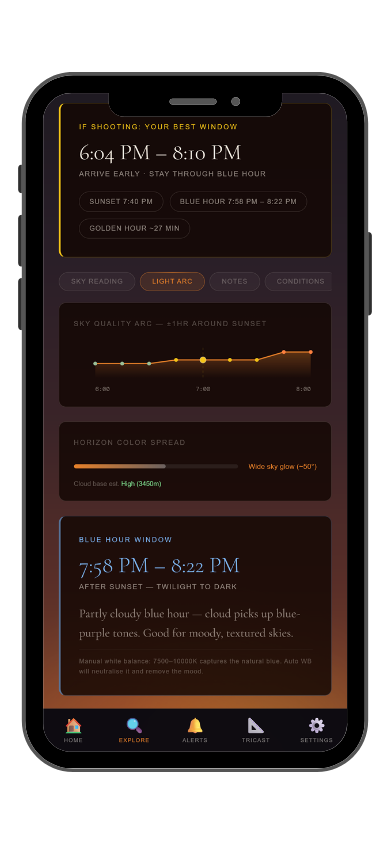
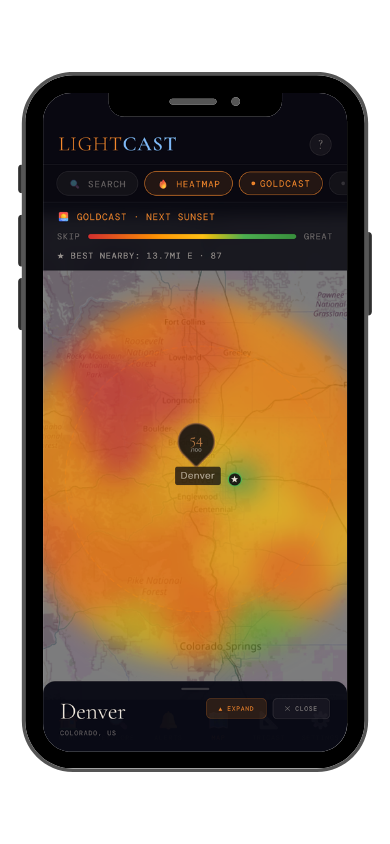
GoldCast shows exact golden hour and blue hour windows, plus cloud cover so you know whether the light will reach your subject. Check conditions for any Colorado location before you leave — mountain weather moves fast.
Get LightCast on iPhone
$2.99/mo · 7-day free trial
Check GoldCast on web →
GoldCast: golden hour forecast (left) · conditions heatmap (right)
🌌 Astrophotography · Colorado
Best Astrophotography Locations
Colorado's high altitude and inland location give it some of the best atmospheric transparency in the lower 48. The San Luis Valley and the San Juan Mountains in the southwest are the darkest regions. The Milky Way core is visible from Colorado from late March through October — peak season is June and July, when the galactic core rises high in the south and transparency is excellent on storm-free nights. The main enemies are summer afternoon lightning and the light glow from Denver's Front Range sprawl.
🏜️
Great Sand Dunes National Park Bortle 2–3
The San Luis Valley surrounding Great Sand Dunes is one of Colorado's prime astrophotography corridors. The dunes themselves are an extraordinary foreground: the dune ridges and shadows create abstract shapes at ground level that work well with a wide Milky Way arc overhead. The park has no ambient lighting in the main dune field; the nearest glow is Alamosa to the southeast, which is low on the horizon. Spring and fall avoid summer afternoon storm interference. The park road stays open until midnight, and the sand holds daytime warmth into the evening even when air temperatures drop fast.
🏔️
Ouray & San Juan Mountains Bortle 2
The southwest Colorado mountain corridor around Ouray, Silverton, and Telluride is among the darkest terrain in the state. The high passes, particularly along the Million Dollar Highway and at Ophir Pass, give elevated shooting platforms above valley haze. Abandoned mining structures in the area make for compelling foreground subjects at night. The summer Milky Way season is productive here when afternoon storms clear — which they often do by 9 or 10pm. Fall is more stable: cleaner air, no storms, and the galactic core is still up for a few hours after dark in early September.
StarCast
Night sky score · moon · transparency · seeing
Cloud Cover · Moon Phase · Atmospheric Transparency · Seeing
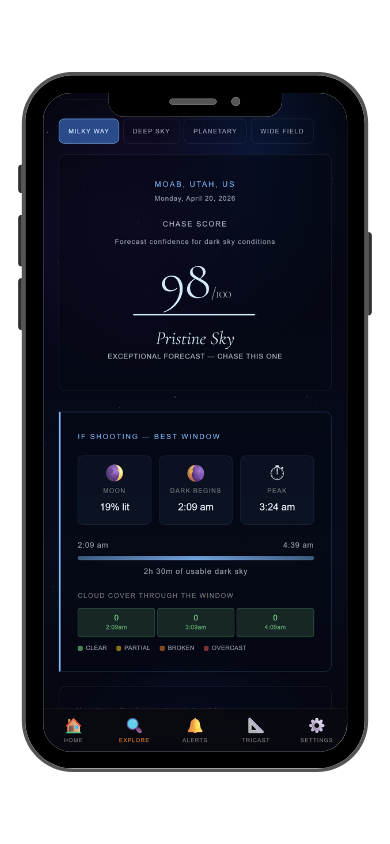
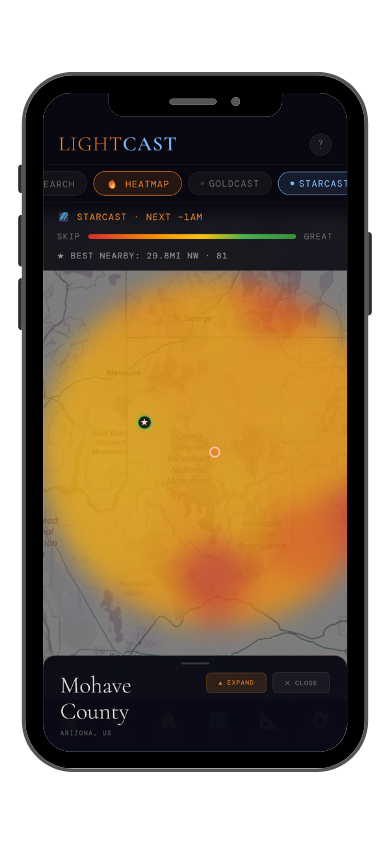
StarCast scores cloud cover, moon phase, atmospheric transparency, and astronomical seeing into a single verdict — updated daily for any location. See on a map where skies are clearest before committing to the drive.
Get LightCast on iPhone
$2.99/mo · 7-day free trial
Check StarCast on web →
StarCast: night sky score (left) · conditions heatmap (right)
🚁 Drone Photography · Colorado
Best Drone Locations
Colorado offers some of the most dramatic aerial terrain in North America, but national park and wilderness area restrictions cover a significant portion of the best scenery. Always verify FAA authorization and NPS, USFS, or BLM rules before flying. High altitude affects drone performance: battery life drops significantly at 10,000+ feet, and thin air reduces lift. Check Dronecast for wind, which at mountain elevations can be deceptive; gusts in ridgeline terrain are much stronger than valley-level forecasts suggest.
🏔️
Black Canyon of the Gunnison: South Rim Road Montrose County
The Black Canyon drops 2,700 feet in places, with near-vertical walls of ancient Precambrian rock that catch extraordinary light at sunrise and sunset. NPS prohibits drone use inside the monument, but the BLM land along the South Rim outside the monument boundary allows flight. The Gunnison Gorge National Conservation Area directly adjacent to the monument provides good launch points. The canyon walls create serious updrafts; morning launches before wind builds are significantly more stable than afternoon. The scale of the canyon only becomes fully apparent from altitude.
🏜️
San Luis Valley: Zapata Falls & Baca National Wildlife Refuge Alamosa County
The broad San Luis Valley provides open, unrestricted airspace across most of its length, with the Sangre de Cristo Mountains as a backdrop on the east and the San Juan Mountains to the west. Zapata Falls BLM area is an accessible launch point with the Blanca Massif visible to the north. The Baca National Wildlife Refuge allows drone use by permit — check with the refuge office in advance. Valley floor winds are generally calm in early morning, then build steadily from the west by midday. The flat agricultural patchwork of the valley floor is a distinctive aerial subject in its own right.
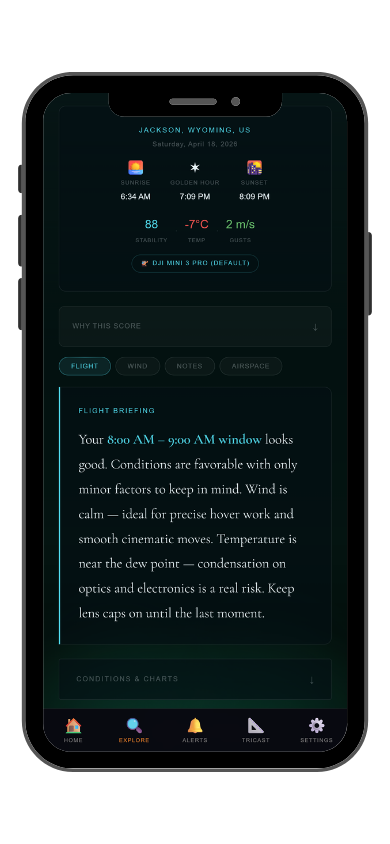
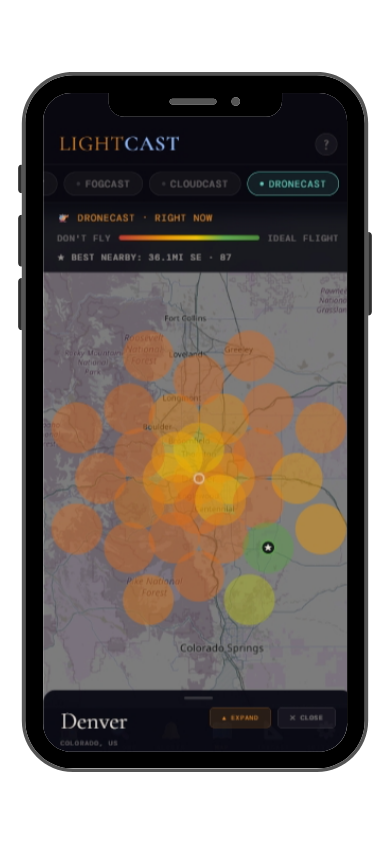
Dronecast
Wind, gusts, visibility & flight score
Wind Speed · Gusts · Visibility · Cloud Base
Dronecast scores wind speed, gusts, visibility, and cloud base into a single flight verdict — updated hourly. See window-by-window when conditions are safe and stable for your launch.
Get LightCast on iPhone
$2.99/mo · 7-day free trial
Check Dronecast on web →
Dronecast: flight score (left) · conditions heatmap (right)
LightCast · All tools
5 Forecasts in 1 App
🌫️
Fog Cast
Valley fog, hour by hour
See when valley fog is expected to form or clear — so you know when to be at the overlook for that sunrise shot above the clouds.
☁️
Cloud Cast
Cloud cover that matters to photographers
Not just "cloudy or clear" — see cloud type and coverage so you know whether you're getting dramatic alpenglow texture or a blocked-out summit.
✦ Fog Cast and Cloud Cast are app-exclusive features
Frequently asked
Where is the best place to photograph sunset in Colorado?
Maroon Bells near Aspen is the most iconic location, with alpenglow on twin peaks reflected in Maroon Lake. Great Sand Dunes offers a completely different composition: dune ridges with the Sangre de Cristos behind them. Both require checking the forecast — afternoon storms are common and can block the light entirely. Use
GoldCast to track cloud cover and storm clearing.
Where can I see the Milky Way in Colorado?
Great Sand Dunes and the San Juan Mountains around Ouray and Silverton are the darkest accessible areas. Both sit in Bortle 2 territory. The window is April through October; June and July are peak for galactic core height. Check
StarCast for moon phase, transparency, and storm clearing before committing to a mountain drive.
Can I fly a drone at Rocky Mountain National Park?
No. Rocky Mountain National Park prohibits drone use within park boundaries, as do most other NPS units in Colorado. BLM land, Arapaho/Roosevelt National Forest areas outside wilderness zones, and state wildlife areas provide the most accessible legal territory. Always verify before flying.
When does fall color peak in Colorado?
Colorado's aspen color typically peaks from mid-September through early October, varying by elevation. The Maroon Bells area usually peaks around September 20–28. The San Juan Mountains around Telluride and Ouray run slightly later, peaking in early October at higher elevations. Both years and locations vary; check the forecast for clear skies with
GoldCast and time your shoot around the peak window.
What is LightCast?
LightCast is a suite of sky and weather tools built specifically for photographers.
GoldCast handles sunset and sunrise timing with cloud and fog forecasts.
StarCast scores night sky conditions for astrophotography.
Dronecast gives wind and visibility forecasts for drone pilots. All three are free on web; full features are available in the
LightCast iOS app — $2.99/month after a 7-day free trial.