🌅 Sunset & Golden Hour · Hawaii
Best Sunset Locations
Hawaii's summit locations produce some of the most dramatic sunset photography in the world because you're shooting from above the cloud layer. At 10,000 feet and above, you watch the sun set over an ocean of clouds while the peaks catch warm alpenglow. Trade wind clouds build throughout the day and often sit below 7,000 feet, meaning clear summit conditions while the lowlands are socked in. Check GoldCast for cloud layer height before driving up.
🌋
Haleakala Summit, Maui Maui County · 10,023 ft
Haleakala's summit crater is one of the most famous sunrise photography locations on earth, but sunset is equally spectacular and less crowded. The crater rim gives views in every direction above the trade wind cloud layer. The moonscape of the crater — red cinder cones and silversword plants — provides otherworldly foreground. Summit reservations are required for sunrise; sunset is first-come, first-served. Road to the summit takes about 90 minutes from Paia; account for traffic at the top. Temperatures drop to near freezing even in summer — bring layers.
🌊
Pololu Valley Lookout, Big Island Hawaii County · North Kohala
The Pololu Valley overlook on the Big Island's northern tip offers a wide view across a dramatic valley and black sand beach framed by sea cliffs. The cliffs catch side light from the setting sun in the northwest during summer months. The valley is lush and green against the dark basalt cliffs — a combination that works especially well in the warm diffused light of golden hour. The drive along the North Kohala coast at sunset is itself worth the trip.
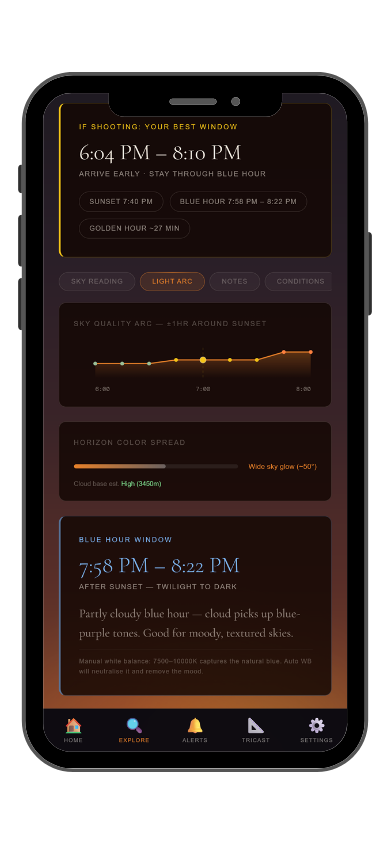
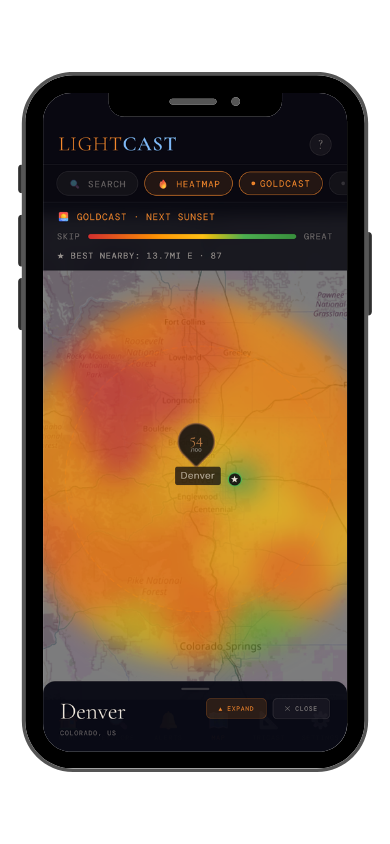
GoldCast
Golden hour timing + cloud layer forecast
Sunset · Sunrise · Cloud Cover · Trade Wind Clouds
GoldCast shows exact golden hour windows and cloud cover forecasts. For Hawaii summit shoots, check cloud layer forecasts the night before — the difference between a clear summit and a socked-in drive is everything.
Get LightCast on iPhone
$2.99/mo · 7-day free trial
Check GoldCast on web →
GoldCast: golden hour forecast (left) · conditions heatmap (right)
🌌 Astrophotography · Hawaii
Best Astrophotography Locations
Hawaii is home to two of the best astrophotography locations on the planet. Mauna Kea sits at 13,796 feet above the marine cloud layer in the cleanest air accessible by road anywhere in the world. The Milky Way core is visible year-round from Hawaii and is overhead for much of the year. The only limiting factors are cloud cover (which sits well below the summit on most nights) and moon phase.
🔭
Mauna Kea Summit, Big Island Bortle 1
Mauna Kea's summit is one of the premier astrophotography sites on earth. At 13,796 feet, you're above 40% of the atmosphere and above the marine inversion layer that keeps low clouds below. The summit lake (Lake Waiau) and the observatory domes provide distinctive foregrounds. The Visitor Information Station at 9,200 feet is the practical staging area — acclimate there for at least 30 minutes before driving to the summit. The summit road is unpaved and requires a 4WD vehicle. Temperatures approach freezing year-round after dark; high-altitude hypoxia is a real factor.
🌋
Haleakala Summit, Maui Bortle 1–2
Haleakala's summit at 10,023 feet is above the trade wind cloud layer most nights, giving Bortle 1–2 skies with an extraordinary crater foreground. The red cinder cones and alien terrain of the crater floor under the Milky Way are unlike any other night photography setting in the US. The park stays open for stargazing; no reservations are needed after 3pm. Temperatures drop sharply after dark — significantly colder than the coast. This is a technically accessible dark sky site by US standards and among the best in the world.
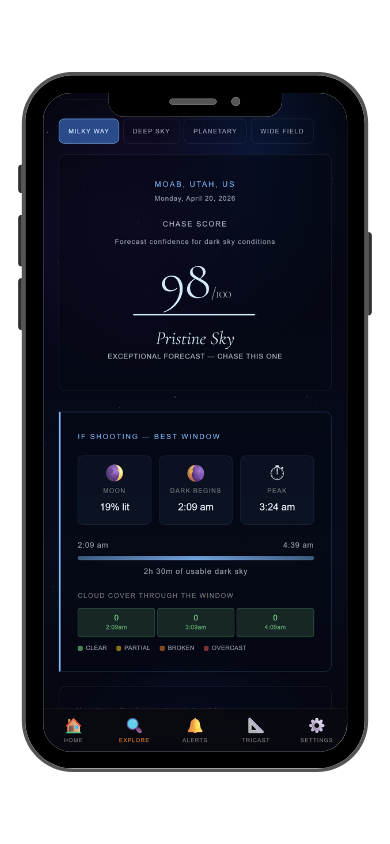
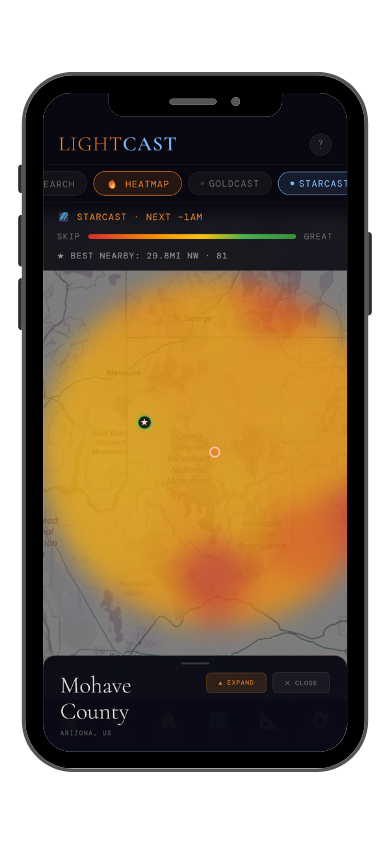
StarCast
Night sky score · moon · transparency · seeing
Cloud Cover · Moon Phase · Atmospheric Transparency · Seeing
StarCast scores cloud cover, moon phase, atmospheric transparency, and seeing into a single verdict. Even at Mauna Kea, cloud coverage and moon phase vary — check before committing to the summit drive.
Get LightCast on iPhone
$2.99/mo · 7-day free trial
Check StarCast on web →
StarCast: night sky score (left) · conditions heatmap (right)
🚁 Drone Photography · Hawaii
Best Drone Locations
Hawaii's aerial terrain — sea cliffs, lava fields, volcanic craters, and reef-fringed coastline — is among the most photogenic in the world from altitude. Drone restrictions are significant: Hawaii Volcanoes National Park, Haleakala National Park, and most other NPS units prohibit drones entirely. Active lava entry zones and helicopter tour corridors also restrict access. BLM land and state land outside park boundaries provide the most viable options. Always verify FAA authorization before flying.
🌊
Waipio Valley Overlook Area, Big Island Hawaii County · Hamakua Coast
The state land adjacent to the Waipio Valley overlook is outside national park jurisdiction and provides one of Hawaii's most dramatic aerial foregrounds — a 2,000-foot deep valley with a black sand beach visible from the rim. The Hamakua Coast sea cliffs to the north offer additional aerial subjects. Confirm airspace and property status before flying; the overlook area itself is state managed. Trade winds are often calm in early morning and pick up significantly by midday.
🌋
South Point (Ka Lae) Lava Fields, Big Island Hawaii County · Ka'u District
Ka Lae is the southernmost point in the US and sits on open state land with dramatic lava coastline. The graphic contrast of black lava, green cliffs, and deep blue ocean reads powerfully from altitude. The area is outside national park boundaries and has more permissive drone access than most of the Big Island's dramatic terrain. Wind is the main challenge — the area is notoriously exposed and trade winds funnel through the point. Morning launches before the trades build are most reliable.
Dronecast
Wind, gusts, visibility & flight score
Wind Speed · Gusts · Visibility · Cloud Base
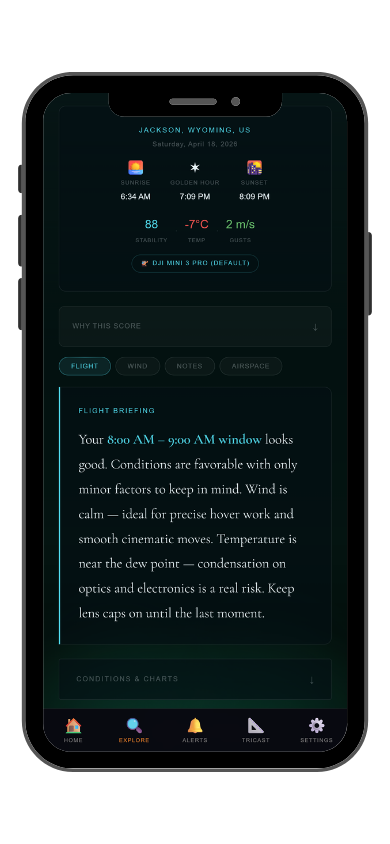
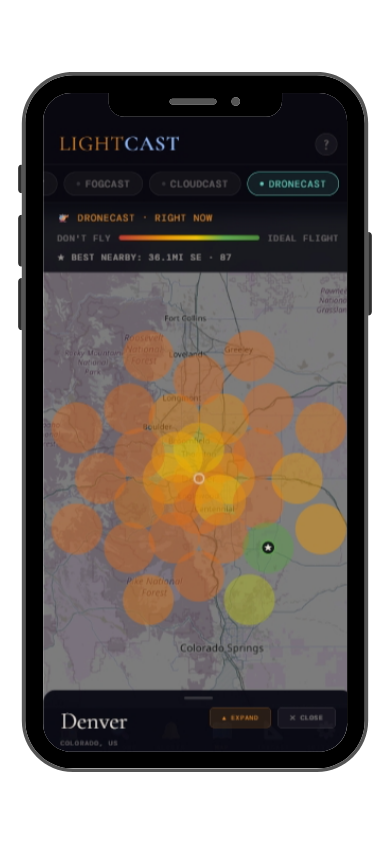
Dronecast scores wind speed, gusts, visibility, and cloud base into a single flight verdict — updated hourly. Hawaii's trade winds are consistent but vary significantly by location and time of day; check before you fly.
Get LightCast on iPhone
$2.99/mo · 7-day free trial
Check Dronecast on web →
Dronecast: flight score (left) · conditions heatmap (right)
Frequently asked
Where is the best place to photograph sunrise in Hawaii?
Haleakala Summit on Maui is the most famous sunrise location. A reservation is required for the summit at sunrise (book through recreation.gov well in advance). Mauna Kea on the Big Island offers an even higher vantage but requires a 4WD vehicle. Check
GoldCast for cloud layer forecasts before either drive.
Where can I see the Milky Way in Hawaii?
Mauna Kea summit is one of the best astrophotography sites on earth (Bortle 1). Haleakala is close behind. Both are above the trade wind cloud layer most nights. The Milky Way is visible year-round from Hawaii. Check
StarCast for moon phase and cloud cover before making the summit drive.
Can I fly a drone in Hawaii Volcanoes National Park?
No. Drone use is prohibited in Hawaii Volcanoes National Park, Haleakala National Park, and virtually all NPS-managed land in Hawaii. State land outside park boundaries offers more options; South Point and the Hamakua Coast area are good alternatives. Always verify FAA authorization before flying.
What is LightCast?
LightCast is a suite of sky and weather tools built for photographers.
GoldCast handles sunset and sunrise timing with cloud and fog forecasts.
StarCast scores night sky conditions for astrophotography.
Dronecast gives wind and visibility forecasts for drone pilots. All three are free on web; full features are in the
LightCast iOS app — $2.99/month after a 7-day free trial.