🌅 Sunset & Golden Hour · Idaho
Best Sunset Locations
Idaho's Sawtooth Range is one of the most dramatic mountain profiles in the American West, with jagged granite peaks rising sharply from high-elevation lake basins. Evening alpenglow on the Sawtooths, reflected in the Stanley Basin lakes, rivals anything in the Rockies. In the south, the Snake River Plain creates wide open western horizons. Summer smoke from wildfires is the biggest weather variable — it can produce extraordinary orange-red sunsets or block the light entirely. Check GoldCast before heading out.
🏔️
Sawtooth National Recreation Area Custer County · Central Idaho
The Stanley Basin and Sawtooth Valley offer one of the best mountain sunset environments in the lower 48. Redfish Lake, Alturas Lake, and Petit Lake all sit below the Sawtooth Range's western face, providing lake reflection foregrounds for alpenglow. The range faces roughly east, so it catches alpenglow rather than direct sunset — the light comes from the west and wraps around the peaks in the last 20 minutes before dark. Fall is particularly striking: the hillsides turn gold and orange, the lodgepole forests go rust-colored, and the lakes reflect the whole scene. Stanley sits at 6,200 feet and frost is possible any month.
🌊
Snake River Canyon, Twin Falls Area Twin Falls County · South-Central Idaho
The Snake River Canyon near Twin Falls cuts 500 feet deep through the basalt plateau. The canyon walls catch warm side light at sunrise and sunset, and the Perrine Bridge offers a wide overlook. Shoshone Falls, upstream from Twin Falls, is most dramatic in spring when snowmelt maximizes flow. The canyon rim overlooks provide wide views across the Snake River Plain with the distant Sawtooths visible on clear days. Summer evenings with a high-pressure system give the cleanest light and air.
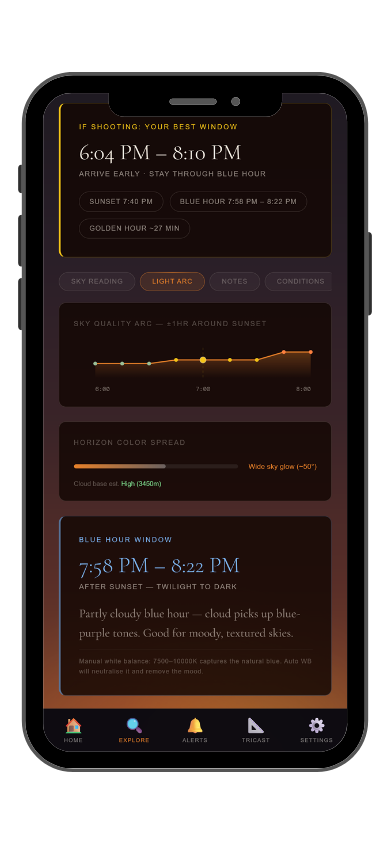
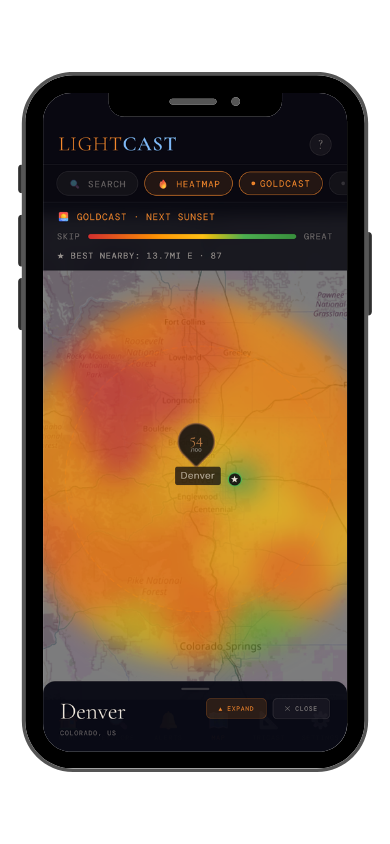
GoldCast
Golden hour timing + fog & cloud forecast
Sunset · Sunrise · Cloud Cover · Smoke & Haze
GoldCast shows exact golden hour windows and cloud cover forecasts. In Idaho's fire-prone summers, smoke visibility can shift dramatically day to day — check before committing to the Sawtooth drive.
Get LightCast on iPhone
$2.99/mo · 7-day free trial
Check GoldCast on web →
GoldCast: golden hour forecast (left) · conditions heatmap (right)
🌌 Astrophotography · Idaho
Best Astrophotography Locations
Idaho has some of the darkest accessible skies in the continental US. Craters of the Moon National Monument is an International Dark Sky Park with Bortle 1–2 designation. The Frank Church River of No Return Wilderness to the north is among the largest roadless dark sky areas in the lower 48. The Milky Way core is visible from Idaho from late March through October; July and August bring the galactic core high in the south and are the peak season. Summer wildfire smoke is the main wildcard for transparency.
🌋
Craters of the Moon National Monument Bortle 1–2
Craters of the Moon is one of the premier dark sky sites in the US and holds International Dark Sky Park certification. The black lava fields are completely devoid of light pollution in every direction. The alien lava formations — cinder cones, lava tubes, pressure ridges — create extraordinary foregrounds for Milky Way compositions. The monument road stays open overnight and the campground has designated dark sky areas. June through August are the best months for galactic core height; spring and fall have cleaner air on average. The lava holds daytime heat into the evening, making cold-night shoots more comfortable than the elevation (5,900 ft) would suggest.
🏔️
Stanley Basin, Sawtooth NRA Bortle 2
The Stanley Basin sits in one of the darkest valleys in Idaho, with the Sawtooth peaks as a dramatic northern foreground. Redfish Lake and Alturas Lake provide reflective water under the Milky Way arch. The valley's elevation (6,200 ft) and distance from any population center keeps sky glow minimal in all directions. Summer nights get cold fast even in July; temperatures can drop into the 30s by midnight. Fall offers the best transparency and the galactic core is still up for a few hours after dark in September.
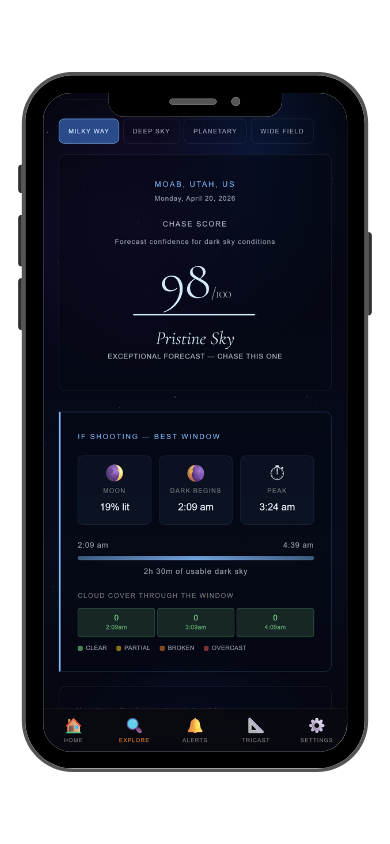
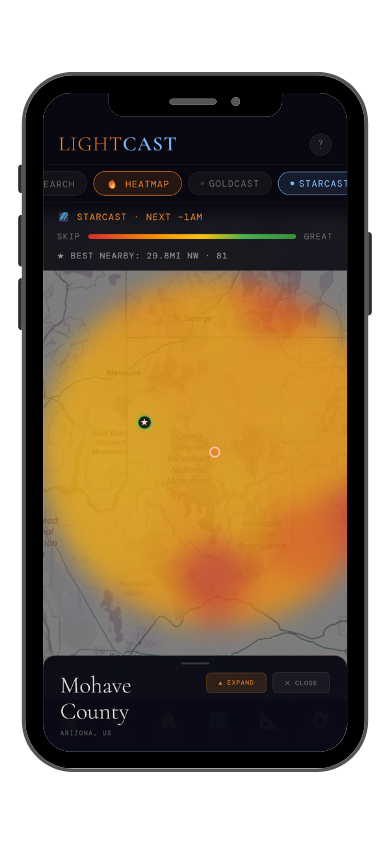
StarCast
Night sky score · moon · transparency · seeing
Cloud Cover · Moon Phase · Atmospheric Transparency · Seeing
StarCast scores cloud cover, moon phase, atmospheric transparency, and seeing into a single verdict — updated daily. Wildfire smoke can slash transparency even at Craters of the Moon; check before making the drive.
Get LightCast on iPhone
$2.99/mo · 7-day free trial
Check StarCast on web →
StarCast: night sky score (left) · conditions heatmap (right)
🚁 Drone Photography · Idaho
Best Drone Locations
Idaho's BLM land and national forest territory is extensive, and much of it is open to drone use outside wilderness and park designations. The Snake River Canyon and lava fields are accessible and visually exceptional from altitude. Always verify FAA authorization and check for Temporary Flight Restrictions — wildfire activity frequently generates TFRs over large areas of Idaho in summer. Craters of the Moon prohibits drones within monument boundaries.
🌊
Snake River Canyon, Jerome County BLM Jerome / Twin Falls Counties
The BLM land along the Snake River Canyon outside the Twin Falls city area offers open drone access to exceptional canyon aerial terrain. The 500-foot basalt walls, river meanders, and occasional waterfalls create strong graphic aerial subjects. The canyon geometry is most dramatic from low altitude — staying 200 feet AGL puts the walls in perspective. Morning before the canyon thermals build gives the smoothest flight conditions. The canyon rim roads provide easy access to multiple launch points.
🏔️
Sawtooth Valley, Custer County Custer County · Highway 75 Corridor
The Sawtooth Valley along Highway 75 sits outside the Sawtooth Wilderness boundary and allows drone flight on USFS and BLM land adjacent to the corridor. The aerial view of the Sawtooth Range is extraordinary: the jagged peaks rise above the valley floor lake chain in a composition impossible to capture from ground level. Fall color from mid-September through mid-October adds warmth to the aerial palette. Wind picks up significantly by midday; morning launches before 9am give the most stable conditions.
Dronecast
Wind, gusts, visibility & flight score
Wind Speed · Gusts · Visibility · Cloud Base
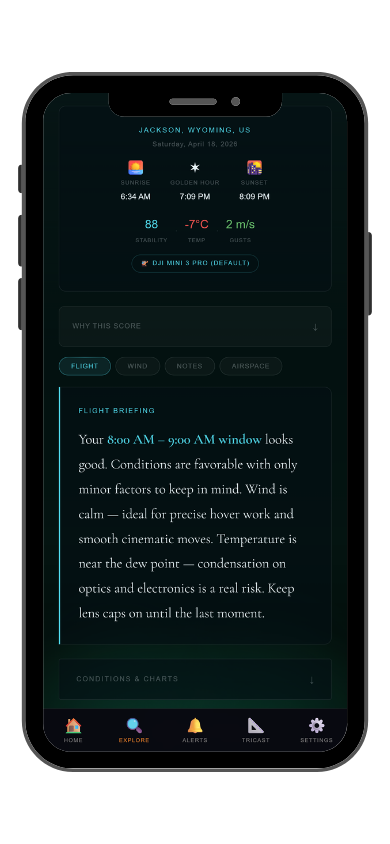
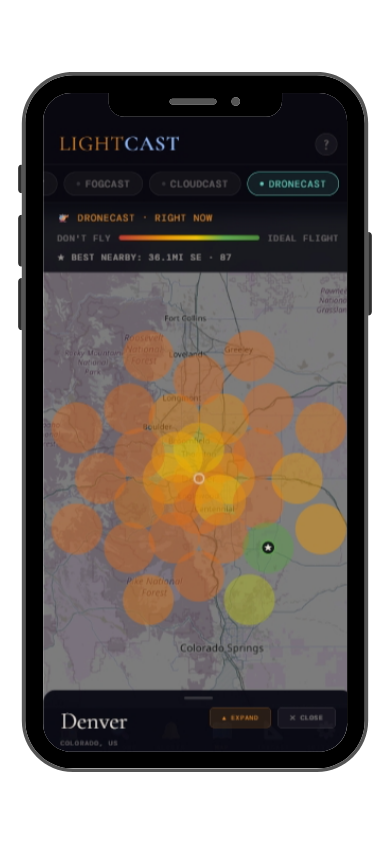
Dronecast scores wind speed, gusts, visibility, and cloud base into a single flight verdict — updated hourly. Mountain valley winds in Idaho are deceptive; calm at ground level doesn't mean calm at altitude. Check before you launch.
Get LightCast on iPhone
$2.99/mo · 7-day free trial
Check Dronecast on web →
Dronecast: flight score (left) · conditions heatmap (right)
Frequently asked
Where is the best place to photograph the Milky Way in Idaho?
Craters of the Moon National Monument is an International Dark Sky Park with Bortle 1–2 skies — one of the best accessible Milky Way sites in the country. The Stanley Basin in the Sawtooth NRA is a close second. Both work best July through September. Check
StarCast for wildfire smoke transparency before going.
When does fall color peak in the Sawtooth area?
The Sawtooth Valley and Stanley Basin typically peak from mid-September through early October. Higher elevation areas (Galena Summit, Alturas Lake) turn first; the valley floor lags by a week or two. Both the hillside vegetation and the basin meadows change color, giving multiple compositions within a short drive.
Can I fly a drone at Craters of the Moon?
No — drone use is prohibited within Craters of the Moon National Monument. The BLM land adjacent to the monument boundary offers some access; verify specific parcels before flying. The Snake River Canyon BLM land near Twin Falls is a more accessible alternative with excellent aerial terrain.
What is LightCast?
LightCast is a suite of sky and weather tools built for photographers.
GoldCast handles sunset and sunrise timing with cloud and fog forecasts.
StarCast scores night sky conditions for astrophotography.
Dronecast gives wind and visibility forecasts for drone pilots. All three are free on web; full features are in the
LightCast iOS app — $2.99/month after a 7-day free trial.