🌅 Sunset & Golden Hour · Mississippi
Best Sunset Locations
Mississippi's photography reputation is underrated. The Gulf Coast and Delta both offer enormous sky and open-horizon sunsets that reward wide-angle shooting. The Delta's flat terrain and atmospheric haze can create pastel sunset gradients unlike anything in the hill country to the east. Cloud cover and afternoon thunderstorm timing are the key variables; GoldCast's hourly forecast matters on any afternoon in Gulf Coast proximity.
🌾
Mississippi Delta — Yazoo City and Satartia Road Overlooks Yazoo County
The Mississippi Delta's pancake-flat agricultural landscape gives a 360-degree unobstructed horizon that's genuinely rare in the Southeast. The Yazoo County levee roads and old highway corridors put you at marsh edge with the western sky completely open. Delta sunsets are often diffuse and warm from the atmospheric haze — not always the saturated orange of a mountain shoot, but with a quality that's specific to the place and the climate. October and November, after crop harvest, expose the full geometry of the fields. This is minimalist landscape photography in the truest sense.
🏖️
Ship Island, Gulf Islands National Seashore Harrison County
Ship Island is a barrier island 12 miles offshore accessible by ferry from Gulfport. The island faces open Gulf water on the south and the Mississippi Sound on the north, giving both sunrise and sunset options depending on the season. The west-facing beach toward sunset is one of the cleanest horizon compositions on the Gulf Coast — white sand, turquoise water, and no development in the frame. The ferry schedule limits your flexibility, so check the schedule and the GoldCast forecast together before booking.
GoldCast
Golden hour timing + cloud forecast
Sunset · Sunrise · Cloud Cover · Fog
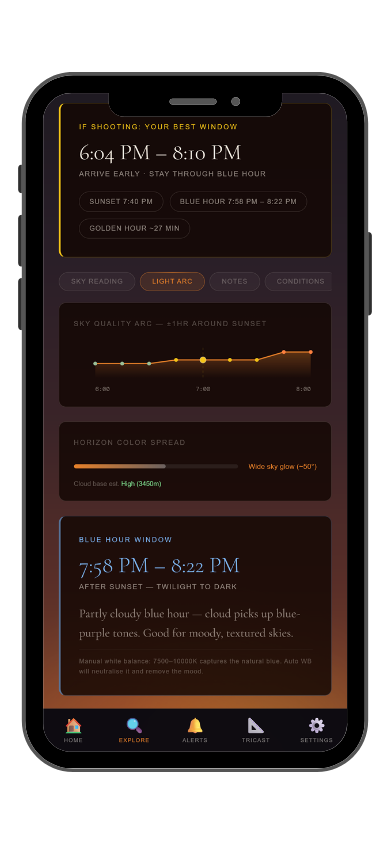
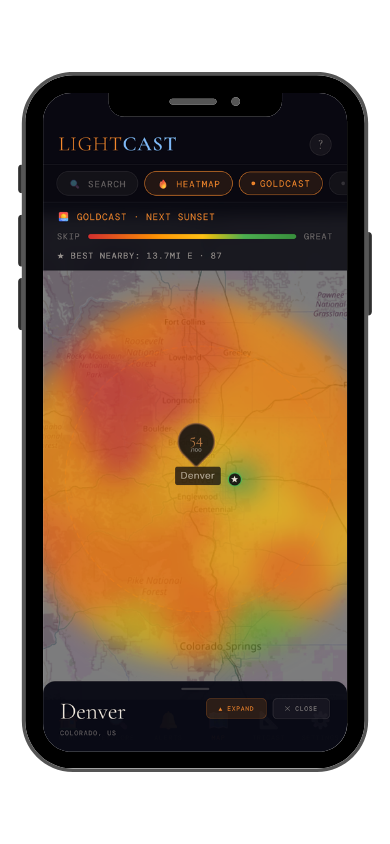
GoldCast shows exact golden hour windows and hourly cloud cover for any Mississippi location. Gulf Coast afternoon thunderstorms can blow through and actually improve the light if timing works out — the hourly update tells you whether to stay or pull back.
Get LightCast on iPhone
$2.99/mo · 7-day free trial
Check GoldCast on web →
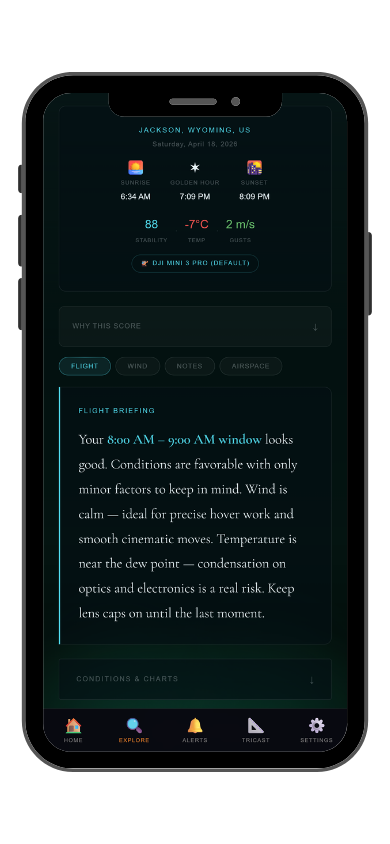
GoldCast: golden hour forecast (left) · conditions heatmap (right)
🌌 Astrophotography · Mississippi
Best Astrophotography Locations
Mississippi has significant light pollution along the I-20 corridor and the Gulf Coast. The darkest accessible skies are in the national forests of the central highlands and along the Natchez Trace Parkway in its most remote sections. The state's southern latitude means the Milky Way core gets high in the sky by midsummer, which helps. Humidity and haze reduce transparency; check StarCast's transparency score before making the drive.
🌲
Bienville National Forest — Marathon Lake Bortle 3–4
The Bienville National Forest in central Mississippi holds some of the state's darkest skies. Marathon Lake Recreation Area is a practical base with a lake foreground and open southern horizon. The Milky Way core reaches its highest altitude from May through August — from Mississippi's latitude, it's positioned nearly overhead at peak transit, which gives a different compositional angle than northern states. Humidity is the main challenge; even clear nights can have haze at the horizon. Spring and fall offer better transparency than summer.
🌿
Natchez Trace Parkway — Rocky Springs Section Bortle 4
The Natchez Trace Parkway between Port Gibson and Natchez passes through undeveloped woodland corridor with no commercial development along its length. The Rocky Springs section, near mile marker 54, gives access to open meadows and old settlement clearings with reasonable southern sky access. The parkway itself has minimal lighting, and the tree canopy breaks at several pulloffs. It's not the darkest sky in the state, but the roadway access and historical landscape context make it a distinctive photography location. April through October is the practical Milky Way window.
StarCast
Night sky score · moon · transparency · seeing
Cloud Cover · Moon Phase · Atmospheric Transparency · Seeing
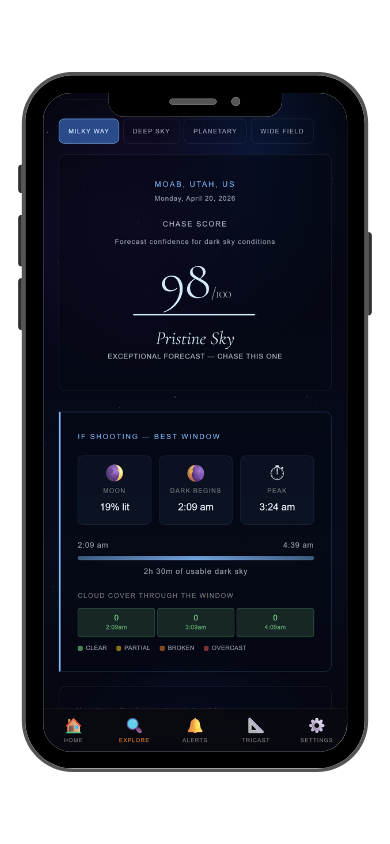
StarCast scores cloud cover, moon phase, atmospheric transparency, and seeing for any Mississippi location. Humidity reduces transparency even on clear nights — the StarCast transparency score tells you whether you're actually getting a usable night sky or just a clear forecast.
Get LightCast on iPhone
$2.99/mo · 7-day free trial
Check StarCast on web →
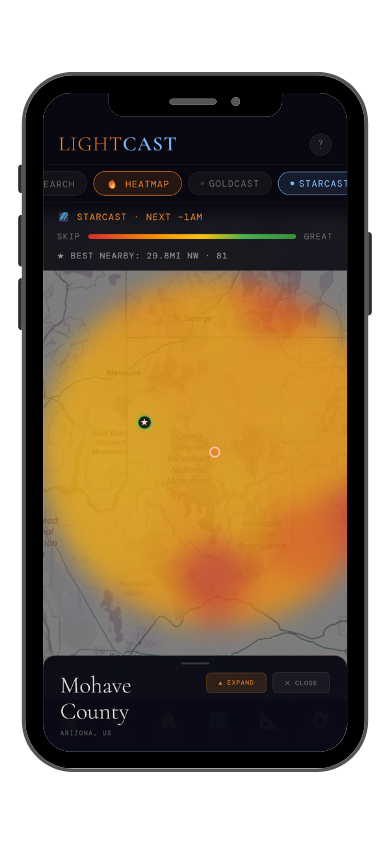
StarCast: night sky score (left) · conditions heatmap (right)
🚁 Drone Photography · Mississippi
Best Drone Locations
Mississippi has generally permissive drone airspace outside the Gulf Coast airport corridors. Gulf Islands National Seashore prohibits drones on park land. National forests and most state parks allow drone use under standard FAA rules. Wind and afternoon instability are the primary operational variables; Dronecast is especially useful for timing Gulf Coast shoots.
🌾
Mississippi Delta — Sunflower River Corridor Sunflower County
The Sunflower River meanders through the Delta in a pattern that's visually striking from altitude — oxbow curves, cypress-lined banks, and agricultural fields on either side that reveal the floodplain's history. The region is largely outside controlled airspace and the flat terrain keeps wind consistent and manageable. September and October, after crop harvest, give the most open compositions. Morning launches before field work starts avoid dust and obstruction. The delta light in early morning is flat and soft — a different aesthetic than the dramatic coastal shots, but compelling in its own quiet way.
🏖️
Stennis Space Center Buffer Zone and Bay St. Louis Area Hancock County
The Bay St. Louis area on the western Mississippi Gulf Coast has accessible shoreline outside the more restricted airspace around Gulfport-Biloxi International Airport. The Bay St. Louis harbor, Old Town waterfront, and surrounding coastal marsh are strong aerial subjects with the open Gulf visible to the south. Check LAANC before flying — portions of the area may require authorization depending on your specific location. Afternoon sea breeze builds quickly on the Gulf Coast; morning launches are more stable.
Dronecast
Wind, gusts, visibility & flight score
Wind Speed · Gusts · Visibility · Cloud Base
Dronecast scores wind, gusts, visibility, and cloud base for any Mississippi location. Gulf Coast conditions shift with daily sea breeze cycles — morning is consistently calmer than afternoon for coastal drone work.
Get LightCast on iPhone
$2.99/mo · 7-day free trial
Check Dronecast on web →
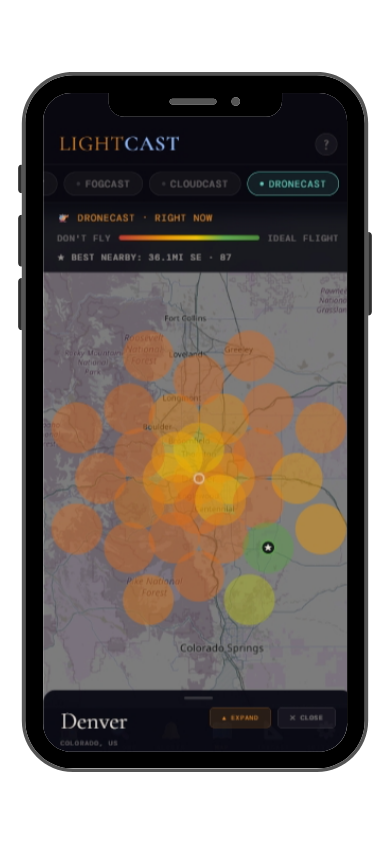
Dronecast: flight score (left) · conditions heatmap (right)
Frequently asked
Where is the best place to photograph sunset in Mississippi?
Ship Island off Gulfport gives one of the cleanest Gulf sunset horizons in the state, accessible by ferry. For inland work, the Delta's levee roads near Yazoo City offer a 360-degree open horizon that's rare in the Southeast. Check
GoldCast for cloud and storm timing before the Ship Island ferry.
Where can I see the Milky Way in Mississippi?
Bienville National Forest in central Mississippi reaches Bortle 3–4 on good nights. The Natchez Trace Parkway's remote sections are accessible alternatives. Use
StarCast to check transparency — summer humidity reduces visibility even on nominally clear nights.
Can I fly a drone at Gulf Islands National Seashore?
Drones are prohibited on National Park Service land, which includes the Gulf Islands National Seashore and Ship Island. The surrounding Gulf Coast areas outside park boundaries are generally accessible. Bay St. Louis and surrounding Hancock County areas are more permissive, though LAANC verification is required near the airport corridor.
When is the best time for landscape photography in Mississippi?
October through February offers the best sky clarity and Gulf Coast conditions. The Delta is most photogenic in fall after harvest and in early spring before crop cover. Milky Way season runs May through September, with July peak transit the highest core elevation. Summer afternoons bring thunderstorms that can create dramatic post-storm light on the Gulf Coast.
What is LightCast?
LightCast is a suite of sky and weather tools built specifically for photographers.
GoldCast handles sunset and sunrise timing with cloud and fog forecasts.
StarCast scores night sky conditions for astrophotography.
Dronecast gives wind and visibility forecasts for drone pilots. All three are free on web; full features are available in the
LightCast iOS app — $2.99/month after a 7-day free trial.