LightCast · Montana

Best Landscape Photography Locations in Montana
Glacier National Park, the Beartooth Highway, and the wide-open Missouri Breaks — the top landscape spots in Montana, and how to time conditions before you make the drive.
iOS app: $2.99/mo · 7-day free trial
🌅 Sunset & Golden Hour · Montana
Best Sunset Locations
Montana is one of the top five states for landscape photography in the US. The combination of alpine terrain, genuine dark skies, and geographic scale is hard to match anywhere else in the lower 48. Glacier National Park's peaks catch alpenglow long after ground-level sunset, and the eastern plains give horizon-to-horizon sky that most mountain states can't offer. Afternoon thunderstorms are frequent in summer; GoldCast's hourly cloud forecast is essential for timing alpine shoots.
🏔️
Many Glacier Valley, Glacier National Park Glacier County
Many Glacier is the most photogenic valley in Glacier National Park for golden hour work. Swiftcurrent Lake reflects Mount Grinnell and the Grinnell Glacier cirque wall, and the alpenglow on those peaks stays pink for 15 to 20 minutes after the sun drops below the western ridgeline. The Many Glacier Hotel dock gives one of the most reproduced compositions in Montana photography, but the lakeshore north of the hotel is less crowded and equally strong. The Going-to-the-Sun Road corridor and Logan Pass offer an entirely different sunset perspective. Check road conditions and sunrise/sunset access restrictions through the park's timed entry system.
🌋
Beartooth Highway — Rock Creek Vista and Beartooth Pass Carbon County
The Beartooth Highway reaches 10,947 feet at its pass — the highest paved highway in the US north of Colorado. The Rock Creek Vista pullout and the area around the pass give 360-degree alpine views above treeline with no foreground obstruction. Sunset from this elevation hits the surrounding peaks and plateau in a sequence of color changes that lasts nearly 45 minutes. The road is typically open Memorial Day through mid-October. Snow can arrive in July at pass level; layer up even in summer and monitor the cloud forecast closely — afternoon storms at this elevation form fast.
GoldCast
Golden hour timing + cloud forecast
Sunset · Sunrise · Cloud Cover · Fog
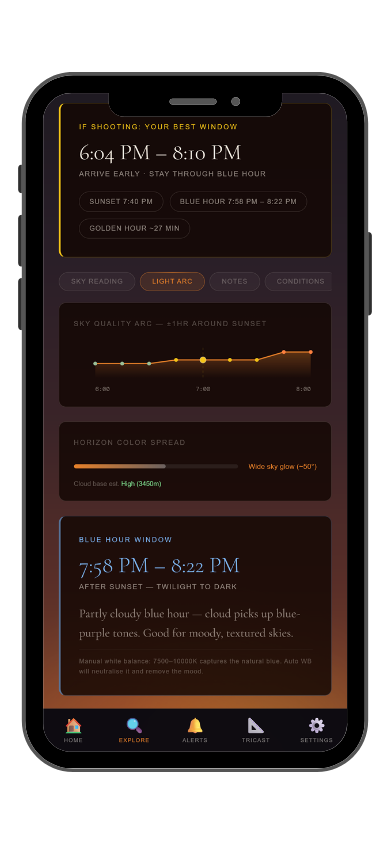
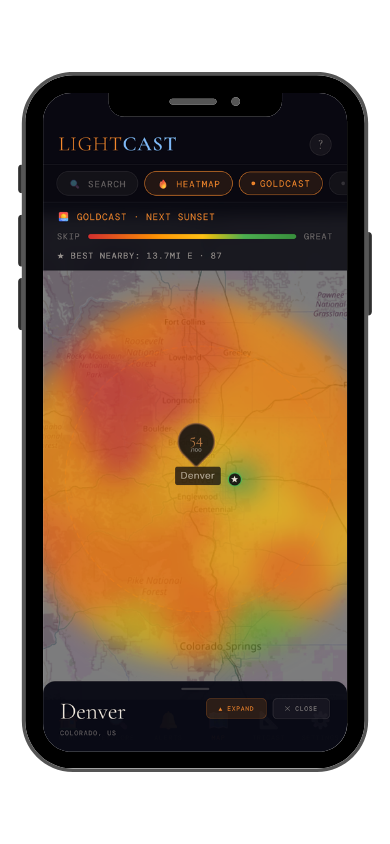
GoldCast shows exact golden hour windows and hourly cloud cover for any Montana location. Alpine afternoon storms in Glacier and the Beartooth are the primary wildcard — the hourly forecast is much more useful than a morning check for high-elevation shoots.
Get LightCast on iPhone
$2.99/mo · 7-day free trial
Check GoldCast on web →
GoldCast: golden hour forecast (left) · conditions heatmap (right)
🌌 Astrophotography · Montana
Best Astrophotography Locations
Montana has among the darkest accessible skies in the continental US. The Missouri Breaks, eastern prairie, and central Montana reaches Bortle 1–2 across vast tracts of land, and even Glacier National Park's interior approaches Bortle 2 on the clearest nights. The scale and quality of Montana astrophotography is genuinely world-class. Moon phase and smoke from western wildfires in late summer are the primary variables; check StarCast's transparency and smoke forecast before heading out.
🌌
Upper Missouri River Breaks National Monument Bortle 1–2
The Missouri Breaks in north-central Montana holds some of the darkest certified skies in the United States. The eroded badlands terrain along the Wild and Scenic Missouri River corridor provides dramatic foreground, and the complete absence of light pollution in every direction creates a sky density that has to be seen to be believed. The Milky Way casts a visible shadow on the ground on the best nights. Access is via a rough dirt road from the James Kipp Recreation Area near Winifred; a high-clearance vehicle is recommended. May through August is the Milky Way window; September is often the clearest month of the year for transparency.
🏔️
Glacier National Park — Logan Pass and Two Medicine Bortle 2–3
Logan Pass at Glacier National Park offers above-treeline astrophotography with the park's iconic Going-to-the-Sun Road corridor visible from altitude. Two Medicine on the park's eastern slope is less crowded and often clearer than the west side. The park holds an International Dark Sky Park designation. The Milky Way in July and August arcs across the southern sky with the peaks as silhouette. Timed entry permits for the Logan Pass parking area operate in summer; night photographers arriving after 9pm typically have more flexibility. The Two Medicine area requires a separate approach but delivers equally strong conditions.
StarCast
Night sky score · moon · transparency · seeing
Cloud Cover · Moon Phase · Atmospheric Transparency · Seeing
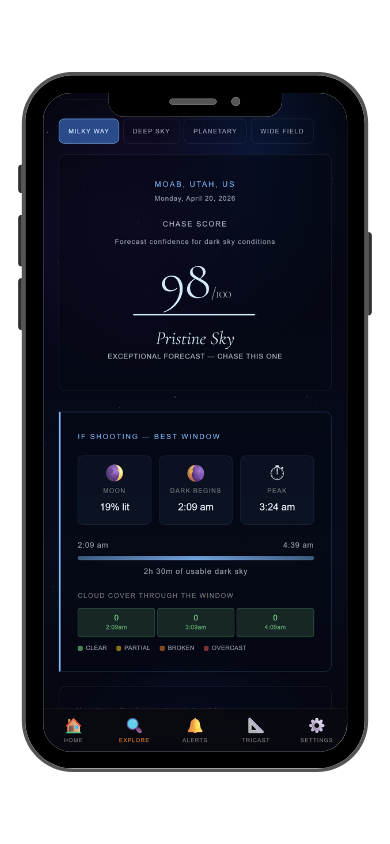
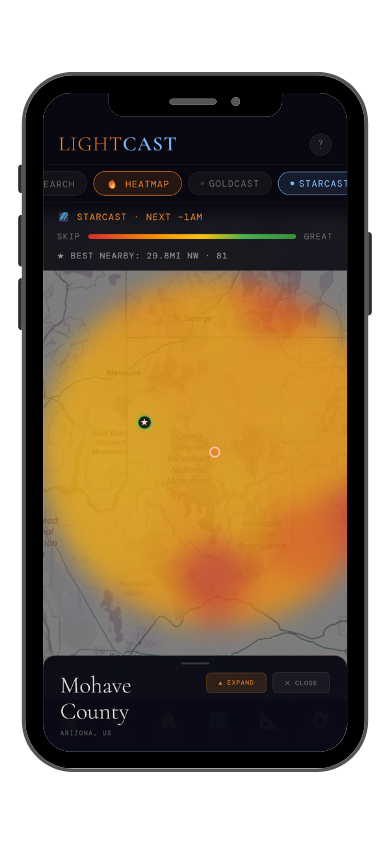
StarCast scores cloud cover, moon phase, atmospheric transparency, and seeing for any Montana location. Wildfire smoke from late July through September can dramatically reduce transparency even when cloud cover is zero — the transparency score is essential for eastern Montana shoots in smoke season.
Get LightCast on iPhone
$2.99/mo · 7-day free trial
Check StarCast on web →
StarCast: night sky score (left) · conditions heatmap (right)
🚁 Drone Photography · Montana
Best Drone Locations
Montana's national parks prohibit drone use entirely. The surrounding national forests, BLM land, and state land are largely open — and Montana has more accessible public land for drone work than almost any state in the US. The Missouri Breaks BLM land, the Beartooth plateau, and the eastern prairie are all generally accessible under FAA rules. Wind is the primary variable at altitude; Dronecast's gust layer is essential for high-elevation launches.
🌋
Beartooth Plateau — BLM and Forest Service Land Carbon and Stillwater Counties
The Beartooth plateau outside the national forest wilderness designations is among the best high-elevation drone terrain in the US. The combination of alpine lakes, glacially carved cirques, and 10,000-foot-plus terrain creates aerial compositions that are unavailable at lower elevations. BLM and Forest Service land above the highway gives accessible launch points. Wind at this elevation can be strong and variable; plan morning launches before convective weather develops. The plateau sees afternoon thunderstorms almost daily in July and August — be on the ground before noon.
🌾
Upper Missouri River Breaks — BLM Wilderness Study Areas Fergus and Blaine Counties
The Missouri Breaks BLM land east of Fort Benton is the most visually striking drone terrain in the Montana plains. The eroded clay and sandstone formations along the river corridor change color throughout the day, and the aerial view reveals the river's canyon depth that's not apparent from the road. Most of the Breaks is BLM land outside wilderness designations where drones are permitted under FAA rules; verify that your specific launch point is not within a Wilderness Study Area, where drones are restricted. Morning is the calmest window before prairie wind builds.
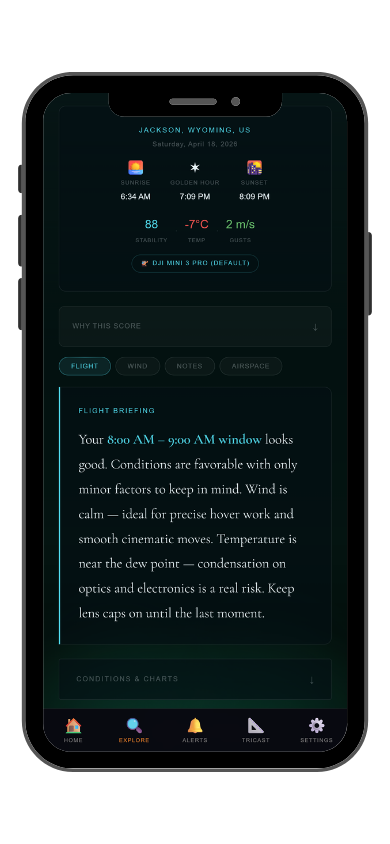
Dronecast
Wind, gusts, visibility & flight score
Wind Speed · Gusts · Visibility · Cloud Base
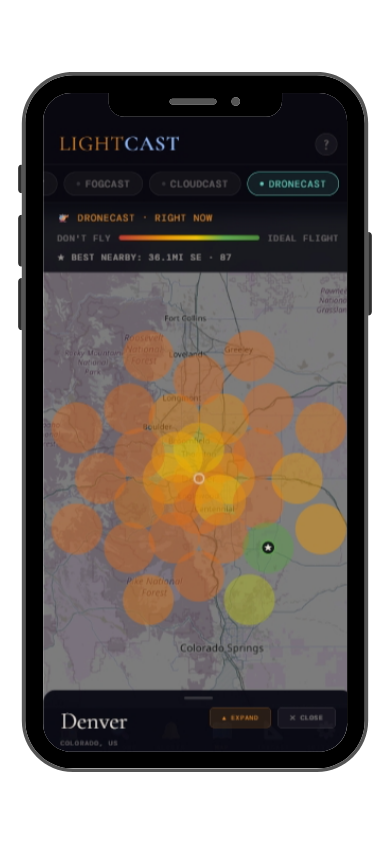
Dronecast scores wind, gusts, visibility, and cloud base for any Montana location. At elevation in the Beartooth and Glacier areas, launch-site conditions can be dramatically different from what the lower-altitude forecast shows — check conditions at your target altitude before committing.
Get LightCast on iPhone
$2.99/mo · 7-day free trial
Check Dronecast on web →
Dronecast: flight score (left) · conditions heatmap (right)
LightCast · All tools
5 Forecasts in 1 App
🌫️
Fog Cast
Coastal fog, hour by hour
See when fog is expected to roll in or clear — so a low cloud bank doesn't end your golden hour session before it starts.
☁️
Cloud Cast
Cloud cover that matters to photographers
Not just "cloudy or clear" — see cloud type and coverage so you know whether you're getting dramatic texture or a blown-out white sky.
✦ Fog Cast and Cloud Cast are app-exclusive features
Frequently asked
Where is the best place to photograph sunset in Montana?
Many Glacier Valley in Glacier National Park, with Swiftcurrent Lake reflecting the Grinnell cirque wall, is the top sunset composition in the state. The Beartooth Highway above 10,000 feet gives an entirely different scale of alpine alpenglow. Check
GoldCast for cloud and storm timing before heading up.
Where can I see the Milky Way in Montana?
The Upper Missouri River Breaks (Bortle 1–2) is one of the darkest locations in the continental US. Glacier National Park's interior (Bortle 2–3) is the most accessible alternative. Use
StarCast to check cloud cover, moon phase, and wildfire smoke transparency before making the drive.
Can I fly a drone in Glacier National Park?
Drones are prohibited on all National Park Service land, including all of Glacier National Park. The surrounding Flathead National Forest land adjacent to the park is accessible for drone flight under FAA rules. The Missouri Breaks BLM land east of Fort Benton is open for drone use outside designated Wilderness Study Areas.
When is the best time for landscape photography in Montana?
Late September through early October brings the strongest combination of fall color, clear skies, and golden hour light at lower elevation. July and August are peak Milky Way months but wildfire smoke can be an issue. The Going-to-the-Sun Road typically closes by late October. Winter at lower elevations delivers extraordinary snow and ice compositions, but Glacier's park roads are closed.
What is LightCast?
LightCast is a suite of sky and weather tools built specifically for photographers.
GoldCast handles sunset and sunrise timing with cloud and fog forecasts.
StarCast scores night sky conditions for astrophotography.
Dronecast gives wind and visibility forecasts for drone pilots. All three are free on web; full features are available in the
LightCast iOS app — $2.99/month after a 7-day free trial.